The Corporate Question
You built the personal stack — TFSA, RRSP, FHSA, filled in a deliberate order through a Shariah lens. Then your corporation had a good year, and the surplus above your salary line is sitting in the business chequing account. Halal corporate investing is where the same faith commitment meets a different rulebook: inside a CCPC, three tax mechanics that simply don't exist personally — the $50,000 passive-income grind, refundable tax (RDTOH), and the capital dividend account — change the cost and sequencing of every portfolio decision. And one personal-side advantage disappears at the door: the RRSP's treaty exemption on US withholding tax has no corporate equivalent.
Almost everything written about halal investing treats “the investor” as an individual. Canadian incorporated professionals and business owners don't invest that way — their surplus lives inside a corporation. This post is the corporate hub of this series: the second pillar, sitting beside the personal-side pillar, organized around four decisions. It does not pick funds, does not adjudicate permissibility, and does not tell you how to pay yourself — it maps the terrain so the conversations with your scholar, advisor, and CPA are the right ones.
Key Takeaways
- Halal corporate investing runs through four decisions: where the surplus sits (corporate vs personal), which corporate tax mechanics move the math (AII grind, RDTOH, CDA, foreign withholding), what the corporate portfolio can actually hold, and how the corporate layer exits (estate, zakat, sale).
- A Shariah-compliant corporate portfolio is structurally interest-free and equity-tilted — zero interest income, modest distributions, returns skewed to deferred capital gains. Under this post's worked-example assumptions, that composition produces lower adjusted aggregate investment income per dollar of return (the $50K cliff arrives at a ~$1.8M book instead of ~$1.46M) and a larger capital-dividend-account share. That is composition arithmetic, not a tax promise.
- One personal advantage has no corporate equivalent: a corporation pays the 15% US withholding tax on US-listed fund distributions that an RRSP is treaty-exempt from — relief is a foreign-tax-credit question on the T2, not an exemption.
- The five Canadian-accessible halal funds are all reachable from a corporate account through the right platform — but corporate cash has no Shariah-compliant insured default in Canada as of mid-2026. That gap deserves a deliberate plan, not a sweep-account shrug.
- In this post more than any other in the series, the CPA lane is load-bearing — every dollar figure here has a filing-position counterpart on a T2 schedule that is theirs to confirm.
On this page
- What I Do, What Your Scholar, Advisor, and CPA Do
- The Two-Pillar Map
- Decision 1 — Where the Surplus Sits
- Decision 2 — The Mechanics That Move the Math
- Decision 3 — What the Corporate Halal Portfolio Can Hold
- Decision 4 — Estate, Zakat, and the Exit
- The Headline Worked Example: Halal Corporate Investing by the Numbers
- Three Planning Failures I See Most
- Sources
- Frequently Asked Questions
- Related Reading on This Site
- Conclusion
What I Do, What Your Scholar, Advisor, and CPA Do
Four lanes, same as everywhere in this series. Your scholar adjudicates Shariah compliance — including the holdings themselves, any interest-bearing corporate defaults, and the differing scholarly views on zakat for corporate-held assets. Your CIRO-registered investment advisor or portfolio manager selects products inside the corporate account. My lane as your financial planner is the framework: the corporate-vs-personal architecture, the sequencing, the integration logic. Your CPA owns everything with a tax character — the AII computation, RDTOH and CDA tracking, foreign tax credit claims, and the T2 schedules they all land on. In this post more than any other in the series, the CPA lane is load-bearing — every dollar figure here has a filing-position counterpart that is theirs to confirm.
The Two-Pillar Map
This series has two hubs. Pillar A owns the personal balance sheet — screening, account architecture, the product landscape, the mortgage decision. This post is Pillar B: it owns the corporate one. It is written for the incorporated business owner or professional whose corporation holds retained surplus after the compensation decision has been made. The compensation decision itself — how much salary, how much dividend — is its own post: salary vs dividends. Whether a holding company belongs in your picture at all is also its own post: do I need a holding company? Pillar B starts where those leave off: there is surplus inside the corporate structure, you want it invested in a Shariah-compliant way, and the rules are different in here.
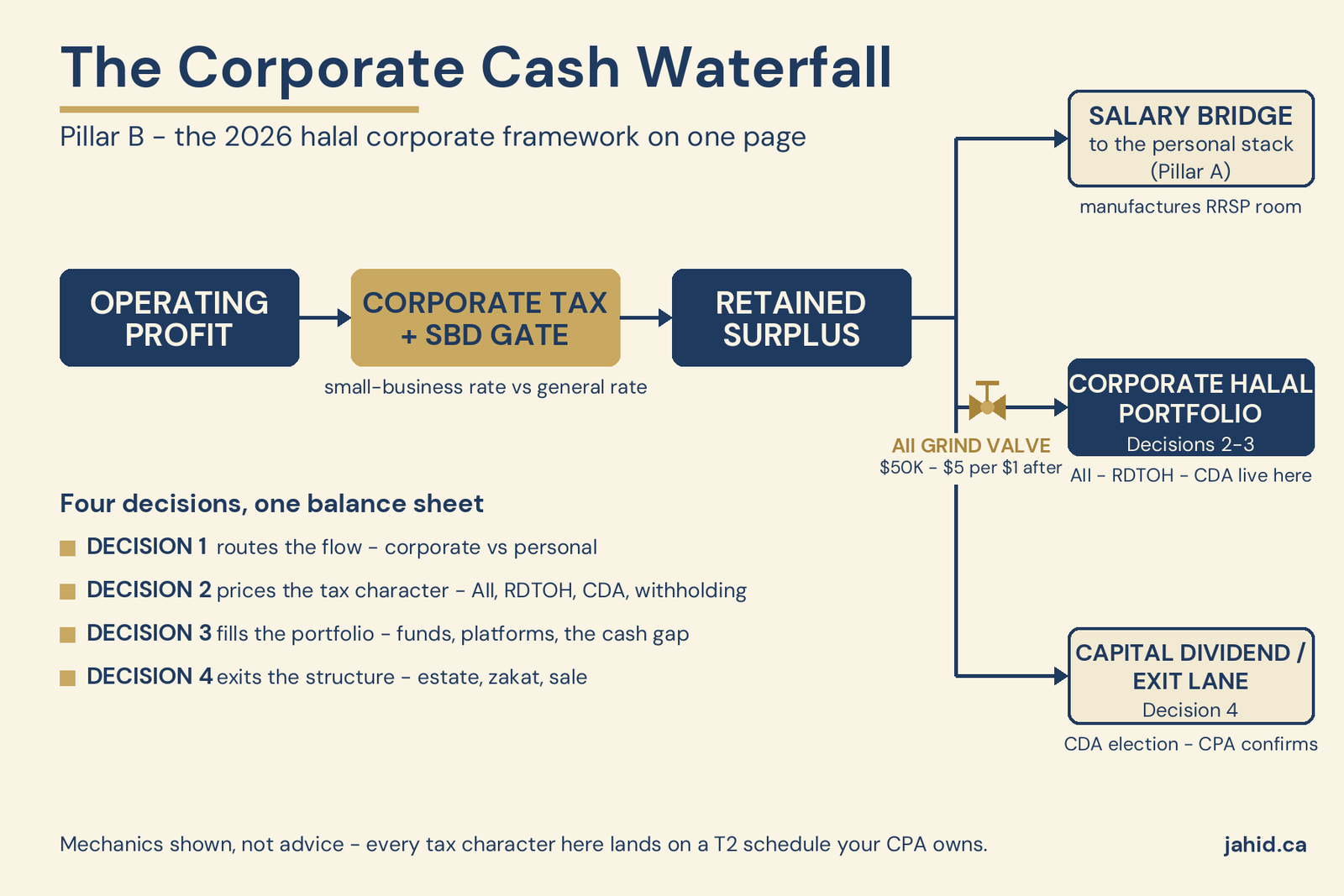
Decision 1 — Where the Surplus Sits
The first decision is routing: does this year's surplus stay invested inside the corporation, or come out to be invested personally? Canada's tax system is built on integration — in plain language, a dollar earned through a corporation and eventually paid out is supposed to face roughly the same total tax as a dollar earned personally. The rates roughly even out. What does not even out is timing and room. Money retained in the corporation was taxed at the corporate rate only, so more dollars stay invested for longer — that's the deferral case for leaving surplus inside. Money paid out as salary costs personal tax now but manufactures something dividends never do: RRSP room, at 18% of earned income up to the annual maximum, plus CPP pensionable earnings. Dividends preserve cash flow flexibility and avoid payroll costs, but build no registered room at all.
Here is where the halal lens changes the weights without changing the arithmetic. On pure rate math, the framework is faith-neutral — integration doesn't care what the portfolio holds. But registered room is scarcer and more valuable for a Muslim investor, for a reason this series has already mapped: the halal fixed-income menu is thin, so the registered accounts that shelter the least tax-efficient income — and the RRSP's treaty exemption on US-listed fund distributions — do more work per dollar of room. That logic is built out in the personal account-stack post, which is downstream of this very decision: the salary bridge is what feeds it. Two cautions belong in this section. Income-splitting through dividends to family members runs into the TOSI rules — pointer only, that post owns the topic. And surplus pulled out informally, without a salary or dividend decision, becomes a shareholder-loan problem — a CRA red flag with its own post.
The spoke for this decision on the personal side already exists — the account stack. The compensation mechanics live in salary vs dividends.
Decision 2 — The Mechanics That Move the Math
Four mechanics give the corporate balance sheet its own physics. None of them exist in your TFSA.
Adjusted aggregate investment income (AII) is, roughly, the investment income your corporate group earned in the prior year — interest, taxable capital gains, rents, and portfolio dividends. Once it crosses $50,000, every additional dollar shrinks the group's $500,000 small business deduction limit by $5; at $150,000 of AII, the small-business rate is gone entirely. The precise computation sits in subsection 125(5.1) of the Income Tax Act and on Schedule 7 — your CPA's lane, dollar for dollar.
(a) The AII grind. The $50,000–$150,000 corridor is the most consequential cliff in corporate passive investing, and it is a composition test as much as a size test — interest counts in full, capital gains count at one-half and only when realized. A structurally interest-free portfolio therefore generates different AII per dollar of return than a conventional balanced one. One wrinkle your CPA will price in: Ontario does not mirror the federal grind for its provincial small-business rate, while Alberta in practice follows the federal computation per major-firm guidance — the province on your T2 changes the dollars at stake.
(b) RDTOH. Corporate investment income is taxed upfront at roughly 46.7% in Alberta and 50.2% in Ontario (2026 combined rates), but a large slice — 30.67 percentage points federally — is refundable: it accumulates in the corporation's refundable dividend tax on hand accounts and comes back at $38.33 per $100 of taxable dividends paid out. The system is a timing mechanism, not a penalty — but the refund only flows when dividends flow, which couples your portfolio's tax cost to your compensation decisions. One 2025 federal budget change worth a flag: where a holding company sits between you and the cash, dividends between affiliated corporations with mismatched year-ends can now have the payer's refund suspended until the money reaches a shareholder outside the group — a holdco-chain detail squarely in your CPA's lane.
(c) The capital dividend account. When the corporation realizes a capital gain, the taxed half flows through the AII and RDTOH machinery — and the untaxed half credits a notional account called the CDA, from which a properly elected capital dividend can reach shareholders tax-free under the Income Tax Act's integration design. The election, the timing, and the account tracking are filing positions your CPA owns. For 2026 the arithmetic is settled: the proposed increase to the capital-gains inclusion rate was cancelled in March 2025 and stayed cancelled through the fall 2025 federal budget, so the inclusion rate remains one-half and the CDA credit remains the other half. An equity-tilted halal book, with returns skewed to capital gains, is structurally CDA-heavy — more of its lifetime return is eligible to exit through that lane than a conventional balanced book's.
(d) Foreign withholding, without the treaty shelter. Personally, the account stack could park US-listed halal ETFs in an RRSP and make the 15% US withholding tax disappear under Article XXI of the Canada–US treaty. A corporation does not qualify for that exemption — it pays the 15% treaty rate on US fund distributions and recovers what it can as a foreign tax credit on the T2. For a halal corporate portfolio this matters more than it first appears, because most of the halal equity menu is US-listed. The credit mechanics — section 126, the relevant CRA folio, what's creditable against what — are a CPA conversation, not a checkbox.
This decision will grow its own corporate-side spokes; for now, the worked example below shows all four mechanics on one page.
Decision 3 — What the Corporate Halal Portfolio Can Hold
The product landscape is the same five funds compared in detail in the fund-landscape post — WSHR (CAD, Cboe Canada, 0.56% MER), HLAL (USD, 0.50%), SPUS (USD, 0.45%), MNZL (USD, 0.40%), and the Manzil Mortgage Fund (CAD, 1.49% MER) — viewed through a corporate-account lens. Access is the first question. Wealthsimple's business accounts are open to corporations and its self-directed business trading accounts can hold the listed funds; whether its managed Halal portfolio can be opened as a corporate account is a contact-support question as of mid-2026 — confirm directly. The major discount brokerages (Questrade, Interactive Brokers Canada) open corporate accounts that reach both Cboe Canada and US listings. Manzil's platform, now delivered by Corex Financial, supports corporate and other non-individual accounts, which is the route to the Manzil Mortgage Fund.
Tax character is the second question, and it maps straight onto Decision 2. The three US-listed equity funds carry the corporate withholding treatment described above. WSHR, being Canadian-listed, distributes without US withholding at the account level (foreign withholding is embedded at the fund level instead). The Manzil Mortgage Fund deserves special care in a corporation: its monthly distributions are income-character — structurally free of interest on the Shariah side, but not capital gains on the tax side — and the exact characterization on the year-end tax slip (income vs return of capital) should be confirmed from the offering memorandum and the fund's reporting before your CPA models its AII impact. That is a direct-inquiry item, flagged honestly.
The third question is the one with no good answer yet: corporate cash. As of June 2026 there is no CDIC-insured, Shariah-compliant business savings account or GIC in Canada. The default corporate cash products — business savings accounts, sweep accounts, redeemable GICs — are interest-bearing. Habib Canadian Bank lists an Islamic index-linked term deposit as “coming soon” with business eligibility unstated; Manzil's business savings offering is an invested account rather than an insured deposit; a small Ontario credit union offers Mudarabah term deposits with business eligibility unconfirmed. Until the landscape matures, what your operating cash does between investment decisions is a deliberate scholar-and-advisor conversation. And one boundary item: corporate-owned real property is sometimes raised as the halal alternative to securities. The halal financing landscape that exists in Canada today is personal-residential — the providers compared in the mortgage post do not finance corporate investment property at scale — so a corporate real-estate strategy is, for now, largely an all-cash strategy with its own concentration trade-offs.
The spoke for this decision exists on the personal side: the fund landscape. Its corporate-specific facts — platform availability, the cash gap — will get their own spoke as the product set matures.
Decision 4 — Estate, Zakat, and the Exit
Corporate wealth eventually leaves the corporation — through your estate, through zakat obligations along the way, or through a sale. Each path has a halal dimension the personal pillar never had to address.
Zakat on corporate-held assets is a genuinely contested scholarly question — and this post's job is to name it, not adjudicate it. AAOIFI's Shari'ah Standard No. 35 describes the main approaches: in some circumstances the company itself pays zakat as a legal person; otherwise shareholders pay individually — with shares held for trading assessed on market value, and long-term holdings assessed on the underlying net zakatable assets (cash, receivables, inventory). Practitioner resources like AMJA's fatwa bank and NZF Canada's business-asset worksheets work through the same distinction for North American owners. Which approach applies to your CCPC's retained portfolio is precisely the kind of question that belongs with your scholar — ideally one conversation, annually, with your year-end statements in hand.
Estate. Corporate assets do not pass under faraid arithmetic by themselves — shares do, and what the shares are worth depends on everything above. Islamic estate planning for corporate wealth — wasiyyah limits, faraid shares, the interaction with shareholder agreements — is the first spoke of this pillar: estate planning and zakat for Muslim Canadians. Where an estate freeze or family trust enters the conversation, the structural mechanics live in the freeze-and-trust post — with the Shariah-compatibility questions (who actually owns what, and when) added to the agenda for both scholar and lawyer. Sale. If the exit is a sale of the business itself, the capital-gains mechanics — including the lifetime capital gains exemption — are mapped in the business-sale post; the halal overlay is mostly about what the proceeds become next, which loops back to Pillar A.
The spoke for this decision is the estate + zakat post.
The Headline Worked Example: Halal Corporate Investing by the Numbers
Take one corporation, one year, one $500,000 portfolio, and two compositions: a conventional balanced book with 40% in interest-bearing assets, and a halal equity-tilted book with zero interest and a 10% halal mortgage-fund sleeve. Assume both earn the same $30,000 (6%) total return — split differently between income, realized gains, and unrealized appreciation. This is mechanics only — an illustration of tax character, not a recommendation of either composition.
| Conventional balanced (40% interest-bearing) | Halal equity-tilted (0% interest) | |
|---|---|---|
| Interest income | $8,000 | $0 |
| Dividends + fund distributions | $5,400 | $8,300 (incl. $2,000 income-character halal fund sleeve) |
| Realized capital gains (modest turnover) | $7,500 | $11,250 |
| AII total | $17,150 | $13,925 (lower) |
| SBD grind triggered ($5 per $1 of AII over $50K) | $0 at this size — the $50K cliff arrives at a ~$1.46M book | $0 — cliff arrives at ~$1.80M, roughly $340K later |
| CDA addition (untaxed half of realized gains) | $3,750 | $5,625 (higher share) |
| US withholding drag (corporate — FTC, not exempt) | $405 | $486 (more US-listed exposure) |
Scale both books to $1.5M with the same composition and the cliff stops being theoretical: the conventional book's AII lands around $51,450 — about $7,250 of small-business limit ground away — while the halal book's $41,775 leaves the limit untouched that year. Same growth, different distance to the cliff. The halal book also carries more US withholding, not less — the equity tilt is US-heavy, and there is no corporate treaty shelter. Same dollar of return, different tax character — that's the whole point of Decision 2. The composition is observable arithmetic; what your corporation should actually hold is your advisor's lane, and every line above lands on a T2 schedule your CPA owns.
Three Planning Failures I See Most
1. Surplus parked in an interest-bearing sweep “until we decide.” The most common state of a successful owner's corporate cash is indecision — and the default the bank supplies is an interest-bearing account. For a Muslim owner that default fails on compliance grounds first, before tax ever enters; and when the balance is large, the interest it generates is also the single most AII-expensive income type per dollar. Indecision is a decision. If the cash gap above has no compliant insured answer yet, the right response is a deliberate plan with your scholar and advisor, not a sweep account by inertia.
2. Running the corporate book as a clone of the personal one. The same five funds are reachable, so the same portfolio gets built — with no RDTOH awareness, no CDA tracking, no thought to which assets generate refundable versus unrecoverable tax, and US-listed funds held with no plan for the withholding that an RRSP would have shielded. The corporate account is not a bigger TFSA. It has its own physics, and the portfolio design conversation with your advisor should start from Decision 2's mechanics, not from a copy-paste of the personal allocation.
3. Deferring the zakat and estate layer to exit time. Zakat on corporate assets compounds annually whether or not it was calculated; faraid applies to shares whenever death arrives, not when the shareholder agreement is finally updated. Owners who defer Decision 4 to “when we sell” routinely discover years of unresolved zakat methodology and an estate structure their family cannot administer. The estate + zakat spoke exists precisely so this layer gets built while the owner is alive and the corporation is healthy.
Sources
- CRA — Small business deduction rules and passive investment income
- Income Tax Act s. 125 (business limit reduction, 125(5.1)) — Justice Laws
- Prime Minister's Office — Cancellation of the proposed capital gains inclusion rate increase (Mar 21, 2025)
- Budget 2025 — Tax Measures: Supplementary Information (Department of Finance)
- Income Tax Folio S3-F2-C1 — Capital Dividends (CRA)
- CRA — Corporation tax rates
- EY — Corporate investment income tax rates 2026
- CRA — Dividend refund rules (eligible and non-eligible RDTOH)
- Income Tax Folio S5-F2-C1 — Foreign Tax Credit (CRA)
- CRA — Ontario small business deduction (no passive-income grind provincially)
- Department of Finance — Backgrounder: Passive investment income (Oct 2017)
- AAOIFI — Shari'ah Standard No. 35 (Zakah)
Frequently Asked Questions
Can my corporation invest halal-compliantly at all — and in what?
Yes — the landscape is real, if narrower than the conventional one. Corporate investment accounts at the major brokerages and at Wealthsimple's business platform can hold the five Canadian-accessible halal funds (WSHR, HLAL, SPUS, MNZL, and the Manzil Mortgage Fund through Manzil's platform). The genuine gap is cash: no CDIC-insured Shariah-compliant business savings product exists in Canada as of mid-2026. Which holdings fit your corporation is your advisor's lane; whether each holding passes your standard is your scholar's.
Does halal investing change the $50K passive-income limit math?
It changes the composition that feeds the math. The $50,000 threshold counts interest in full and capital gains at one-half, realized only. A Shariah-compliant portfolio holds no interest-bearing assets and tilts toward deferred capital gains, so under this post's worked-example assumptions it generates lower adjusted aggregate investment income per dollar of return — meaning the cliff arrives at a larger portfolio size. That is composition mechanics, not advice and not a promise; your corporation's actual AII is computed on Schedule 7 by your CPA.
Should I invest inside the corporation or pay myself out first?
That is the rate–timing–room triangle, and it has no universal answer. Retention buys deferral — more dollars invested for longer. Salary buys registered room — RRSP space that matters more when the halal fixed-income menu is thin, plus the RRSP's US-withholding exemption that a corporation can never claim. Dividends buy flexibility but no room. The framework weighing is my lane as your planner; the rate arithmetic on your actual numbers is your CPA's; and the compensation mechanics have their own post.
What's the difference between what my scholar, planner, advisor, and CPA do?
Four lanes. Scholar: Shariah-compliance adjudication — holdings, structures, and the zakat methodology for corporate assets. CIRO-registered advisor: product selection and suitability inside the corporate account. Planner (me): the framework — corporate-vs-personal architecture, sequencing, integration with the rest of the plan. CPA: everything with a tax character — AII, RDTOH, CDA, foreign tax credits, and the T2 they all land on. In this post the CPA lane is widest: every figure here has a filing-position counterpart that is theirs to confirm.
Related Reading on This Site
- Halal Investing in Canada — The 2026 Decision Framework — Pillar A, the personal balance sheet this pillar mirrors.
- TFSA, RRSP and FHSA Through a Shariah Lens — the personal account stack the salary bridge feeds.
- Halal ETFs in Canada — A Planner's Comparison — the five-fund landscape behind Decision 3.
- Halal Home Financing in Canada (2026) — the personal-residential financing boundary referenced in Decision 3.
- Estate Planning + Zakat for Muslim Canadians — Decision 4's spoke.
- Do I Need a Holding Company? — whether the structure itself belongs in your picture.
- Salary vs Dividends — the compensation decision upstream of this whole post.
- Capital Gains Tax When Selling a Canadian Business — the sale exit in Decision 4.
Conclusion
The corporate balance sheet is where halal corporate investing stops being a product question and becomes an architecture question. Four decisions — routing, mechanics, holdings, exit — and a composition insight that runs through all of them: a structurally interest-free, equity-tilted portfolio interacts with the AII grind, RDTOH, and the CDA differently than the conventional book the system was tuned for, and loses one shelter the personal stack had. None of that is a verdict on what your corporation should do. It is the map for four conversations — scholar, advisor, CPA, and the framework one with me — each in their own lane, all looking at the same balance sheet.
Want a planner's read on your corporate halal-investing framework? Book a complimentary 15-minute call → Book a discovery call
Important disclosure
General educational information only — not personalized investment, tax, legal, or Shariah-compliance advice and not a recommendation to buy, sell, or hold any specific security or to adopt any corporate structure. Specific funds named in this post (WSHR, HLAL, SPUS, MNZL, Manzil Mortgage Fund) are referenced as factual examples of the 2026 Canadian halal-investing product landscape; mention is not endorsement, recommendation, or solicitation. Nothing here is tax advice. Corporate tax characterization — AII, RDTOH, CDA, foreign tax credits — is determined on filing by a qualified CPA. Product selection within any corporate account is the role of a CIRO-registered investment advisor. Shariah-compliance adjudication, including the treatment of zakat on corporate-held assets, is the role of a qualified scholar. Rates and thresholds are stated as of publish date — verify against CRA sources before acting. Consult all four professionals before acting on anything in this post.
Author bio: Jahid Hassan is a CFA Charterholder and CFP Professional based in Calgary, Alberta, specializing in comprehensive financial planning for Canadian incorporated business owners, newcomers to Canada, and Muslim investors building Shariah-compliant portfolios. Connect on LinkedIn.