The Planning Question
You want to invest in line with your faith. You open a brokerage account, search “halal investing Canada,” and immediately hit a wall: a fund-provider’s marketing page, a Reddit thread where strangers argue about which ETF is “really” halal, a YouTube review that sounds suspiciously like a paid placement, and a CRA explainer that doesn’t mention Shariah at all. Nobody is comparing the actual options for you, honestly, in a Canadian-tax context.
The planning question isn’t “is this fund halal?” — that’s your scholar’s call, not mine, and the answer depends on which school of thought you follow and which screening methodology your scholar accepts. The planning question is: of the halal-compliant options available to me as a Canadian resident in 2026, which fit my goals, in which account, in what order — and what am I trading off to get the compliance?
That question has four parts: your time horizon and risk tolerance, which Canadian tax-shelter account you fund first, which mix of available halal funds you actually buy, and how the eventual home-purchase question shapes your account choices today. It also has trade-offs the salesperson-led content rarely names — a meaningfully higher MER (50–80 basis points), structural sector concentration (no financials, heavy tech and healthcare), and a cash-drag problem because Canadian Shariah-compliant high-interest savings options are limited.
This post is the framework. It does not adjudicate Shariah compliance — that boundary is fixed throughout — and it does not pitch a fund. What it does is lay out the decisions a Canadian Muslim investor actually faces in 2026 and give you a planner’s read on each, with forward-links to the deeper posts that comp the specific funds, walk the account-by-account math, and unpack the halal mortgage decision.
Key Takeaways
- The planning question is not “is this fund halal?” (your scholar’s call) but “which compliant options fit my plan, in what account, in what order?” (your planner’s call).
- Four planning decisions drive every Canadian halal investing build: time horizon and risk tolerance, which account first, which fund mix, and the home-purchase integration.
- The major Shariah screening methodologies (AAOIFI, FTSE Yasaar, MSCI Islamic, S&P Shariah) converge on similar thresholds (~30–33% leverage cap, ~5% impermissible income cap). The real differences for a retail investor are fees, listing currency, geography, and account eligibility — not methodology hair-splitting.
- Halal-screened equity funds cost roughly 50–80 basis points more than conventional broad-market ETFs and carry structural sector concentration (no financials, large tech and healthcare overweight). Both are real trade-offs the salesperson-led content rarely names.
- For most Canadian Muslim investors in 2026, the clean default sequence is: max TFSA first (~$7,000 of 2026 room), open FHSA if home purchase is in scope, then RRSP, then non-registered. Halal fund options are eligible in all four accounts.
On this page
- What I Do, What Your Scholar Does, Your Advisor Does, Your CPA Does
- Part 1 — What Shariah Screening Actually Excludes
- Part 2 — The Four Planning Decisions Every Canadian Muslim Investor Faces
- Part 3 — The Trade-Offs the Salesperson Doesn’t Name
- Part 4 — Where to Start (A Category-Level Planning Framework)
- The Three Planning Failures I See Most
- Sources
- Frequently Asked Questions
- What’s the cheapest way to start halal investing in Canada with $5,000?
- How much extra am I really paying for halal funds vs conventional ETFs?
- Can I hold halal investments in my RRSP, or only my TFSA?
- What’s the difference between what my scholar, planner, investment advisor, and CPA do on halal investing?
- Related Reading on This Site
- Conclusion
What I Do, What Your Scholar Does, Your Advisor Does, Your CPA Does
Halal investing sits at the intersection of four professional lanes. Your scholar adjudicates Shariah compliance — whether a specific fund, contract structure, or transaction is permissible under your school of thought. Your CPA handles tax filing — TFSA over-contribution penalties, RRSP deductions, T-slips, zakat-as-charitable-donation receipts. Your registered investment advisor or portfolio manager (a CIRO-registered professional) executes specific product recommendations — which ticker to buy, in what quantity, at what time. My role as your financial planner sits across these three: I help you build the framework — your goals, time horizon, account-priority sequence, asset-class targets, household integration, and the planning trade-offs that drive product fit — so the decisions handed to your advisor, your scholar, and your CPA are clear, deliberate, and integrated. I do not adjudicate Shariah compliance, I do not file your return, and I do not recommend specific investment products. I help you decide the framework that makes those three lanes work together.
Part 1 — What Shariah Screening Actually Excludes (And What That Means For Your Portfolio)
A Shariah-compliant equity fund is one whose holdings have been passed through a two-layer screen. The first layer is a business-activity screen — companies whose primary business is impermissible (conventional banking and insurance, alcohol, tobacco, conventional weapons, gambling, pork, adult entertainment, high-debt financials) are excluded outright. The second layer is a financial-ratio screen — companies that pass the business-activity test but carry too much interest-bearing debt or earn too much incidental impermissible income are also excluded. The thresholds vary slightly by methodology, but the structure is the same.
| Methodology | Debt threshold | Impermissible-revenue cap | Cash + interest-bearing cap | Canadian funds applying it |
|---|---|---|---|---|
| AAOIFI Standard 21 | <30% of avg market cap | <5% of total revenue | <30% of avg market cap | Manzil portfolios (cited compliance) |
| FTSE Yasaar | <33.33% of total assets | <5% of total revenue | <33.33% of total assets | HLAL (Wahed FTSE USA Shariah ETF) |
| MSCI Islamic Index | <33.33% of total assets | <5% of total revenue | <33.33% of total assets | Limited Canadian access |
| S&P Shariah Indices | <33% of 36-month avg MV | <5% (excl. interest) | <33% of 36-month avg MV | SPUS (S&P 500 Shariah Industry Exclusions); WSHR via DJIM family |
What the table doesn’t show is what survives the screen. Two structural consequences for a Canadian Muslim investor:
Financials are gone. Conventional banks, insurance companies, and most REITs that hold interest-bearing debt are excluded by the business-activity screen. In the S&P 500 the financial sector represents roughly 11–12% of market capitalization. In HLAL (Wahed’s FTSE USA Shariah ETF) it is zero. Whatever weight financials would have carried gets redistributed to the sectors that pass the screen.
Technology and healthcare get overweight. Apple, Microsoft, Google, Meta, Eli Lilly, Johnson & Johnson — most large-cap tech and healthcare names pass both screens. The result: a halal-screened US large-cap fund carries roughly 47% technology and 11% healthcare, versus the S&P 500’s 36% technology and 9% healthcare (May 2026 weights, GICS-aligned). The portfolio is less diversified by sector than the broad market. That is not a flaw; it is a trade-off the investor should price in.
This is the most-skipped point in salesperson-led halal content: Shariah-compliant investing does not give you the broad-market index minus the impermissible names. It gives you a structurally different equity portfolio, with concentrated sector exposure, that may behave differently from broad-market benchmarks in a given year. For most long-horizon investors that’s a manageable trade-off. For someone explicitly diversifying away from tech-sector concentration, it’s a planning problem.
Part 2 — The Four Planning Decisions Every Canadian Muslim Investor Faces
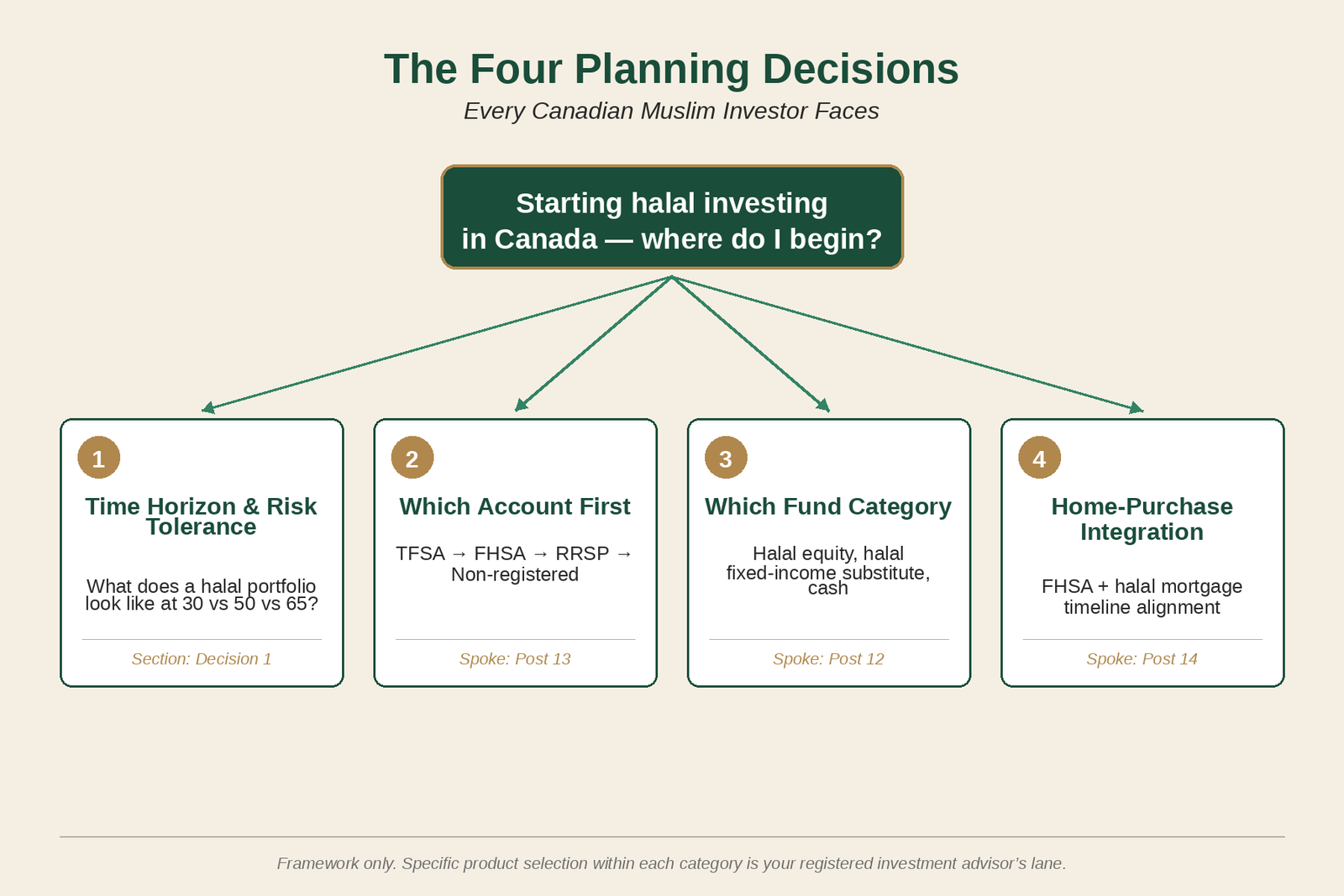
Every halal investing build comes down to four decisions. They are sequential — answer them in order — and each cascades into the next.
Decision 1 — Time horizon and risk tolerance
The question that gets skipped in 90% of halal-investing conversations. A 30-year-old saving for retirement and a 60-year-old saving for retirement need different portfolios — that’s true for conventional investors and equally true for halal investors. The Shariah screen does not change the underlying asset-allocation logic. A 30-year horizon supports 90–100% equity in compliant funds; a 60-year horizon usually argues for some allocation to halal fixed-income substitutes (Manzil’s mortgage fund, sukuk where available) to dampen equity volatility in the drawdown years.
There is one Shariah-specific wrinkle: the conventional bond-substitute problem. Most balanced portfolios use bond funds to reduce volatility. Halal portfolios cannot — bonds are interest-bearing. The substitute categories (sukuk funds, halal mortgage funds, halal money-market alternatives) are fewer, less liquid, and more expensive than conventional fixed-income. Investors building a halal balanced portfolio in Canada in 2026 are typically working through one of three framework choices: (a) 100% halal equity with higher volatility, (b) halal equity + a halal mortgage-fund position (the Canadian market has private-fund options in this category, typically with MERs around 1.4–1.5%), or (c) halal equity + non-registered cash as the volatility buffer. Each has trade-offs that depend on your time horizon and risk tolerance — and which specific product fills the fixed-income substitute is your advisor’s call.
Decision 2 — Which Canadian account first
The account-architecture decision. For 2026 the registered accounts available to a Canadian resident are: TFSA ($7,000 annual, $102,000 cumulative since 2009), FHSA ($8,000 annual, $40,000 lifetime), RRSP ($33,810 maximum 2026 contribution), and non-registered. Halal funds are eligible in all four.
The planner’s default sequence for most Canadian Muslim investors with limited cash to deploy is TFSA first (tax-free growth amplifies the MER drag of halal funds in your favour), FHSA second if a home purchase is in scope within the next 15 years (the 8-year-use deadline is real but generous), RRSP third (the deduction matters more for high earners and the 15% U.S. withholding-tax shelter on U.S.-listed halal ETFs is meaningful), and non-registered last. The deep account-by-account math — including the spousal RRSP question for income-splitting and the FHSA-after-residency-start logic for newcomers — is in the TFSA, RRSP and FHSA Through a Shariah Lens post.
Decision 3 — Which fund category (and the landscape your advisor will work within)
The fund-category decision. The Canadian-accessible halal product universe in 2026 is small and concrete. On the equity side, the funds in the category as of publication include WSHR (Wealthsimple Shariah Equity, Cboe Canada-listed), HLAL (Wahed FTSE USA Shariah, Nasdaq-listed), SPUS (SP Funds S&P 500 Shariah, NYSE Arca-listed), and MNZL (Manzil Russell Halal USA Broad Market, Nasdaq-listed, launched November 2025). On the halal fixed-income substitute side, the Manzil Mortgage Fund is one of the main Canadian options (private fund, distributed via OneVest Halal Portfolio).
These products are not interchangeable. They differ on listing currency (CAD vs USD), geography (Canadian + global vs US-only), MER (the category runs roughly 0.40% to 0.64% all-in for equity ETFs), AUM, and the screening methodology each tracks. The planning framework that drives which category you want in which account is mine; the specific-product selection within the category is your investment advisor’s. The side-by-side factual comparison of the funds in the category — for your own understanding before your advisor’s conversation — is in the Halal ETFs in Canada — A Planner’s Comparison post.
Decision 4 — How to handle the home-purchase question
For most Canadian Muslim investors under 45, the home-purchase decision shapes the investing decision. The FHSA was designed for first-time home buyers — but a Muslim buyer who plans to use a halal mortgage at withdrawal needs the FHSA-to-halal-mortgage handoff to actually work. That requires (a) opening the FHSA early enough that the 15-year use-it window doesn’t trap you, (b) sizing the FHSA contribution against your expected halal mortgage down payment requirement (which can run higher than conventional because of structural differences in the contract), and (c) coordinating the FHSA withdrawal with the halal mortgage provider’s documentation requirements. The full mortgage decision — Manzil vs EQRAZ vs IjaraCDC vs Tjara, with the planner’s read on each — is in Halal Home Financing in Canada (2026).
Part 3 — The Trade-Offs the Salesperson Doesn’t Name
Two trade-offs deserve more space than they typically get in halal investing content.
The MER drag
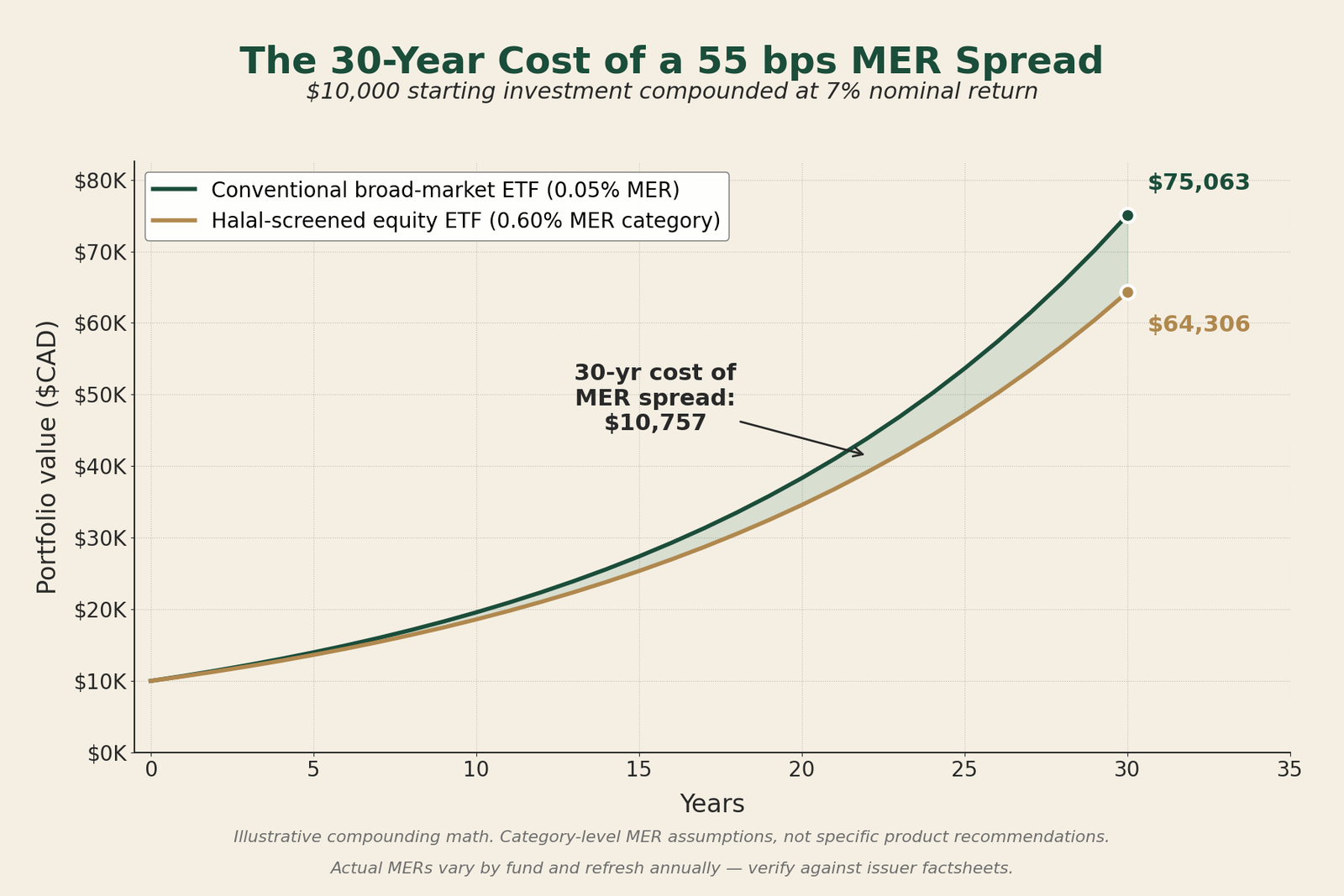
A 0.55% MER spread between a typical halal-screened equity ETF (the category in Canada in 2026 runs around 0.40% to 0.60% all-in across the available funds) and a conventional broad-market ETF (around 0.05% for VFV.TO, Vanguard’s S&P 500 fund) does not sound like much. Over 30 years on a TFSA, compounded at a 7% nominal return on a $10,000 starting investment, the spread costs roughly $10,750 — the conventional ETF grows to about $75,000; the halal-screened ETF grows to about $64,300.
For most Muslim investors the cost is worth paying. The point isn’t to talk you out of halal investing — the point is to name the cost honestly so you can plan around it. Three planning implications worth raising with your investment advisor before product selection:
- MER matters in product evaluation. A 20-basis-point difference between two halal equity ETFs over 30 years compounds to roughly $3,000 on a $10,000 investment — small in isolation but meaningful on a portfolio of $50,000+. Your advisor’s product selection should weigh MER alongside methodology fit, AUM, liquidity, and account eligibility.
- Asset location matters for halal portfolios. Tax-sheltered accounts (TFSA in particular) amplify the cost of higher-MER funds in your favour through tax-free compounding. Conventional asset-location wisdom partly inverts here — the expensive fund benefits most from the tax shelter. Worth discussing with your advisor when sequencing account fills.
- Account architecture and product selection are separate decisions. The framework question — which account do I fund first — is the planner’s lane. The product question — which specific ticker fills that account — is your advisor’s. Funding a non-registered account before maxing the TFSA compounds the MER drag with bad account architecture; that’s a framework error, fixable in planning before the advisor executes.
The sector concentration
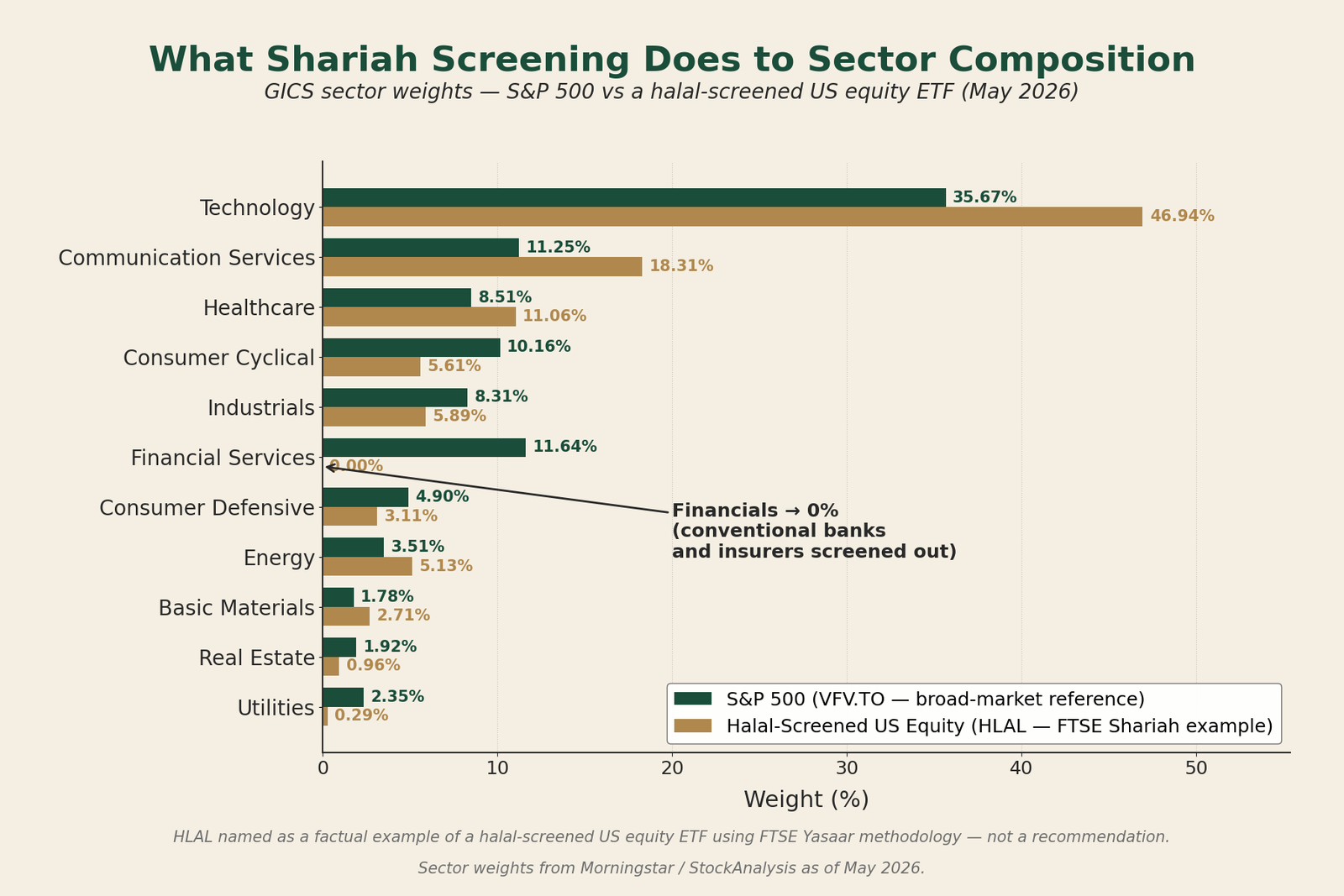
The sector composition of a halal-screened US large-cap fund is meaningfully different from the broad-market benchmark. Comparing VFV.TO (Vanguard’s S&P 500 ETF, Canadian-listed) to HLAL (Wahed’s FTSE USA Shariah ETF) at May 2026 weights:
- Financials: 11.64% → 0.00% — the headline cut
- Technology: 35.67% → 46.94% — the dominant overweight (+11.3pp)
- Communication Services: 11.25% → 18.31% — meaningful overweight (+7.1pp)
- Healthcare: 8.51% → 11.06% — modest overweight
- Consumer Cyclical: 10.16% → 5.61% — meaningful underweight
- Industrials and Materials: roughly comparable
What this means in practice: in a year when financials lead (a rising-rate environment, a banking-sector rally), the halal-screened portfolio underperforms by a meaningful margin. In a year when tech leads, it outperforms. The halal-screened portfolio has higher single-sector risk than the broad market — not by choice, but by methodology. For long-horizon investors, this averages out. For investors who want diversification to be the primary risk-control mechanism, the sector concentration is something to acknowledge in the plan.
The other under-discussed trade-off is the cash-drag problem. Halal investors cannot park cash in a conventional high-interest savings account that pays interest. The substitutes — Manzil’s mortgage fund, halal HISA-equivalents at boutique providers — are limited, less liquid, and carry their own fees. For a Canadian halal investor, holding a meaningful cash sleeve costs more than the conventional equivalent. Plan the equity allocation knowing the cash buffer is more expensive to maintain.
Part 4 — Where to Start (A Category-Level Planning Framework)
For an illustrative 35-year-old Calgary professional with $40,000 to invest, $7,000 of unused 2026 TFSA room, $8,000 of FHSA room (account already opened), and a 25–30 year retirement horizon with a home purchase planned in 5–8 years, the planning framework — the part I help build before any product gets selected — looks like this:
| Account | Allocation | Asset class category |
|---|---|---|
| TFSA | $7,000 | Halal-screened equity exposure (Canadian- or US-listed ETF, methodology of investor’s choice) |
| FHSA | $8,000 | Halal-screened equity exposure with FX considerations matched to home-purchase timeline (a CAD-listed option avoids conversion friction at withdrawal) |
| Non-registered | $25,000 | Split: ~$15,000 halal fixed-income substitute (private halal mortgage fund, sukuk fund if available, or halal HISA-equivalent) + ~$10,000 cash planning runway |
The framework decisions are mine to help you make: which accounts get funded in what order, what proportion goes to equity versus fixed-income substitutes, what role cash plays as 12-month planning runway, and how the home-purchase horizon shapes the FHSA. The specific product selection — which halal equity ETF fills the TFSA, which halal fixed-income substitute fills the non-registered position, which currency and listing fits — is your investment advisor’s lane. Your scholar confirms that whichever products your advisor proposes meet your school of thought.
The decisions that shift the framework: if the home-purchase horizon is 2–3 years (not 5–8), the FHSA category shifts from equity to capital-preservation. If the investor is closer to 60 than 35, the equity-to-fixed-income ratio comes down. If the TFSA cumulative room is unused since 2009 (up to $102,000 of accumulated room), the catch-up plan needs its own conversation — sequencing matters more when there’s a meaningful backlog. None of these shifts changes who owns which decision: you choose with your advisor what to buy; I help you decide what the buying plan should look like.
The Three Planning Failures I See Most
In my practice, three failure modes account for most of the halal investing damage I see.
Failure 1 — Treating “halal” as a single binary rather than understanding the methodology differences. Buying any fund labeled “halal” without checking which screening methodology it uses, against your scholar’s accepted standards, treats compliance as the salesperson’s claim rather than the scholar’s adjudication. The planning fix is to ask your scholar which methodology they accept (AAOIFI, FTSE Yasaar, MSCI Islamic, S&P Shariah, or a specific fund-provider’s scholar board) before you buy any fund — not after. The methodology choice and the fund choice are two different decisions.
Failure 2 — Account-blind buying. Funding halal investments in a non-registered account before maxing the TFSA loses 30+ years of tax-free compounding on the highest-cost fund in your portfolio. The planning fix is the standard account-priority sequence (TFSA first, FHSA if home is in scope, RRSP, non-registered), applied to halal funds the same way it would be to conventional funds. The Shariah screen does not change account-architecture logic.
Failure 3 — Ignoring the MER drag in long-horizon math. Assuming the spread between halal and conventional funds is small enough to ignore — without running the 30-year compounding math — underestimates the trade-off you’re making. The planning fix is to run the math explicitly at the start (a 55-bp spread costs roughly $10,750 over 30 years on a $10,000 TFSA investment at 7% nominal return), decide whether the trade-off fits your goals — and bring that math to your advisor so MER weighs properly in their product selection alongside methodology fit, AUM, liquidity, and execution. Don’t ignore the cost; price it in.
Sources
- Wealthsimple Shariah World Equity Index ETF (WSHR) product page
- Wahed FTSE USA Shariah ETF (HLAL) — ETFdb
- SP Funds S&P 500 Sharia Industry Exclusions ETF (SPUS)
- Manzil Mortgage Fund (Canada)
- Manzil Russell Halal USA Broad Market ETF (MNZL) — Zoya overview
- FTSE Yasaar Global Equity Shariah Index Series Ground Rules
- MSCI Islamic Index Series Methodology (Oct 2024)
- S&P Shariah Indices Methodology (April 2026)
- AAOIFI Shariah Standards overview (Secretary General)
- CRA — Registered plans limits (TFSA / RRSP / FHSA)
- CRA — Contributing to your FHSA
Frequently Asked Questions
What’s the cheapest way to start halal investing in Canada with $5,000?
The planning framework for a Canadian resident with $5,000 to invest and unused TFSA room is straightforward: open or top up a TFSA at a Canadian discount broker, then fund it with a halal-screened equity ETF in the category that fits your screening-methodology preference, currency comfort, and account-architecture sequence. The 2026 Canadian halal-ETF universe spans roughly 0.40% to 0.60% all-in MER; the lowest-cost options are US-listed and require USD conversion, while Canadian-listed options are denominated in CAD and avoid that friction. Which specific ticker fits is your investment advisor’s call — they evaluate methodology fit, AUM, liquidity, and execution. Which methodology your scholar accepts is your scholar’s call. My role as planner is to confirm the framework — TFSA-first sequencing is the correct first move for most $5,000 starters — and integrate the resulting product choice with the rest of your plan.
How much extra am I really paying for halal funds vs conventional ETFs?
A halal-screened equity ETF in 2026 typically carries a management expense ratio (MER) of 0.40% to 0.60% all-in, compared to roughly 0.05% to 0.10% for a conventional broad-market Canadian or US equity ETF — a spread of approximately 30 to 55 basis points. On a $10,000 TFSA investment compounded at a 7% nominal annual return over 30 years, a 55-basis-point spread costs roughly $10,750 (the conventional ETF grows to about $75,000; the halal-screened ETF to about $64,300). The cost is meaningful but not prohibitive for most long-horizon retail investors. Two framework levers reduce the cost: MER is a key dimension your advisor weighs at product selection, and account sequencing — which account fills first — is the planning decision that determines how much tax-shelter compounding the chosen fund actually gets.
Can I hold halal investments in my RRSP, or only my TFSA?
Yes — halal investments are eligible in every Canadian registered account, including TFSA, RRSP, FHSA, RRIF, RESP, and non-registered accounts. The Shariah screen is a portfolio-construction question, not a CRA registered-plan question. The account-priority sequence for most Canadian Muslim investors is TFSA first, FHSA second (if home purchase is in scope), RRSP third, non-registered last. The RRSP has one Shariah-specific advantage: for US-listed halal ETFs (HLAL, SPUS, MNZL), holding them in an RRSP eliminates the 15% US dividend withholding tax under the Canada–US tax treaty — a benefit that does NOT apply in a TFSA. For Canadian-listed WSHR, the withholding question doesn’t arise. The full account-architecture decision is in the TFSA, RRSP and FHSA Through a Shariah Lens post.
What’s the difference between what my scholar, planner, investment advisor, and CPA do on halal investing?
Four lanes, four professionals. Your scholar adjudicates Shariah compliance — whether a specific fund, mortgage structure, or investment contract is permissible under your school of thought. Where compliance is contested, the scholar is the final voice. Your registered investment advisor or portfolio manager (a CIRO-registered professional licensed to provide securities-specific recommendations) selects the actual tickers, executes the trades, and provides product-level suitability assessment. Your financial planner (me, a CFP/CFA, not securities-registered) builds the framework that sits underneath those two — your goals, time horizon, account-priority sequence, asset-class targets, household integration — so when your advisor selects products and your scholar confirms compliance, the choices fit a coherent plan. Your CPA owns tax filing — TFSA over-contribution penalties, RRSP deduction claims, T-slips, foreign-tax-credit calculations on US-listed halal ETFs, and zakat-as-charitable-donation receipts. Each lane is critical; none of the four substitutes for the others. Best practice is to know who owns which question in advance: scholar for compliance, advisor for product selection, planner for the framework, CPA for the filing.
Related Reading on This Site
- Halal ETFs in Canada — A Planner’s Comparison (WSHR, HLAL, SPUS, MNZL) — the side-by-side fund-comparison post that drills into Decision 3.
- TFSA, RRSP and FHSA Through a Shariah Lens — Which Canadian Accounts Hold Halal Best — the account-architecture spoke for Decision 2.
- Halal Home Financing in Canada (2026) — Manzil, EQRAZ, IjaraCDC Compared — the mortgage decision that drives Decision 4.
- Halal Investing Inside Your CCPC — Shariah-Compliant Corporate Investing for Muslim Business Owners — Pillar B. If you own an incorporated business, the corporate halal-investing decision is its own post.
- Estate Planning + Zakat for Muslim Canadians — Islamic Inheritance Within Canadian Law — the estate-integration spoke.
Conclusion
Halal investing in Canada in 2026 is not a single decision — it is four sequential framework decisions about horizon, account, fund category, and home purchase, each with trade-offs the salesperson-led content does not name. The Canadian halal-fund universe is small and concrete, the major screening methodologies converge on similar thresholds, and the structural costs (50–80 bps MER drag, tech-and-healthcare sector concentration, cash-drag from limited halal HISA alternatives) are real but manageable inside a deliberate plan. The investors who do this well separate the four lanes cleanly — scholar for Shariah compliance, planner for the framework, registered investment advisor for product selection, CPA for filing — and stop trying to make any one professional answer all four questions.
Want a planner’s read on your specific halal-investing build? Book a complimentary 15-minute call → Book a discovery call
Important disclosure
General educational information only — not personalized investment, tax, or Shariah-compliance advice and not a recommendation to buy, sell, or hold any specific security. Specific funds named in this post (WSHR, HLAL, SPUS, MNZL, Manzil Mortgage Fund) are referenced as factual examples of the 2026 Canadian halal-investing product landscape; mention is not endorsement, recommendation, or solicitation. Product-level recommendations are the role of a CIRO-registered investment advisor or portfolio manager. Shariah-compliance adjudication is the role of a qualified Islamic scholar of your choosing — the institutional methodologies referenced (AAOIFI, FTSE Yasaar, MSCI Islamic, S&P Shariah) are summarized for planning context, not endorsed. Tax filing is the role of a qualified Canadian CPA. Fund MERs, AUM, sector weightings, and contribution limits change frequently; verify against issuer factsheets and the CRA limits table before acting. Consult all four professionals before acting on anything in this post.
Author bio: Jahid Hassan is a CFA Charterholder and CFP Professional based in Calgary, Alberta, specializing in comprehensive financial planning for Canadian incorporated business owners, newcomers to Canada, and Muslim investors building Shariah-compliant portfolios. Connect on LinkedIn.