The Buying Question
You’ve decided to build a halal portfolio. You want one place that compares the Canadian-accessible halal funds side by side, honestly, without selling you any of them. This post is that. It does not recommend a fund — product recommendations are your registered investment advisor’s lane. What it does is lay out the factual landscape: ticker, fee, AUM, screening methodology, geography, currency. The framework decisions (which account, in what order, with what asset-class mix) are in the pillar post. This post is Decision 3 — which fund category — for your understanding before the advisor conversation.
Key Takeaways
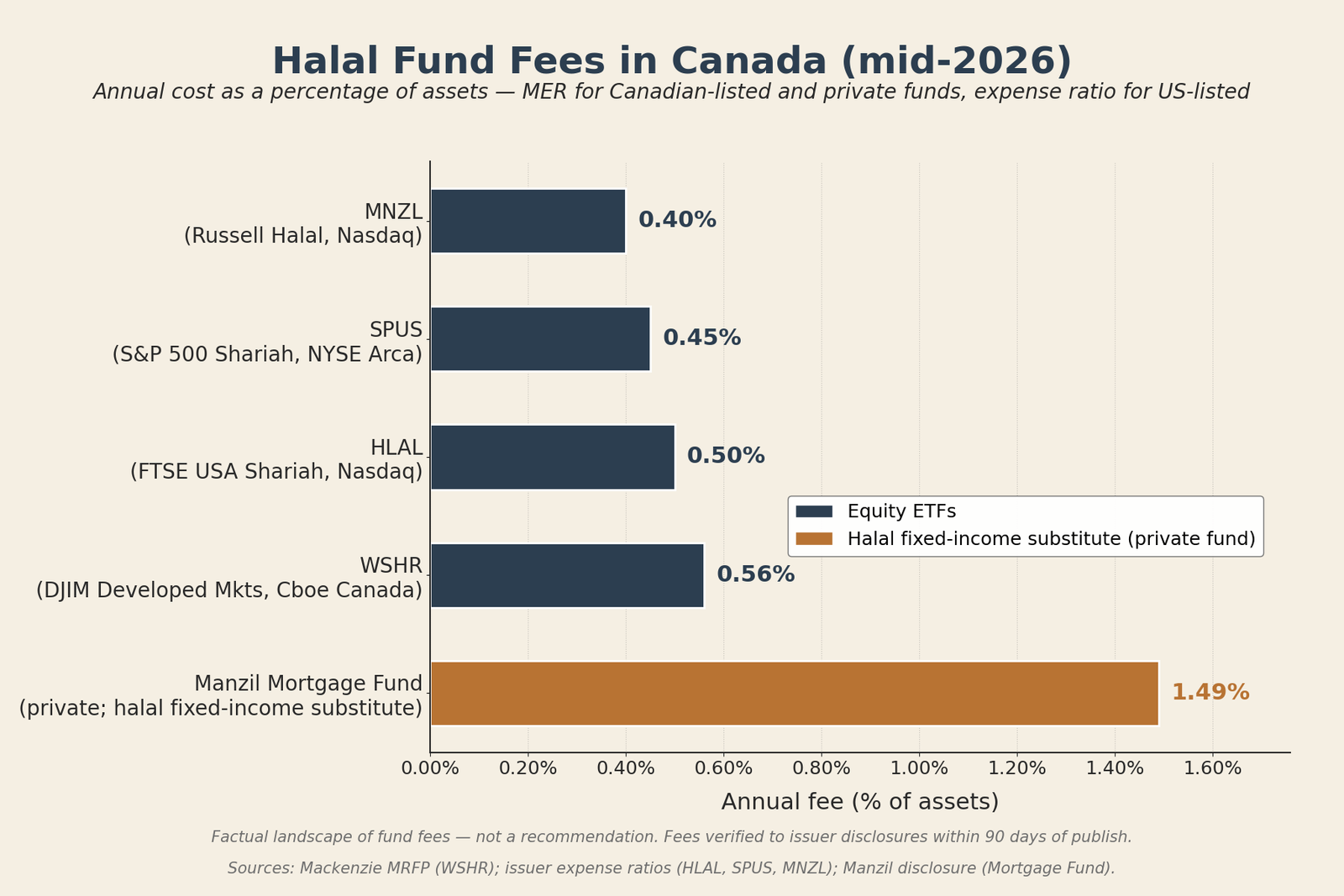
- The 2026 halal ETFs Canada universe is five funds: WSHR (CAD, developed-markets, 0.56% MER), HLAL (USD, FTSE USA Shariah, 0.50% ER), SPUS (USD, S&P 500 Shariah, 0.45% ER, largest at ~$2.0B AUM), MNZL (USD, Russell Halal, 0.40% ER — newest and cheapest), and the Manzil Mortgage Fund (CAD, 1.49% MER — the halal fixed-income substitute).
- The category is in a growth phase: SPUS quadrupled to ~$2.0B in 24 months; HLAL grew ~23% in two months in 2026.
- The four major screening methodologies (AAOIFI, FTSE Yasaar v4.6, MSCI Islamic, S&P Shariah) converge on similar quantitative thresholds. Methodology choice is the fund’s, not yours — scholar’s call.
- The differences that matter at product selection are fee, currency, geography, AUM (and the liquidity it drives), and methodology fit with your scholar’s preference — not methodology hair-splitting.
On this page
- What I Do, What Your Advisor Does
- The Master Comparison Table — Halal ETFs Canada at a Glance
- WSHR — Wealthsimple Shariah World Equity Index ETF
- HLAL — Wahed FTSE USA Shariah ETF
- SPUS — SP Funds S&P 500 Sharia Industry Exclusions ETF
- MNZL — Manzil Russell Halal USA Broad Market ETF
- Manzil Mortgage Fund — Halal Fixed-Income Substitute
- Framework Questions for Your Advisor Conversation
- Sources
- Frequently Asked Questions
- Related Reading on This Site
- Conclusion
What I Do, What Your Advisor Does
Halal investing sits at the intersection of four professional lanes. Your scholar adjudicates Shariah compliance. Your CPA files your tax return. Your registered investment advisor or portfolio manager (CIRO-registered) selects specific products. My role as your financial planner is the framework — goals, time horizon, account-priority sequence, asset-class targets — so when your advisor selects products, the choices fit a coherent plan. This post discusses funds by name as factual landscape information, not as product recommendation.
The Master Comparison Table — Halal ETFs Canada at a Glance
| Fund | Ticker / Exchange | Fee | AUM (date) | Methodology | Geography | Currency |
|---|---|---|---|---|---|---|
| WSHR Wealthsimple Shariah World Equity Index ETF | WSHR / Cboe Canada | 0.56% MER (Mackenzie MRFP, Jun 2025) | ~CAD $458M (May 2026) | DJIM Developed Markets Quality and Low Volatility Index (S&P DJI Shariah family) | Developed markets | CAD |
| HLAL Wahed FTSE USA Shariah ETF | HLAL / Nasdaq | 0.50% ER | ~USD $925M (Jun 2026) | FTSE USA Shariah Index (FTSE Yasaar v4.6, Feb 2026) | USA only | USD |
| SPUS SP Funds S&P 500 Sharia Industry Exclusions ETF | SPUS / NYSE Arca | 0.45% ER | ~USD $2.0B (Mar 2026) | S&P 500 Shariah Industry Exclusions Index (S&P Shariah methodology, May 2026) | USA only (S&P 500) | USD |
| MNZL Manzil Russell Halal USA Broad Market ETF | MNZL / Nasdaq | 0.40% ER (cheapest in NA) | ~USD $17M (May 2026; launched Nov 18, 2025) | Russell IdealRatings Manzil Halal USA Broad Market Index (AAOIFI-aligned + ethical overlay) | USA, large + mid-cap | USD |
| Manzil Mortgage Fund | Private fund; distribution unit MANZL on Cboe Canada | 1.49% MER | ~CAD $100M+ (mid-2025 CEO disclosure) | Diminishing musharaka residential mortgages, AAOIFI-aligned | Canada (residential) | CAD |
WSHR — Wealthsimple Shariah World Equity Index ETF
What it is. The only Canadian-listed (Cboe Canada) halal equity ETF as of June 2026. Issued by Mackenzie Investments, co-promoted by Wealthsimple. Tracks the Dow Jones Islamic Market Developed Markets Quality and Low Volatility Index — a multi-factor screened developed-markets index from the S&P DJI Shariah family.
Characteristics worth understanding. CAD-denominated — no FX conversion required. All-in MER 0.56% per the latest Mackenzie MRFP; the 0.50% often cited online is the management fee only. Developed-markets geography (US ~46%, UK, Japan, Switzerland, Canada, Australia, EU) — broader than the US-only alternatives. Multi-factor weighting rather than market-cap, producing a different concentration profile than the US-only Shariah ETFs. AUM ~CAD $458M (May 2026), up from $341.7M a year prior.
HLAL — Wahed FTSE USA Shariah ETF
What it is. US-listed FTSE-Yasaar-screened US-only large-cap Shariah ETF, sponsored by Wahed Invest. Tracks the FTSE USA Shariah Index, screened under FTSE Yasaar Ground Rules v4.6 (February 2026).
Characteristics worth understanding. USD-denominated, US-listed — Canadian residents pay FX conversion on purchase/sale, and US dividend withholding tax (15%) applies in TFSA but is eliminated in RRSP under the Canada–US tax treaty. Expense ratio 0.50%, stable since launch. FTSE Yasaar buffer band — existing constituents within ±5% of the 33.333% ratio thresholds are not immediately removed (two consecutive quarters outside the buffer required), reducing churn. AUM ~USD $925M (June 2026), up roughly 23% in two months.
SPUS — SP Funds S&P 500 Sharia Industry Exclusions ETF
What it is. US-listed Shariah-screened US large-cap ETF. Tracks the S&P 500 Shariah Industry Exclusions Index, screened under S&P Shariah methodology (May 2026).
Characteristics worth understanding. USD-denominated, US-listed — same FX and withholding-tax dynamics as HLAL. Expense ratio 0.45%. Tracks S&P 500 universe, so post-screening sector mix tilts more heavily to technology than HLAL. Largest halal equity ETF accessible to Canadians at ~USD $2.0B (Mar 2026), up roughly 4× from ~$500M in early 2024. Larger AUM generally means tighter bid-ask spreads and better trading liquidity. The growth trajectory is the headline halal-ETF story of the past 24 months.
MNZL — Manzil Russell Halal USA Broad Market ETF
What it is. Newest entrant — launched November 18, 2025 on Nasdaq under Tidal ETF Trust, with Manzil Investment Advisors as sub-adviser. Tracks the Russell IdealRatings Manzil Halal USA Broad Market Index, with AAOIFI-aligned Shariah screening plus an ethical overlay (American Friends Service Committee human-rights criteria).
Characteristics worth understanding. 0.40% expense ratio — lowest in the halal ETF category in North America. USD-denominated, US-listed — same FX and withholding-tax dynamics. Broadest holdings count at ~461 securities as of June 2026, producing lower single-stock concentration than SPUS or HLAL. Smallest AUM at ~USD $17M (May 2026) reflecting the fund’s six-month track record — smaller AUM generally means wider bid-ask spreads and lower trading liquidity. Track record is short — full market-cycle assessment won’t be possible until late 2028.
Manzil Mortgage Fund — Halal Fixed-Income Substitute
What it is. Private mutual fund providing exposure to Shariah-compliant residential mortgages on Canadian property, structured as diminishing musharaka contracts. Distributed via Corex Financial and OneVest (including the OneVest Halal Portfolio); a listed distribution unit trades on Cboe Canada under MANZL.
Characteristics worth understanding. The principal halal fixed-income substitute available to Canadian retail investors — sukuk funds aren’t retail-accessible in Canada. MER 1.49%, reflecting active management of the underlying mortgage book. AUM crossed CAD $100M mid-2025 per CEO disclosure to BetaKit. Liquidity is structurally different from listed ETFs — settles at NAV on a periodic basis. Investors and advisors should understand redemption mechanics before allocating.
Framework Questions for Your Advisor Conversation
Three illustrative profiles — these are framework questions to bring to your advisor, not allocation recommendations.
Early-career, TFSA-first, CAD-only comfort: which methodology does my scholar accept; do I want geography beyond US-only; how do MER differences compound over my horizon.
Mid-career, balanced halal portfolio: what proportion goes to halal fixed-income substitute; if I hold US-listed funds, what’s my RRSP-vs-TFSA allocation logic for the withholding-tax trade-off; what’s my USD exposure tolerance.
Pre-retirement, fixed-income substitute needed: what’s the role of a halal mortgage fund in my drawdown; how do private-fund redemption mechanics affect my income strategy.
Product selection is your advisor’s lane; the framework these questions feed is mine.
Sources
- Mackenzie Investments — WSHR Annual MRFP (FY-end Mar 31, 2025)
- Wealthsimple Shariah World Equity Index ETF (WSHR) product page
- Wahed FTSE USA Shariah ETF (HLAL) — ETFdb
- SP Funds S&P 500 Sharia Industry Exclusions ETF (SPUS)
- Manzil Mortgage Fund (Canada)
- Manzil Russell Halal USA Broad Market ETF (MNZL) — Zoya overview
- BetaKit — Manzil Crosses $100M AUM (July 2025)
- FTSE Yasaar Ground Rules v4.6 (Feb 2026)
- S&P Shariah Indices Methodology (May 2026)
Frequently Asked Questions
Is MNZL really the cheapest halal ETF — and does cheapest mean best?
The 0.40% expense ratio is the lowest in the halal ETF category as of mid-2026 — a real cost advantage. Whether that makes MNZL the right fund for any specific investor is a product-suitability question for your registered investment advisor, not a planner’s call. The factors that work alongside fee at product selection are AUM (which drives liquidity), track record length (MNZL has six months), screening methodology fit, and currency. The 0.40% saves real money over a long horizon; smaller AUM and shorter track record are real trade-offs.
Should I hold US-listed halal ETFs in my TFSA or RRSP?
For US-listed halal ETFs (HLAL, SPUS, MNZL), holding them in an RRSP eliminates the 15% US dividend withholding tax under the Canada–US tax treaty; the same shelter does not apply in a TFSA. For Canadian-listed WSHR, this question doesn’t arise. The framework implication for your account-priority sequence is in the pillar post. Your CPA confirms the treaty mechanics at filing; my role is to surface the account-architecture implication.
How do WSHR, HLAL, SPUS, and MNZL differ in what they actually hold?
Three dimensions: geography (WSHR developed-markets, others US-only), screening methodology (S&P DJI Shariah, FTSE Yasaar, S&P Shariah, Russell IdealRatings), and weighting approach (WSHR multi-factor quality + low-volatility, others market-cap weighted). The result is meaningfully different sector compositions — SPUS most tech-concentrated, MNZL holds ~461 names so lowest single-stock concentration, WSHR’s multi-factor weighting typically less tech-heavy than the US-only three.
What’s the difference between what my scholar, planner, advisor, and CPA do?
Four lanes. Scholar adjudicates Shariah compliance. Registered investment advisor or portfolio manager (CIRO-registered) selects products, executes trades, provides suitability assessment. Financial planner (CFP/CFA, not securities-registered) builds the framework — goals, horizon, account-priority sequence, asset-class targets. CPA files taxes — TFSA penalties, RRSP deductions, T-slips, foreign-tax credits on US-listed ETFs.
Related Reading on This Site
- Halal Investing in Canada — The 2026 Decision Framework for Muslim Investors — Pillar A, the framework this post drills into (Decision 3).
- TFSA, RRSP and FHSA Through a Shariah Lens — Decision 2: account architecture.
- Halal Home Financing in Canada (2026) — Decision 4: mortgage decision.
- Halal Investing Inside Your CCPC — Pillar B, for Muslim incorporated business owners.
- Estate Planning + Zakat for Muslim Canadians — estate-integration spoke.
Conclusion
Five funds, five trade-offs. WSHR for CAD-denominated developed-markets exposure. HLAL for US-only FTSE Shariah. SPUS for the largest AUM in the category. MNZL for the cheapest fee on paper. Manzil Mortgage Fund as the principal halal fixed-income substitute. The category quadrupled on the US side in two years — niche to mainstream in 24 months. Which fund fits any specific investor is your advisor’s lane; the framework that makes that conversation productive — goals, horizon, accounts, asset-class targets — is mine.
Want a planner’s read on your halal-investing framework? Book a complimentary 15-minute call → Book a discovery call
Important disclosure
General educational information only — not personalized investment, tax, or Shariah-compliance advice and not a recommendation to buy, sell, or hold any specific security. Specific funds named in this post (WSHR, HLAL, SPUS, MNZL, Manzil Mortgage Fund) are referenced as factual examples of the 2026 Canadian halal-investing product landscape; mention is not endorsement, recommendation, or solicitation. Product-level recommendations are the role of a CIRO-registered investment advisor or portfolio manager. Shariah-compliance adjudication is the role of a qualified Islamic scholar of your choosing. Tax filing is the role of a qualified Canadian CPA. Fund MERs, AUM, sector weightings, and contribution limits change frequently; verify against issuer factsheets and the CRA limits table before acting. Consult all four professionals before acting on anything in this post.
Author bio: Jahid Hassan is a CFA Charterholder and CFP Professional based in Calgary, Alberta, specializing in comprehensive financial planning for Canadian incorporated business owners, newcomers to Canada, and Muslim investors building Shariah-compliant portfolios. Connect on LinkedIn.