The Home-Financing Question
Most of what you'll find when you research a halal mortgage in Canada is one of two things: provider marketing, or scholarly debate about which contract structure is permissible. Almost none of it filters the question through a Canadian household's full balance sheet — the down payment math, the FHSA and HBP integration, the debt-service ratios, the cost of the structure premium over 25 years. That filter is this post. It does not pick a provider, does not adjudicate which contract is permissible (your scholar's call), and does not recommend buying a home at any particular time. It lays out the 2026 landscape — three contract structures, four providers — through the eyes of three buyers, because the contract-versus-provider matrix only becomes legible once you've named which buyer you are. This is Decision 4 in the pillar framework: how the home-financing choice cascades back into today's account-architecture decisions.
Key Takeaways
- The 2026 halal mortgage Canada landscape is four active providers — Manzil (diminishing musharaka, ON/AB/BC/SK), EQRAZ (monthly murabaha, most provinces), Canadian Halal Financial Corporation (Alberta), and Servus Halal (25-year fixed murabaha, Alberta — the first product from a provincially regulated financial institution, launched fall 2025).
- Three contract structures — musharaka, ijara, murabaha — differ in who holds title, what the payment is composed of, and what happens when you sell or refinance. Which one is permissible for you is your scholar's call.
- Halal home financing is not CMHC-insurable in 2026, so plan for a 20–25% down payment — not the 5% conventional minimum. That makes the FHSA + HBP down-payment stack more decisive for halal buyers, not less.
- The structure premium is real and measurable: on a $500K home with 20% down, a 6.30% musharaka rate costs roughly $529 more per month than a 3.99% conventional 5-year fixed — about $159K over 25 years if the spread held. Whether that premium is worth paying is a household + scholar conversation.
- Three buyer profiles drive this post: the first-time buyer, the move-up refinancer, and the cash / family-equity buyer. The structures and providers that fit each are different.
On this page
- What I Do, What Your Scholar, Mortgage Agent, Advisor, and CPA Do
- The Quick Glossary — Musharaka, Ijara, Murabaha
- Persona 1 — The First-Time Halal Buyer
- Persona 2 — The Move-Up Buyer (Conventional to Halal Refinance)
- Persona 3 — The Cash Buyer and the Family-Equity Buyer
- The Master Provider Table — Halal Mortgage Canada at a Glance
- The Worked Example — What the Structure Premium Costs in 2026
- Three Planning Failures I See Most
- Sources
- Frequently Asked Questions
- What's the difference between diminishing musharaka, ijara, and murabaha — in plain English?
- Can I use the FHSA and HBP for a halal mortgage?
- Is halal financing more expensive than conventional? By how much in 2026?
- What's the difference between what my scholar, planner, mortgage agent, advisor, and CPA do?
- Related Reading on This Site
- Conclusion
What I Do, What Your Scholar, Mortgage Agent, Advisor, and CPA Do
Halal home financing sits at the intersection of five professional lanes — one more than the usual four, because a mortgage is not a securities transaction. Your scholar adjudicates which contract structure (musharaka, ijara, murabaha) is permissible under your school of thought, and whether a specific provider's documented structure meets the bar. A provincially licensed mortgage broker or agent selects the provider, runs prequalification, and handles the paperwork. Your CPA confirms the tax treatment of the payment structure and your FHSA + HBP withdrawal eligibility. Your CIRO-registered investment advisor manages the portfolio side — mortgages fall outside CIRO's scope. My role as your financial planner is the household framework: down-payment math, FHSA/HBP integration, debt-service capacity, total-cost trade-off. Providers are named in this post as factual landscape information, not as recommendation.
The Quick Glossary — Musharaka, Ijara, Murabaha
Three terms before the personas land. Two sentences each — the mechanics surface where they hit each buyer's arc.
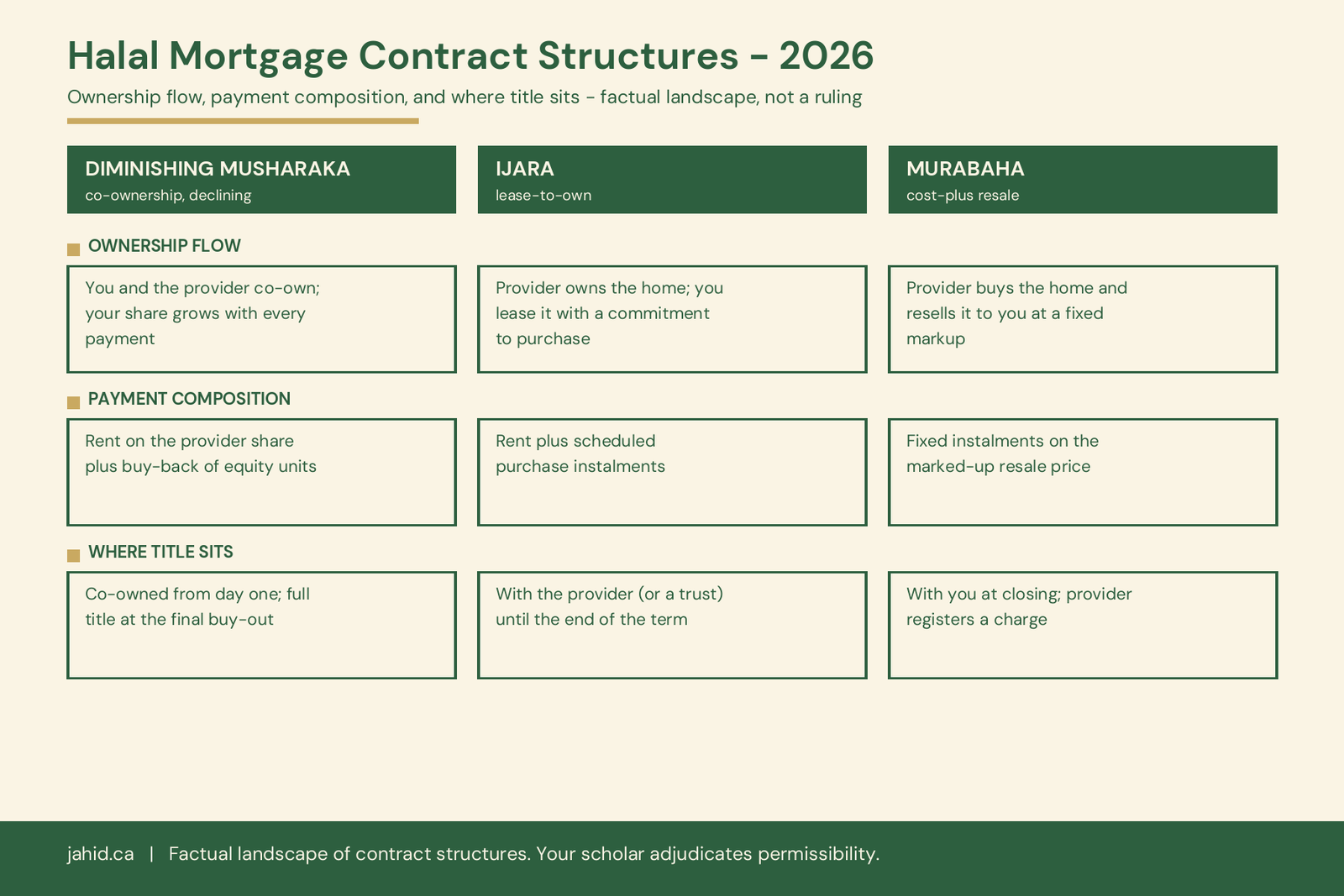
Diminishing musharaka (“declining partnership”) — you and the financier buy the home together; each month you buy a slice of the financier's share while paying a usage payment on the portion you don't yet own. Your ownership rises, theirs diminishes, until you own 100% — the structure addressed by AAOIFI Shariah Standard No. 12.
Ijara (“lease”) — the financier buys the property and leases it to you, with ownership transferring at the end of the term. Less common in Canada as a standalone retail product; in practice its lease mechanics live inside diminishing-musharaka arrangements — the structure addressed by AAOIFI Shariah Standard No. 9.
Murabaha (“cost-plus sale”) — the financier acquires the home and sells it to you at cost plus a disclosed profit, paid in instalments; title sits with you from the start. Canadian variants differ meaningfully — from full-term fixed pricing to monthly-renewal structures — the structure addressed by AAOIFI Shariah Standard No. 8.
Persona 1 — The First-Time Halal Buyer
Profile: combined household income $140K, $50K saved, no existing equity, looking at a $550K home in Calgary, Edmonton, or the GTA.
What the math looks like
The first number that changes everything: halal home financing in Canada is not CMHC-insurable in 2026, so the 5% insured minimum down payment doesn't exist in this lane. Manzil's published minimum is 20% (80% maximum finance-to-value); Canadian Halal Financial Corporation asks 25%; Servus Halal works from 20%. On a $550K home, that's $110K–$137.5K down against $50K saved. The gap, not the rate, is this buyer's real planning problem. The second number: debt-service room. Manzil's published ceilings (39% gross debt service, 44% total) on $140K of income leave space for a ~$440K facility at 2026 profit rates — the constraint binds at the down payment, not the income.
Which contract structures are actually available to this buyer
In practice, two: diminishing musharaka through Manzil (Ontario, Alberta, BC, Saskatchewan; financing up to $1.5M; 2–5 year renewable terms at 6.00%–6.30% per the Aug 12, 2026 rate sheet) and murabaha through EQRAZ (monthly murabaha, most provinces), Canadian Halal Financial Corporation (Alberta), or — new since fall 2025 — Servus Halal in Alberta, whose murabaha fixes the payment for the full 25-year term rather than a 2–5 year window. The full-term fix is a different risk profile: no renewal-rate uncertainty, but reviewers flag meaningful early-exit costs. Standalone ijara retail products are effectively absent from the 2026 market.
The FHSA + HBP down-payment stack
Because the bar is 20–25% rather than 5%, the registered-account stack matters more here than in any conventional purchase. The account-architecture post covers the mechanics; the intersection is this: the FHSA gives each spouse $8K/year of deductible room to a $40K lifetime cap with tax-free qualifying withdrawals, and the HBP allows up to $60K per person from RRSPs — stackable on the same purchase. A couple at this income can move from $50K to a six-figure down payment in two to three FHSA years. Two rules don't bend for the financing structure: the FHSA qualifying-home definition (a housing unit in Canada you intend to occupy as your principal residence within a year of buying) and the first-time-buyer lookback. Whether your withdrawal counts cleanly as your equity contribution in the provider's specific contract is a prequalification question — ask it explicitly; no provider publishes a policy.
The trade-off this buyer faces
At mid-2026 rates, the structure premium runs roughly 2–4 percentage points over the best conventional 5-year fixed (~3.99%) — Manzil's musharaka at 6.00–6.30%, EQRAZ's murabaha at a 8.30% special offer. The worked example below puts the musharaka-versus-conventional gap near $529/month on a $500K purchase. The premium buys structure alignment; whether that's worth two more years of saving, or a smaller home, is the household conversation a planner frames and a scholar grounds — there is no universal answer.
What to ask your scholar before signing
Three specific questions to bring: One — does this provider's actual signed contract set (not the marketing page) meet the standard you apply, and may I show you the commitment letter before I sign it? Two — in this structure, who bears the property's downside risk, and does that allocation satisfy the co-ownership requirements of the standard (AAOIFI No. 12 for musharaka)? Three — does the early-termination formula (Manzil's Early Termination Sale Price, Servus Halal's exit costs, EQRAZ's prepayment terms) change the permissibility analysis for my school of thought?
Persona 2 — The Move-Up Buyer (Conventional Mortgage to Halal Refinance)
Profile: owns a $600K home with $200K of equity in a conventional mortgage, considering refinancing into a halal structure — or carrying the structure question into a move-up purchase.
The refinancing puzzle
Most halal providers handle new purchases more cleanly than refinances — a refinance means extinguishing an interest-bearing loan and replacing it with a Shariah-compliant contract on a home you already own, structurally messier than co-purchasing from day one. As of mid-2026, Manzil's rate sheet explicitly lists refinances and transfers, and EQRAZ offers refinancing plus second and third mortgages, subject to credit approval. The cleaner planning question is timing: if you're moving up anyway, switching structures at the new purchase avoids restructuring an existing title arrangement entirely.
Which contract structure fits a refinance
The structure question changes meaningfully here. In a refinance you already hold 100% of title; a diminishing musharaka means selling a share of your home to the financier and buying it back over time, while a murabaha-style refinance keeps title where it already is — with you. That difference is why some buyers who would choose musharaka on a new purchase land differently on a refinance, and why providers disagree publicly: EQRAZ publishes its view that musharaka structures carry tax and compliance risk in Canada; Manzil structures its musharaka to address exactly those concerns. I'm not the referee — your scholar adjudicates the structure, your lawyer reads the title mechanics.
The provider conversation for this buyer
Two providers publish refinance capability in 2026 — Manzil and EQRAZ — so this buyer's mortgage agent starts there, with Canadian Halal Financial as an Alberta conversation and Servus Halal purchase-oriented at launch. The agent owns the provider file: prequalification, rate holds, documentation. The planner owns the before-and-after balance sheet: what the new payment does to debt-service room and what the equity roll-in means for the rest of the plan — particularly for an incorporated owner weighing corporate-side priorities.
Tax + equity-transfer mechanics
Four things for the CPA-and-lawyer file, flagged so you ask before signing. Land-transfer tax: whether moving title (or a share of it) into the new structure triggers provincial land-transfer tax depends on the province and the contract's title mechanics — the most province-sensitive line item in a halal refinance. Disposition risk: the principal-residence exemption generally shelters an embedded gain on an owner-occupied home, but whether a partial title transfer is a disposition belongs to your CPA. Deductibility: on a principal residence, neither conventional interest nor halal profit payments are deductible — the rent-versus-equity split matters to the contract, not your T1 — though the analysis changes if part of the property earns rental income. Payout penalties: breaking your existing conventional term has its own cost, which belongs in the total switching math.
Persona 3 — The Cash Buyer and the Family-Equity Buyer
Profile: parents contributing a major share of the down payment, or a buyer who could pay cash outright but is weighing a halal facility anyway.
The musharaka-with-family-as-partner question. A diminishing musharaka doesn't require an institutional financier — parents can be the co-owning partner, with the same buy-out-their-share-over-time mechanics, documented privately. It's less common in Canada and it is emphatically a lawyer-drafted arrangement, not a handshake: co-ownership percentages, the usage-payment formula, and exit terms all need paper. Done properly, it can be the lowest-cost halal structure available to a family — and the most relationship-sensitive if it's done badly.
Why a cash buyer might still use a halal facility. Liquidity and estate architecture. Locking every dollar into the house leaves nothing in the investable estate — which carries zakat, wasiyyah, and faraid implications that the estate + zakat post walks through. Some cash-capable buyers deliberately finance a portion to keep assets working in registered accounts. That's a portfolio-versus-property allocation question — planner frames it, advisor implements the portfolio side.
Provider availability for this profile. Institutional providers serve this buyer the same way they serve Persona 1 — no published cash-buyer-specific product exists in the 2026 Canadian market; the family-partnership route runs through your lawyer and scholar rather than an application portal. For newcomer families pooling resources, the eligibility groundwork — credit file, RRSP room, FHSA opening — is the first-year sequencing covered in the 3-year newcomer roadmap and the newcomer RRSP/TFSA guide.
The Master Provider Table — Halal Mortgage Canada at a Glance
Now that you know which buyer you are, the landscape consolidates into one table. This is factual landscape as of early June 2026 — this market moves quarterly, so verify every cell with the provider before acting.
| Provider | Contract type | Min. down | Max financing | Regions | Published rate context | Refinance? | Prequal pace |
|---|---|---|---|---|---|---|---|
| Manzil (Halal Homes Program) | Diminishing musharaka | 20% (80% max finance-to-value) | CAD $1.5M | ON, AB, BC, SK | 6.00%–6.30% by term, 2–5 yr renewable (rate sheet, Aug 12, 2026) | Yes — purchases, transfers, refinances | Not published |
| EQRAZ | Monthly murabaha | 20% typical (uninsured) | Quoted at application; 2nd/3rd mortgages offered | Most provinces; excludes QC and Atlantic Canada (verify) | 5-yr posted 9.30% / special offer 8.30% (Aug 14, 2026) | Yes | ~5 business days (published claim) |
| Canadian Halal Financial Corporation | Murabaha / musharaka | 25% | Quoted at application | Alberta (Edmonton-based) | Not published — quoted at application | Case-by-case | ~10 business days (published claim) |
| Servus Halal (Servus Credit Union subsidiary) | Murabaha — fixed for full 25-yr term | 20% | Member application | Alberta | Not published — branch quote; full-term fixed payment | Purchase-oriented at launch | Not published |
The Worked Example — What the Structure Premium Costs in 2026
One house, two structures, mid-2026 rates: $500K purchase, 20% down ($100K), $400K financed, 25-year amortization, monthly payments. Conventional side uses the best nationally available 5-year fixed (~3.99%, August 2026); halal side uses Manzil's published 5-year musharaka profit rate (6.30%). Both computed on the standard Canadian semi-annual-compounding payment convention for comparability, and both assume — illustratively — that the rate holds for the full 25 years, which no 5-year term guarantees in either lane.
| Conventional 5-yr fixed (~3.99%) | Diminishing musharaka (5-yr, 6.30%) | |
|---|---|---|
| Monthly payment | $2,102 | $2,631 |
| 25-year total payments | $630,574 | $789,296 |
| Total cost of financing | $230,574 | $389,296 |
| Premium for halal structure | — | ~$529/month; ~$159K over 25 yrs |
| FHSA + HBP down-payment leverage | $100K equity | $100K equity — identical |
The premium is the cost of structure alignment. Whether that premium is worth paying is a household + scholar conversation; the math of what it costs is mine.
Three Planning Failures I See Most
Failure 1: maxing the FHSA before confirming the provider's treatment of registered-withdrawal funds. The FHSA is almost always the right first move for a future first-time buyer — but the sequencing assumes your provider treats the withdrawal as clean equity contribution at closing. Ask at prequalification, in writing, before year three of contributions — not the month before closing.
Failure 2: locking the full down payment into a non-liquid contract before scholar review. Halal facilities carry early-termination mechanics — Manzil's Early Termination Sale Price, Servus Halal's full-term exit costs — that make “sign now, review later” expensive to unwind. The scholar conversation belongs before the commitment letter, with the actual contract documents in hand.
Failure 3: underestimating the closing-cost differential. A halal closing can carry costs a conventional one doesn't — structure-specific legal drafting (reviewers report $3,000–$4,000 on some products), appraisal, and title-mechanics costs that vary by province. Budget the closing envelope at the high end and treat any land-transfer-tax question as a lawyer-and-CPA line item, not a surprise.
Sources
- AAOIFI Shariah Standards — No. 8 (Murabaha), No. 9 (Ijara), No. 12 (Sharika/Musharaka)
- Manzil Halal Mortgage Rate Sheet (effective May 29, 2026) and Manzil Musharaka program page
- EQRAZ posted profit rates (effective May 22, 2026) and EQRAZ product structure disclosure
- Canadian Halal Financial Corporation
- Servus Halal and Servus Credit Union halal mortgage announcement (2025)
- Budget 2024 halal-mortgage consultation — Torys LLP
- CRA — First Home Savings Account (FHSA)
- CRA — Home Buyers' Plan (HBP)
- Bank of Canada policy interest rate and WOWA best mortgage rates (June 2026)
- RATESDOTCA — Halal mortgages in Canada (landscape guide)
Frequently Asked Questions
What's the difference between diminishing musharaka, ijara, and murabaha — in plain English?
Musharaka: buy the home together with the financier, then buy out their share month by month while paying for the use of what you don't yet own. Ijara: the financier owns and leases it to you, with ownership arriving at the end. Murabaha: the financier buys the home and resells it to you at a disclosed markup paid in instalments — title is yours from day one. The practical differences: where title sits, what the payment is made of, and what an early exit costs. Which structure is permissible for you is your scholar's adjudication, made on the provider's actual contract documents.
Can I use the FHSA and HBP for a halal mortgage?
Structurally, yes — both programs fund your side of the purchase, and CRA's qualifying-home definition doesn't ask how the financing is structured. The FHSA requires a qualifying home you intend to occupy as your principal residence within a year of buying; the HBP allows up to $60K per person from RRSPs with a 15-year repayment schedule. The open question is provider-side, not CRA-side: confirm at prequalification that your provider treats registered-account withdrawals as a clean equity contribution in their specific contract. Your CPA confirms withdrawal eligibility; the account-sequencing framework is in the account-architecture post.
Is halal financing more expensive than conventional? By how much in 2026?
At published mid-2026 rates, yes — the spread runs from roughly 2 points (Manzil musharaka 6.00–6.40% versus ~3.99% best conventional 5-year fixed) to roughly 4 points (EQRAZ murabaha special offer 8.20%). On a $400K facility, the 2.4-point musharaka spread is about $553/month. The drivers are structural: no CMHC insurance, smaller funding pools, and structure-specific legal overhead. Those are today's numbers, not a law of nature — the gap has narrowed as the category scales, and Alberta's regulatory change is pulling deposit-taking institutions into the market.
What's the difference between what my scholar, planner, mortgage agent, advisor, and CPA do?
Five lanes here. Scholar: adjudicates which contract structure is permissible and whether a provider's documents meet the bar. Provincially licensed mortgage broker/agent: selects the provider, runs prequalification, manages the file — this lane exists because a mortgage isn't a securities product. Financial planner (me): the household framework — down-payment math, FHSA/HBP integration, debt-service capacity, total-cost trade-offs. CPA: tax treatment of the payment structure and withdrawal eligibility, with your lawyer on land-transfer tax. CIRO-registered investment advisor: the portfolio side — not the mortgage itself.
Related Reading on This Site
- Halal Investing in Canada — The 2026 Decision Framework — Pillar A; this post is Decision 4.
- TFSA, RRSP and FHSA Through a Shariah Lens — Decision 2: the account architecture the FHSA + HBP stack feeds.
- Halal ETFs in Canada — A Planner's Comparison — Decision 3: the fund landscape, including the Manzil Mortgage Fund that sits on the other side of these contracts.
- Halal Investing Inside Your CCPC — Pillar B, if you're weighing corporate-side priorities against the down payment.
- Estate Planning + Zakat for Muslim Canadians — the estate and zakat implications of home equity.
- The 3-Year Newcomer Financial Roadmap and RRSP and TFSA for Newcomers — the eligibility groundwork many halal buyers are doing in parallel.
Conclusion
Three structures, four providers, three buyers. The first-time buyer's real problem is the 20–25% down-payment bar, which makes the FHSA + HBP stack the planning lever. The move-up buyer's real problem is title mechanics and switching costs, which change the structure choice on a refinance. The cash and family-equity buyer's real problem is liquidity and estate architecture, not financing at all. The structure premium is measurable — roughly $553/month on the worked example — and whether it's worth paying belongs to your household and your scholar, with your mortgage agent running the provider file and your CPA reading the tax mechanics. The framework holding it together is mine.
Want a planner's read on your home-financing framework? Book a complimentary 15-minute call → Book a discovery call
Important disclosure
General educational information only — not personalized financial, mortgage, tax, legal, or Shariah-compliance advice, and not a recommendation to buy a home or to use any specific financing product. Mortgage product selection is the lane of a provincially-licensed mortgage agent. Shariah-compliance adjudication is the role of a qualified scholar. Provider information is factual landscape as of publish date and changes frequently — verify with the provider directly before acting. Providers named in this post (Manzil, EQRAZ, Canadian Halal Financial Corporation, Servus Halal) are referenced as factual examples of the 2026 Canadian landscape; mention is not endorsement, recommendation, or solicitation. Rates, qualifying rules, and program limits change; verify against provider rate sheets and CRA pages before acting. Consult your scholar, mortgage agent, CPA, lawyer, and planner before acting on anything in this post.
Author bio: Jahid Hassan is a CFA Charterholder and CFP Professional based in Calgary, Alberta, specializing in comprehensive financial planning for Canadian incorporated business owners, newcomers to Canada, and Muslim investors building Shariah-compliant portfolios. Connect on LinkedIn.