The Estate Question
Every asset this series has built — the TFSA and RRSP stack, the home a halal mortgage paid off, the corporate portfolio behind a CCPC — eventually ends up somewhere. The question is who decides where. Islamic estate planning in Canada is the discipline of making that destination deliberate: a will that respects faraid, designations that don't quietly contradict it, a zakat ledger that doesn't die unpaid. The uncomfortable fact: the default Canadian setup — joint title on the home, spouse-named beneficiary forms, no will at all — produces a destination nobody chose, and it is almost never the faraid outcome — not because anyone decided against faraid, but because instruments nobody coordinated decided for them.
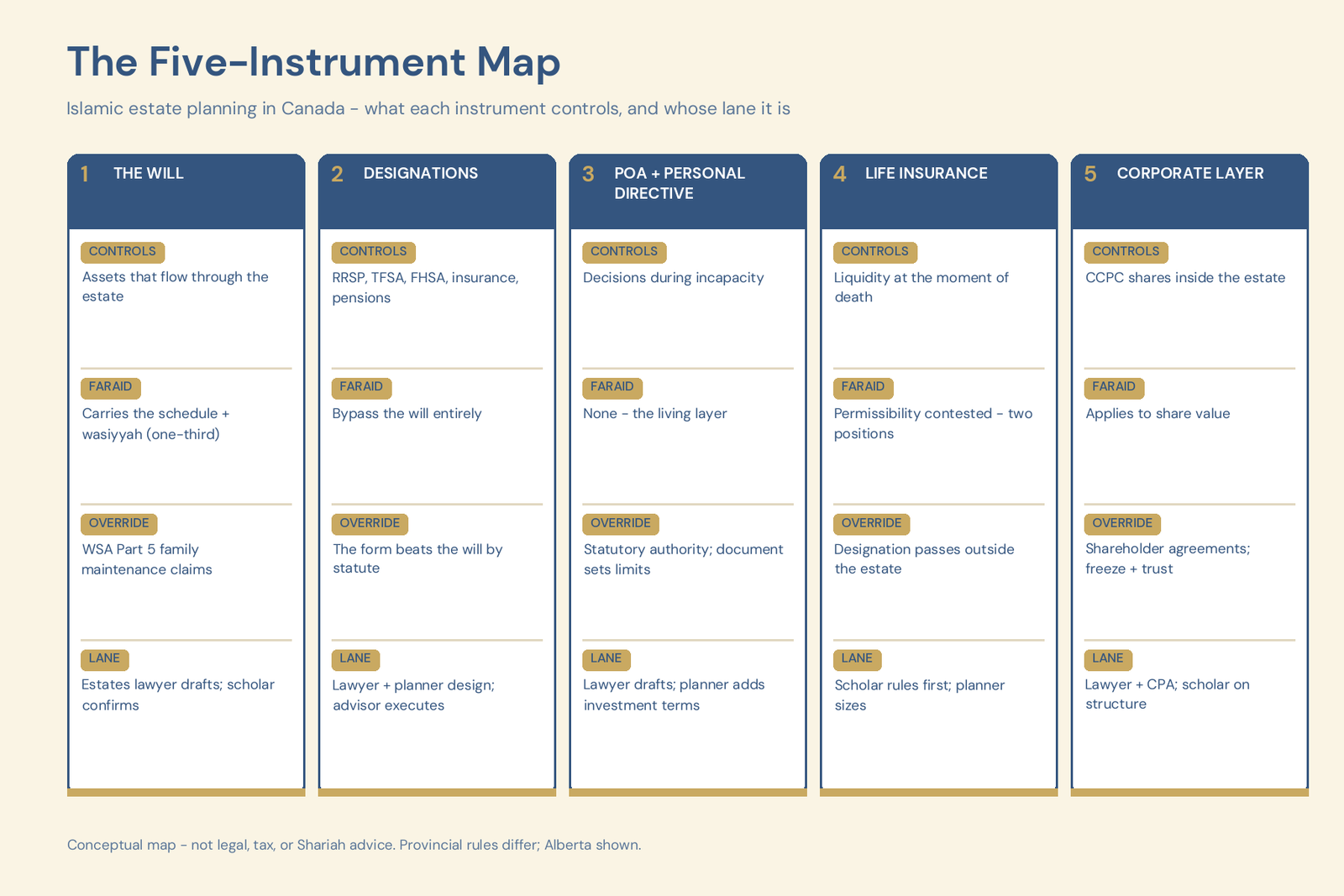
This post maps an architecture, not a document: five instruments, each answering the same four questions — what it controls, where faraid and wasiyyah interact, where Canadian law overrides intention, and whose professional lane it sits in. It does not draft wills, adjudicate fiqh, or give legal advice. It is the map I bring to the table; the drafting belongs to a provincially licensed estates lawyer, and the fiqh belongs to your scholar.
Key Takeaways
- The Islamic estate planning Canada framework is an architecture of five instruments — the will, beneficiary designations, incapacity documents, life insurance, and the corporate layer — and faraid only governs what actually flows through the will.
- Beneficiary designations bypass the will entirely: RRSP, TFSA, FHSA, and insurance proceeds pass outside the estate to whoever the form names — coordination, not drafting, is the failure point.
- Provincial law can override testamentary intention: Alberta's Wills and Succession Act lets a court order family maintenance and support from the estate despite the will. A classical faraid allocation is drafted around that reality — the estates lawyer's lane.
- Registered accounts carry tax characters at death: an RRSP balance is income on the final return unless a qualifying-survivor rollover applies, so a mechanical faraid split of the RRSP can hand the CRA a share that rivals the widow's own. Flexibility often exists — scholar and CPA, together.
- Five lanes, one architecture: the estates lawyer drafts (load-bearing here), the scholar adjudicates faraid, wasiyyah, insurance permissibility, and zakat method, the CPA owns terminal-return mechanics, the advisor executes elections, and the planner — me — frames the map.
On this page
- What I Do, What Your Scholar, Estates Lawyer, Advisor, and CPA Do
- The Quick Glossary: Wasiyyah, Faraid, Hibah
- Instrument 1 — The Will
- Instrument 2 — Beneficiary Designations
- Instrument 3 — Incapacity: Power of Attorney and Personal Directive
- Instrument 4 — Life Insurance
- Instrument 5 — The Corporate Layer
- The Headline Worked Example: Islamic Estate Planning Canada by the Numbers
- Zakat and the Estate
- Three Planning Failures I See Most
- Sources
- Frequently Asked Questions
- Related Reading on This Site
- Conclusion
What I Do, What Your Scholar, Estates Lawyer, Advisor, and CPA Do
Five lanes here — one more than the series standard, because wills and designations are legal instruments. Your scholar adjudicates the fiqh: faraid application under your school, wasiyyah validity, insurance permissibility, zakat method. Your estates lawyer drafts the will, designs the designation strategy, and owns the analysis of where provincial law can override the plan — the load-bearing lane in this post. My lane as your financial planner is the architecture: which assets flow through which instrument, liquidity at death, the tax-versus-allocation framing. Your CPA owns the terminal return, rollover mechanics, and the estate's filings. And your CIRO-registered advisor executes the beneficiary and successor elections — a small lane that quietly decides whether the other four worked.
The Quick Glossary: Wasiyyah, Faraid, Hibah
Wasiyyah is the bequest portion of an Islamic estate — classically capped at one-third of what remains after debts, directed to beneficiaries who are not already fixed-share heirs: charity, a mosque, relatives outside the faraid schedule. Validity under your school is your scholar's call; writing it into a Canadian will so it holds is your estates lawyer's.
Faraid is the fixed-share inheritance system of classical Islamic law: designated heirs receive prescribed fractions — a widow one-eighth where there are children, for example, with the residue flowing to children at a two-to-one son-to-daughter ratio under the classical Sunni schools. Application to your family is your scholar's confirmation — and in Canada the shares operate inside provincial law, which can override them as Instrument 1 describes.
Hibah is lifetime gifting — moving assets to family while alive, outside the estate entirely. Its Canadian tax caveat is the CPA's to price before anything moves: a gift of appreciated property is a deemed disposition at fair market value, and gifts to a spouse or minors can attribute income back to the giver.
Instrument 1 — The Will
What it controls. Only what actually flows through your estate — less than most people assume. Die intestate in Alberta and the Wills and Succession Act writes your will for you: if your surviving spouse or adult interdependent partner is the other parent of all your children, the entire intestate estate goes to that spouse or partner — the children receive nothing directly. In a blended family, the spouse instead takes a preferential share — the greater of $150,000 or half the estate — with the remainder divided among the children. Neither outcome resembles a classical faraid distribution; both are what the statute does when nobody decides. And adult interdependent partner status — three years of interdependent cohabitation, a child together, or a signed partner agreement — means the “spouse” the statute pays may not be whom you assume.
Where faraid and wasiyyah interact. The lawyer-drafted, faraid-aligned will is the corrective: it directs the estate's residue through a distribution schedule your scholar confirms, and carries the wasiyyah — classically up to one-third, to non-heirs — as a specific bequest clause. Canada's Islamic-will service landscape sits here too: Manzil Wills (which acquired the Muslim Will platform in 2022) generates scholar-reviewed Islamic wills online; estates firms in major cities draft faraid-aligned wills directly — named factually, not endorsed. For blended families or business owners, a licensed estates lawyer reviewing your situation is the step no platform replaces.
Where Canadian law overrides. Plainly: a will is not absolute in Canada. Under Part 5 of Alberta's Wills and Succession Act, family members — a spouse or adult interdependent partner, minor children, certain adult children — can apply within six months of the grant for family maintenance and support, and a court may redistribute from the estate despite the will. Ontario's Succession Law Reform Act runs a parallel dependants'-relief regime. This is legal reality, not a drafting flaw: an estates lawyer designs a faraid-aligned will around these claims, so the plan survives contact with the statute. One factual contrast: Alberta's probate fee is capped at $525, while Ontario's estate administration tax runs 1.5% above $50,000 — family-law exposure, not probate cost, is the override that matters here.
Whose lane. The estates lawyer drafts and owns the override analysis; the scholar confirms the schedule and wasiyyah; I frame which assets should flow through the will at all — the next instrument's question.
Instrument 2 — Beneficiary Designations
What it controls. Often more of your net worth than the will. RRSPs, RRIFs, TFSAs, FHSAs, pensions, and life insurance all carry designations, and under provincial law a designated asset passes outside the estate, directly to the named person — never entering probate, never passing through the will's faraid schedule. That is the bypass problem: the most carefully drafted Islamic will in the province cannot reach an account whose beneficiary form — signed in five seconds at account opening — says otherwise. The statute honours the form; that is the override built into this instrument's design.
Where faraid interacts — through tax characters. Each registered account dies differently. An RRSP or RRIF balance is income on the deceased's final return at full marginal rates — unless it passes to a qualifying survivor (a spouse, or a financially dependent child or grandchild), where a rollover defers the tax entirely. A TFSA hinges on one word on the form: a spouse named successor holder steps into the account and the shelter survives; a mere beneficiary receives the date-of-death value tax-free, but post-death growth is taxable and preserving room takes an exempt-contribution filing within deadlines. The FHSA — newest regime, strictest rules: a successor-holder spouse takes over only if they qualify as an eligible first-time-buyer holder themselves; otherwise the balance moves to their RRSP or RRIF or comes out as a taxable distribution by the end of the exempt period. Amounts to non-spouse beneficiaries are taxable income to them.
Where the strategy question lives. Designate, or route through the estate? Mechanical faraid purity argues for routing registered accounts into the estate so the will's schedule governs — but that surrenders the rollovers and shelters reserved for spousal designations; the worked example below prices that surrender. This is a joint design problem: the lawyer and I route assets by channel so the whole — designated assets plus estate — lands as close to the intended distribution as Canadian law and the family's tax position allow, your scholar confirming what flexibility the fiqh gives. Whose lane. Lawyer and planner jointly on strategy; your CIRO-registered advisor executes the elections — successor holder versus beneficiary is a checkbox with five-figure consequences.
Instrument 3 — Incapacity: Power of Attorney and Personal Directive
What it controls. Everything, temporarily — while you are alive but cannot decide. Alberta's pair: an enduring power of attorney for financial decisions and a personal directive for personal and health ones. Where faraid interacts: it doesn't — faraid is a death event, and that is the planning point. During incapacity your attorney controls the portfolio, and nothing obliges them to keep it Shariah-compliant unless the document says so; investment instructions — screening standard, funds, the scholar to consult — are what keep the portfolio halal until the will takes over. Where law overrides: an attorney's authority is statutory and reviewable; the wording sets its limits. Whose lane: the estates lawyer drafts both; mine is making sure the investment instructions exist and match the plan. Brief by design — but the living layer is the one most architectures skip.
Instrument 4 — Life Insurance
What it controls. Liquidity at the exact moment the estate needs it — proceeds pass outside the estate to named beneficiaries, quickly and creditor-protected in most cases. Where the fiqh interacts — and divides. Permissibility is contested; this post names the two broad positions without adjudicating. One, associated with the OIC International Islamic Fiqh Academy, holds that conventional insurance involves enough uncertainty (gharar) and interest-bearing structure (riba) to be impermissible, cooperative takaful being the compliant alternative. The other, articulated in AMJA's published research and reflected in Fiqh Council of North America reasoning, permits conventional coverage in cases of genuine need where takaful is unavailable. Which position binds you is your scholar's call — and as of mid-2026, retail takaful is effectively absent from the Canadian market, a fact at the centre of that conversation.
If permitted for you, the planning uses are factual and specific: liquidity for the terminal tax bill (Instrument 2's RRSP problem arrives as a final-return liability the estate must pay in cash), payout of a halal mortgage balance so the home passes unencumbered, and equalizing faraid shares without selling the family home — proceeds to one heir balancing home equity passing to another, within the statutory override boundaries Instrument 1 mapped. Whose lane: scholar first on permissibility; then planner on sizing, lawyer on integration with the will, advisor on the designation itself.
Instrument 5 — The Corporate Layer
What it controls. For incorporated households, often the largest asset on the balance sheet — and the most commonly orphaned in estate plans. Your CCPC's shares are estate property: at death they are deemed disposed at fair market value, any accrued gain lands on the final return, and the shares pass under the will — so the faraid schedule applies to share value, not the corporate assets underneath, and the same Part 5 claims that can reach the rest of the estate can reach the shares. Where faraid interacts: this is Pillar B's Decision 4 landing in its spoke — the corporate pillar built the portfolio; this instrument decides how its ownership transfers. Where law and structure override: a shareholders' agreement can compel transfers that pre-empt the will; an estate freeze or family trust moves future growth outside the estate entirely — mechanics in the freeze-and-trust post, with the Shariah-compatibility questions added for scholar and lawyer. If the exit is a sale rather than a bequest, the business-sale post owns those mechanics. Those posts carry the depth; this instrument's job is putting the corporate layer on the estate map at all. Whose lane: lawyer and CPA jointly on share-transfer mechanics; scholar on faraid in a frozen or trust-held structure; planner on whether the structure still matches the family's intentions.
The Headline Worked Example: Islamic Estate Planning Canada by the Numbers
Take one Alberta household and run it three ways. The estate: $1,000,000 — $600,000 of home equity, a $250,000 RRSP, a $150,000 TFSA. The survivors: a wife, one son, one daughter, all children of the marriage. Classical faraid, confirmed by the family's scholar, would allocate the widow one-eighth ($125,000), the son roughly $583,000, the daughter roughly $292,000 — subject, as everywhere here, to the provincial overrides Instrument 1 described. Mechanics only; every figure illustrative.
| No will (Alberta intestacy) | Typical default setup (joint home + spouse-designated accounts) | Faraid-aligned architecture (lawyer-drafted) | |
|---|---|---|---|
| Who controls the outcome | Provincial statute | The designations — not the will | Will + coordinated designations |
| Home equity ($600,000) | All to spouse — children of the marriage, so the WSA gives the spouse the entire intestate estate | Passes by survivorship — outside the estate, outside any will | Flows per the plan; equalization tools (including Instrument 4) keep the home intact |
| RRSP ($250,000) | To spouse under the statute; rollover generally preserves deferral | Spousal rollover — full $250,000 stays tax-deferred | The tension: a mechanical faraid split to adult children is income on the final return — roughly $120,000 of tax at Alberta's top combined rate — while a spousal rollover preserves the full $250,000. Scholar + CPA conversation; flexibility often exists |
| TFSA ($150,000) | To spouse under the statute; shelter depends on post-death handling | Successor-holder spouse — shelter survives intact | Allocation-versus-shelter trade-off made explicitly, then executed by the advisor |
| Faraid outcome achieved? | No — by accident | No — by default | Yes, within legal overrides — by design |
None of these columns is advice. The point is that the middle column is what most households have without ever deciding anything — and the right column requires three professionals plus a scholar to build. The architecture that gets you from the middle to the right is mine to frame.
Zakat and the Estate
Zakat does not end at death — it settles. AAOIFI's Shari'ah Standard No. 35 and the classical schools treat zakat that fell due unpaid during life as a debt: the majority position pays it from the estate before distribution, alongside other debts, while the Hanafi school ties payment to a bequest — exactly the divergence your scholar resolves and your will's drafting reflects. Either way the executor's checklist is the same: reconstruct the last zakat date, compute arrears with the family's scholar, settle before the schedule — faraid shares included, inside the same provincial-law boundaries as every allocation here — is distributed. Lifetime zakat on the accounts — what is zakatable inside a TFSA, RRSP, or FHSA, and the contested methodology for corporate-held assets — lives in those posts; this one's job is the handoff at death.
Three Planning Failures I See Most
1. The architecture failure: designations and joint title contradicting a careful Islamic will. A household pays for a faraid-aligned will, feels finished, and never re-papers the beneficiary forms or the home's title. The will is perfect and controls almost nothing — the home passes by survivorship, the RRSP and TFSA by designation, and the faraid schedule governs whatever is left. The fix: every election reviewed against the will, lawyer and advisor in the loop, re-reviewed when accounts move.
2. The “convenience” joint account with one adult child. The joint child often believes the account is theirs at death; Canadian courts generally presume it still belongs to the estate; the disputes that follow are slow, expensive, family-splitting. Dispute bait, squarely the lawyer's lane — if help with banking is the goal, Instrument 3's power of attorney does the job without clouding ownership.
3. The faraid-pure RRSP split that ignores the rollover. Distributing the RRSP mechanically by classical shares to adult children triggers the full income inclusion on the final return — in the worked example above, roughly $120,000 to the CRA, a share that rivals the widow's own — where a spousal rollover would have preserved every dollar, within the provincial-law boundaries framing every allocation here. This is a scholar-and-CPA conversation before it is a drafting instruction. Flexibility often exists; nobody finds it after the fact.
Sources
Primary sources for this post: Alberta's succession statute and court fee schedule, CRA's at-death pages for each registered account, AAOIFI's zakah standard, AMJA's published research, and provider pages verified at time of writing. Statutory and fiqh sources are stable; provider details move — both get re-verified before this post's publish date.
- Wills and Succession Act, SA 2010, c W-12.2 (CanLII) — intestacy, Part 5 family maintenance and support
- Alberta Courts — fee schedule (probate fees, $525 cap)
- Ontario — Estate Administration Tax
- CRA — Death of an RRSP annuitant (RC4177)
- CRA — Amounts paid from an RRSP or RRIF upon the death of an annuitant
- CRA — TFSA: if you are a successor holder
- CRA — TFSA: if you are a designated beneficiary
- CRA — Death and FHSAs
- Insurance Act, RSA 2000, c I-3 (CanLII) — beneficiary designations pass outside the estate
- Alberta Law Reform Institute — Family Maintenance and Support from the Estate (Final Report 117)
- AAOIFI — Shari'ah Standard No. 35 (Zakah)
- AMJA — Life Insurance and the Extent to Which It Is Permitted in a Case of Need (Zarabozo)
- Manzil Wills — Islamic will platform (provider page, verified at time of writing)
Frequently Asked Questions
Can a Canadian will actually follow faraid?
Yes — a lawyer-drafted will can distribute the estate through a classical faraid schedule, with the wasiyyah as a bequest clause. The honest qualifier: it operates inside real statutory overrides — in Alberta, family maintenance and support claims under Part 5 of the Wills and Succession Act can redistribute despite the will; Ontario's dependants'-relief regime is similar. A faraid-aligned will is drafted around those claims, which is why the estates lawyer is the load-bearing lane.
Do beneficiary designations on my RRSP and TFSA override my Islamic will?
In effect, yes. A designated RRSP, TFSA, FHSA, pension, or insurance policy passes outside your estate directly to the named person — the will never touches it, however careful its faraid schedule. Coordination is the fix: every designation reviewed against the will as one architecture, the trade-offs (spousal rollovers, successor-holder shelter) priced before choosing. Lawyer and planner design it jointly; your CIRO-registered advisor executes the forms.
Is life insurance permissible in an Islamic estate plan?
It is genuinely contested, and this site doesn't adjudicate fiqh. One broad position — associated with the OIC International Islamic Fiqh Academy — holds conventional insurance impermissible on gharar and riba grounds, with takaful the compliant route; another — in AMJA's published research and Fiqh Council of North America reasoning — permits conventional coverage in cases of genuine need where takaful is unavailable — currently Canada's retail reality. Your scholar's ruling governs. If permitted for you, the factual uses are terminal-tax liquidity, mortgage payout, and equalizing shares without selling the home — within the same legal boundaries as the rest of the plan.
What's the difference between what my scholar, estates lawyer, planner, advisor, and CPA do?
Five lanes. Scholar: faraid application under your school, wasiyyah validity, insurance permissibility, zakat method. Estates lawyer: drafts the will and incapacity documents, designs the designation strategy, owns the override analysis — load-bearing in estate work. Planner (me): the architecture — which assets flow through which instrument, liquidity at death, the tax-versus-allocation framing. CIRO-registered advisor: executes the elections at the account level. CPA: the terminal return, rollovers, the estate's filings. One architecture, five sets of hands.
Related Reading on This Site
- Halal Investing Inside Your CCPC — The 2026 Corporate Framework — the parent pillar; this post is its Decision-4 spoke.
- Halal Investing in Canada — The 2026 Decision Framework — Pillar A, where the personal stack begins.
- TFSA, RRSP and FHSA Through a Shariah Lens — the accounts whose at-death tax characters this post inherits.
- Halal Home Financing in Canada (2026) — the home equity and payout mechanics behind Instruments 1 and 4.
- Halal ETFs in Canada — A Planner's Comparison — the holdings an attorney's investment instructions would preserve.
- The Estate Freeze + Family Trust Playbook — Instrument 5's structural mechanics.
- Capital Gains Tax When Selling a Canadian Business — the sale-not-bequest exit.
Conclusion
Islamic estate planning in Canada is not a document you buy; it is an architecture you coordinate. Five instruments, four questions each — and a default setup that quietly answers all four against your intentions. The will only governs what reaches it; the designations decide what does; the incapacity documents protect compliance while you live; insurance, if permissible, buys the liquidity faraid arithmetic needs; and the corporate layer holds the largest and least-planned asset of all. None of it is mine to draft, rule on, or file. The map — and the meeting where five lanes finally look at one architecture together — is.
Want a planner's read on your family's estate architecture? Book a complimentary 15-minute call → Book a discovery call
Important disclosure
General educational information only — not personalized financial, investment, tax, legal, or Shariah-compliance advice. Nothing here is legal, tax, or Shariah advice. Will drafting, beneficiary-designation strategy, and estate-law questions are the lane of a provincially licensed estates lawyer. Faraid application, wasiyyah validity, insurance permissibility, and zakat method are the role of a qualified scholar. Terminal-return and rollover mechanics are confirmed by a qualified CPA on filing. Provincial rules differ — this post uses Alberta as its primary example; verify your province's rules before acting. Platforms and providers named in this post (including will-preparation services) are factual references to the 2026 landscape; mention is not endorsement or solicitation. Statutory figures, fees, and tax rates are stated as of publish date — verify against the cited primary sources before acting. Consult all five professionals named here before acting on anything in this post.
Author bio: Jahid Hassan is a CFA Charterholder and CFP Professional based in Calgary, Alberta, specializing in comprehensive financial planning for Canadian incorporated business owners, newcomers to Canada, and Muslim investors building Shariah-compliant portfolios. Connect on LinkedIn.