The Account Question
Every halal-investing conversation I have eventually arrives at the same pair of questions, usually in the wrong order. The question people ask first is which fund. The prior question — the one that moves the math — is which account, in what order. If you have searched for a halal TFSA in Canada, you have likely met two confident, opposite answers: that TFSAs are interest-based products to avoid, and that anything held inside a TFSA is automatically fine. Both are wrong, and both make the same mistake — treating the account as the thing that is or isn’t halal. This post is Decision 2 of the four planning decisions in the pillar framework: what each wrapper is, what belongs inside each one for a Shariah-compliant portfolio, and the order a household fills them. No fund picks, no rulings — those are other lanes, and I will mark them as we go.
Key Takeaways
- The halal TFSA Canada question resolves to one distinction: a TFSA, RRSP or FHSA is a tax wrapper, neither halal nor haram — compliance lives in the holdings and the defaults inside the account, and that adjudication is your scholar’s.
- What a scholar actually checks: idle-cash interest, “high-interest savings” products marketed as TFSAs, and employer-default RRSP funds — each replaceable without abandoning the wrapper.
- The 2026 room map: TFSA $7,000 (cumulative $109,000 since 2009); RRSP 18% of 2025 earned income to a $33,810 maximum; FHSA $8,000 a year toward a $40,000 lifetime limit.
- Asset location is where the halal lens bites: US-listed halal ETFs lose 15% of distributions to US withholding in a TFSA or FHSA but 0% in an RRSP, and the halal fixed-income substitute is fully taxable unregistered — shelter-first logic.
- The fill order is conditional, not universal: FHSA first if a first home is plausibly in scope, RRSP-versus-TFSA by marginal rate, taxable last — and the unused-FHSA fallback (tax-free transfer to an RRSP) gives the home question asymmetric option value.
On this page
- What I Do, What Your Scholar, Advisor, and CPA Do
- Decision 0 — The Halal TFSA Canada Baseline: Is the Wrapper Itself Compliant?
- Decision 1 — The 2026 Room Map
- Decision 2 — Asset Location for a Halal Portfolio
- Decision 3 — The Fill Order
- The Headline Worked Example
- Decision 4 — The Home-Buying Cascade
- Three Planning Failures I See Most
- Sources
- Frequently Asked Questions
- Related Reading on This Site
- Conclusion
What I Do, What Your Scholar, Advisor, and CPA Do
Halal account architecture sits at the intersection of four professional lanes. Your scholar adjudicates Shariah compliance — the holdings, and any interest-bearing defaults hiding inside an account. Your registered investment advisor or portfolio manager (CIRO-registered) selects the specific products that go in each account. Your CPA owns the contribution-room math on your T1 — deductions, over-contribution penalties, FHSA filings. My lane as a financial planner is this post’s subject: the account-architecture framework — which wrappers, in what order, holding which asset classes — so the other three conversations happen in the right sequence. Nothing here is a product recommendation or a ruling.
Decision 0 — The Halal TFSA Canada Baseline: Is the Wrapper Itself Compliant?
A registered account is a contract with the CRA about taxation, not an investment. The wrapper does three things: it defines how much you can put in, it sets the tax treatment of money going in, and it sets the tax treatment of money coming out. None of those three functions involves riba, gharar, or any prohibited activity — they are administrative properties of a container. That is the wrapper-neutrality argument at the centre of the halal TFSA Canada debate, and it cuts both ways: the wrapper can’t corrupt a compliant holding, and it can’t launder a non-compliant one.
So why does so much online content insist a TFSA is haram? Because of what sits inside these accounts by default — three things your scholar will actually look at. First, idle cash: uninvested cash in many accounts accrues credit interest automatically; the wrapper doesn’t cause that, the cash product does. Second, “savings-account TFSAs”: banks market high-interest savings accounts and GICs as TFSAs, so the most visible “TFSA” many households meet is an interest-bearing product inside a neutral wrapper — the source of the “TFSAs are haram” shortcut, and a claim about contents, not container. Third, employer defaults: group-RRSP contributions typically land in a conventional bond-holding target-date fund unless the election is changed. All three are fixable inside the wrapper. What passes is your scholar’s call; that there is something real to check is the planning point.
Wrapper vs holdings. The account — TFSA, RRSP, FHSA — is a tax wrapper: a CRA-registered container that sets contribution room and tax treatment. The holdings are whatever sits inside: funds, shares, cash products. Shariah compliance attaches to the holdings and to any interest the cash earns by default, not to the wrapper. A compliant portfolio inside a TFSA stays compliant; an interest-paying savings product inside a TFSA does not become compliant because the wrapper is registered.
Decision 1 — The 2026 Room Map
Once the wrapper question is settled, the next layer is mechanical: how much space exists, on what clock. TFSA room accrues to every Canadian resident from the year they turn 18 (or become resident, if later) — no income required. RRSP room is earned — 18% of last year’s earned income, capped, reduced by pension adjustments. FHSA room starts only when you open your first FHSA; it never accrues retroactively, which makes it the one clock you can start by acting. These three clocks drive the sequencing later.
| Account | 2026 limit | Carry-forward | The clock | Watch for |
|---|---|---|---|---|
| TFSA | $7,000 | Unused room carries forward indefinitely; cumulative room is $109,000 for someone 18+ and resident since 2009. Withdrawals restore room January 1 of the following year. | Accrues each year you are 18+ and a Canadian resident — no income test. | Tax of 1% per month on the highest excess amount; non-resident contributions attract a separate 1% per month. |
| RRSP | 18% of 2025 earned income, to a maximum of $33,810, minus pension adjustments | Unused room carries forward indefinitely; the deduction itself can also be deferred to a higher-income year. | Built from earned-income history — newcomers start at zero until a Canadian filing year is banked. | $2,000 lifetime over-contribution buffer; beyond it, 1% per month. |
| FHSA | $8,000 per year; $40,000 lifetime | Unused annual room carries forward, to a maximum of $8,000 — one year’s worth. | Starts only when the first FHSA is opened; participation ends at the earliest of 15 years, the year you turn 71, or the year after the first qualifying withdrawal. | If no home is bought, the balance can transfer to an RRSP or RRIF tax-free — without consuming RRSP room. |
Newcomer nuance: TFSA room starts at residency, not 2009 — the $109,000 figure is not yours if you arrived later; RRSP room needs a Canadian earned-income year on file; FHSA eligibility needs residency, age 18, and first-time-buyer status. Mechanics are in the newcomer RRSP/TFSA guide; sequencing in the 3-year newcomer roadmap.
Decision 2 — Asset Location for a Halal Portfolio
Asset location asks: given the holdings your advisor eventually selects, which wrapper holds which? For conventional portfolios, a refinement; for halal portfolios, sharper — the menu is thinner, so the tax properties of the few building blocks matter more per dollar of room. Three placement facts, drawn from the halal ETF comparison, carry the weight.
Fact one: the withholding asymmetry. The US-listed halal equity ETFs accessible to Canadians (HLAL, SPUS, MNZL) pay distributions the US taxes at source. In an RRSP the withholding is 0% — the Canada–US treaty (Article XXI) exempts retirement trusts. In a TFSA or an FHSA the same distributions lose 15%, unrecoverably — the exemption covers neither account, worth stating twice because the FHSA looks retirement-adjacent and is not treated that way. Fact two: the CAD-listed exception. WSHR, the one Canadian-listed halal equity ETF, does not present this account-level asymmetry — the TFSA-versus-RRSP withholding question simply doesn’t arise for it. Fact three: the fixed-income substitute. The Manzil Mortgage Fund — the principal halal fixed-income substitute available to Canadian retail investors — pays income-like distributions, fully taxable unregistered. Of the three building blocks it has the strongest claim on sheltered space; held outside, every distribution gives back a slice at your full marginal rate.
| Holding | In a TFSA / FHSA | In an RRSP | Unregistered |
|---|---|---|---|
| US-listed halal equity ETFs (HLAL, SPUS, MNZL) | 15% US withholding on distributions — not recoverable | 0% — treaty-exempt (Article XXI) | 15% withheld but generally creditable via the foreign tax credit; distributions and gains taxable |
| WSHR (CAD-listed) | No account-level US-withholding asymmetry | No account-level US-withholding asymmetry | Distributions and gains taxable |
| Manzil Mortgage Fund (halal fixed-income substitute) | Distributions sheltered | Distributions sheltered | Distributions fully taxable as income — least tax-efficient placement |
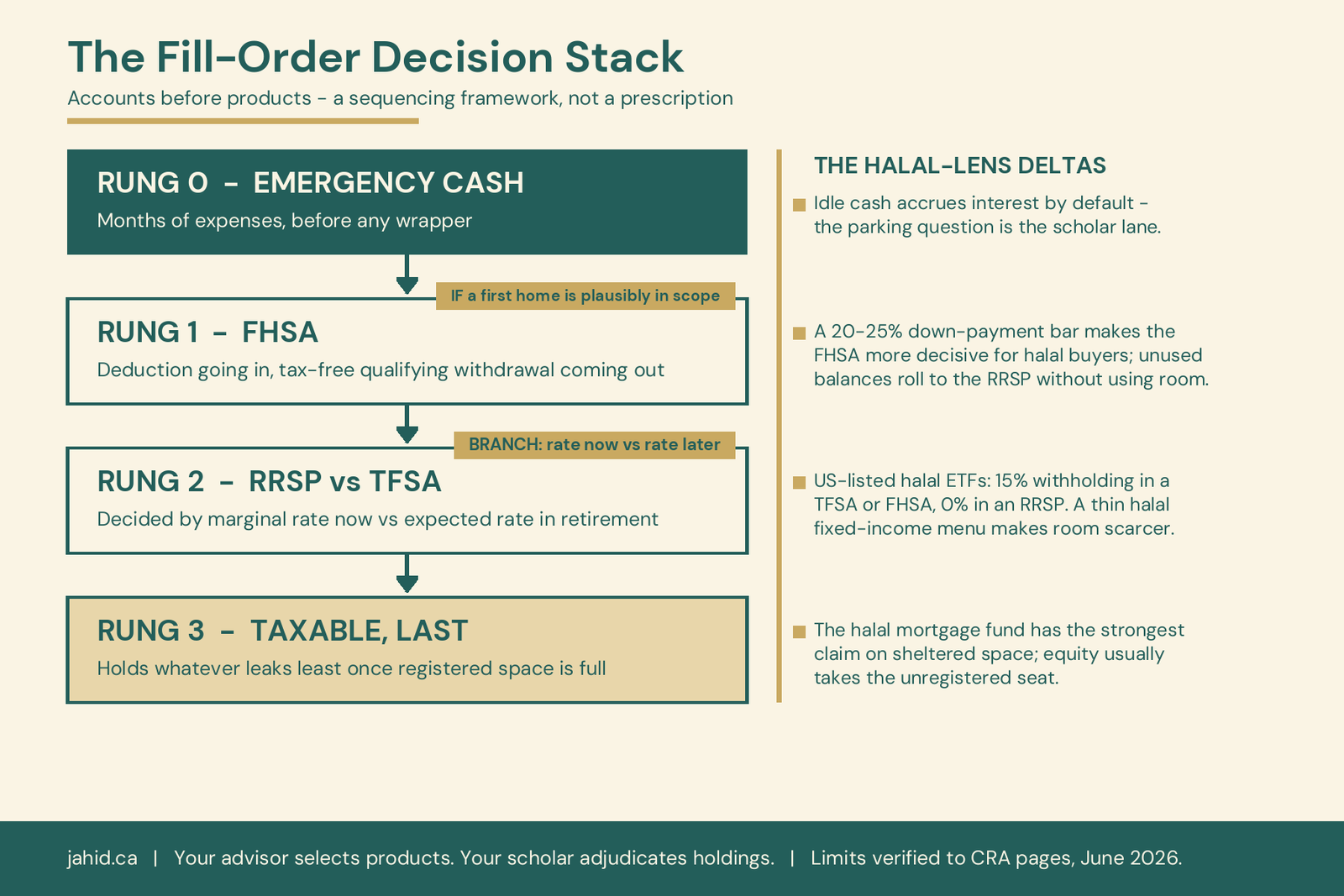
The halal lens doesn’t change that asset location matters; it changes how much. US-listed halal equity in the wrong wrapper pays a recurring avoidable toll; the mortgage fund unregistered pays a larger one. The diagram below is where those placement facts meet the room map.
Decision 3 — The Fill Order
The fill order is a ladder of conditionals, not a ranking of accounts. Climb it in sequence and most of the architecture resolves itself.
Rung 0 — emergency cash, before any wrapper. A cash buffer measured in months of expenses comes before optimization. The halal parking problem — conventional high-interest accounts pay riba, and the compliant alternatives are profit-sharing products whose acceptability is your scholar’s call — is real, and one sentence is all it gets here; flagging it beats pretending it away.
Rung 1 — FHSA, if a first home is plausibly in scope. The FHSA is the only account where both ends are favourable: contributions deduct like an RRSP, and a qualifying withdrawal comes out tax-free like a TFSA. If a first home is plausibly in your next fifteen years, this rung typically leads the conditional logic — with extra weight for halal buyers, because halal financing’s typical 20–25% down-payment bar (Decision 4) means more dollars need staging. If the home never happens, the balance transfers to your RRSP tax-free without consuming RRSP room — the option expires into something useful, which is why “not sure yet” is an argument for the planner conversation, not against the account.
Rung 2 — RRSP versus TFSA, by marginal rate. The deciding variable is your marginal tax rate now versus your expected rate in retirement. Higher now: the RRSP deduction is worth more, and the withdrawal is taxed later at the lower rate. Lower now — early career, parental leave, a building business: the TFSA preserves the deduction opportunity for later and keeps withdrawals unconditionally tax-free. This logic is religiously neutral; the halal lens does not change a single term of it. What the lens changes is the value of registered space: with the fixed-income substitute tax-inefficient unregistered and the US-listed funds carrying the withholding asymmetry, each sheltered dollar does more work in a halal portfolio — an argument for treating room as scarce, not for any particular account.
Rung 3 — taxable, last. Once registered space is spoken for, unregistered is where the remainder goes, with Decision 2 deciding what lands there — the holdings that leak least. The ladder is a framework; the conditionals are the point. Which rung your household is on, and what fills it, depends on your full situation — the planning conversation.
The Headline Worked Example
Mechanics, made concrete — the same household as the home-financing post’s first persona: a couple, $140,000 household income, $12,000 a year to invest, holding a $50,000 position in a US-listed halal equity ETF distributing roughly 1.2% a year. One question: TFSA or RRSP, for that holding?
| Held in a TFSA | Held in an RRSP | |
|---|---|---|
| US withholding on distributions | 15% — not recoverable | 0% — treaty-exempt |
| Annual drag on the $50,000 position (~1.2% yield) | ~$90 per year | $0 |
| Cumulative withholding over 25 years (position growing 6% per year) | ~$4,900 | $0 |
| Tax on contribution | After-tax dollars | Deductible at marginal rate |
| Tax on withdrawal | $0 | Taxable at retirement-year rate |
The withholding line is arithmetic; the contribution and withdrawal lines depend on your marginal rates — that’s the planner conversation. Which fund sits in either account is your advisor’s lane.
Decision 4 — The Home-Buying Cascade
If a home is in scope, Decisions 1 through 3 feed a fourth: the down-payment stack. An FHSA can stage up to $40,000 per buyer; the Home Buyers’ Plan can add up to $60,000 from an RRSP — repayable over fifteen years starting the second year after withdrawal, the 2022–2025 relief window having closed for new withdrawals. That is up to $100,000 of registered-sourced down payment per person, $200,000 per couple — and because halal financing typically asks 20–25% down rather than a conventional minimum, the stack is more decisive for halal buyers than for anyone else. The providers, structures, and trade-offs are their own post: Halal Home Financing in Canada (2026).
Three Planning Failures I See Most
One: compliant intentions, interest-bearing defaults. A household opens a TFSA, plans to pick a halal fund “once we’ve researched,” and the cash sits in the default interest-bearing sweep for eighteen months. The wrapper was never the problem; the waiting was. If the research phase has a timeline, the idle-cash question needs an answer on day one, not at the end.
Two: the withholding drag nobody notices. US-listed halal equity sits in a TFSA for years — $90 here, $110 there, compounding quietly into thousands — because the household never knew the RRSP placement question existed. The drag is invisible on statements; it is withheld before the distribution lands, which is exactly why it persists.
Three: skipping the FHSA because “we might not buy.” Uncertainty about the home gets treated as a reason to pass — but the fallback design makes that backwards: unused, the balance moves to an RRSP tax-free without consuming RRSP room. The downside case is extra retirement space; the upside case is a deduction plus a tax-free withdrawal. Your CPA confirms the transfer mechanics; the asymmetry is the planning observation.
Sources
- CRA — Calculate your TFSA contribution room
- CRA — If you over-contribute to a TFSA
- CRA — MP, DB, RRSP, DPSP, ALDA, TFSA limits and YMPE
- CRA — First Home Savings Account (FHSA)
- CRA — Participating in your FHSAs
- CRA — The Home Buyers’ Plan
- Canada–US Income Tax Convention — Article XXI (IRS treaty text)
- IRS Publication 597 — Information on the United States–Canada Income Tax Treaty
- AAOIFI — Accounting and Auditing Organization for Islamic Financial Institutions
- Wealthsimple Shariah World Equity Index ETF (WSHR) product page
- SP Funds S&P 500 Sharia Industry Exclusions ETF (SPUS)
- Wahed FTSE USA Shariah ETF (HLAL) — ETFdb
- Manzil Mortgage Fund (Canada)
Frequently Asked Questions
Is a TFSA halal? What about RRSPs and the FHSA?
The accounts are tax wrappers — containers setting contribution room and tax treatment — and a container is neither halal nor haram. What requires adjudication sits inside: the funds, and crucially the cash, which in many accounts earns interest by default until invested. A TFSA holding a Shariah-screened portfolio and a TFSA holding a high-interest savings product are the same wrapper around opposite contents. The adjudication is your scholar’s; surfacing the defaults worth checking is the planner’s job.
Should halal ETFs go in my TFSA or RRSP first?
It depends on the listing and on your marginal rates. US-listed halal ETFs (HLAL, SPUS, MNZL) lose 15% of distributions to US withholding in a TFSA or FHSA but 0% in an RRSP under the Canada–US treaty — that part is arithmetic. Whether the RRSP or TFSA comes first overall depends on your marginal rate now versus retirement — that part is conditional, and it is the planner conversation. Which specific fund goes in either account is product selection: your CIRO-registered advisor’s lane.
Does the FHSA make sense if I’m not sure I’ll buy a home?
Uncertainty is what the design accommodates. If you buy, contributions were deductible and the qualifying withdrawal is tax-free. If you never buy, the balance can transfer to your RRSP or RRIF tax-free without consuming RRSP room — the unused option collapses into extra retirement space, not a penalty. That asymmetry is why “not sure” belongs in the planning conversation rather than ending it; your CPA confirms the mechanics, and eligibility (resident, 18+, first-time buyer) still has to hold.
What’s the difference between what my scholar, planner, advisor, and CPA do?
Four lanes. Your scholar adjudicates Shariah compliance — holdings, and any interest-bearing defaults inside an account. Your CIRO-registered investment advisor or portfolio manager selects products and assesses suitability within each account. Your CPA handles the T1 mechanics — contribution-room reconciliation, deductions, over-contribution penalties, FHSA filings. The financial planner builds the framework those three execute against: which accounts, in what order, holding which asset classes. This post is the planner’s lane applied to one decision.
Related Reading on This Site
- Halal Investing in Canada — The 2026 Decision Framework for Muslim Investors — the pillar framework; this post is its Decision 2.
- Halal ETFs in Canada — A Planner’s Comparison — Decision 3: the fund landscape behind the placement facts used here.
- Halal Home Financing in Canada (2026) — Decision 4: where the FHSA + HBP stack lands.
- Halal Investing Inside Your CCPC — Pillar B: the corporate-side account architecture for incorporated owners.
- Estate Planning + Zakat for Muslim Canadians — what happens to registered accounts at death, and the zakat overlay.
- RRSP and TFSA for Newcomers to Canada in 2026 — eligibility and room-start rules referenced in Decision 1.
- The 3-Year Newcomer Financial Roadmap — where account-opening fits a newcomer’s first three years.
Conclusion
The wrapper is neutral; the order is the decision. That is the whole halal TFSA Canada answer in one line — the container is the CRA’s, the holdings and defaults are your scholar’s. From there, a ladder of conditionals: emergency cash, FHSA if a first home is plausibly in scope, RRSP-versus-TFSA by marginal rate, taxable last — with the withholding asymmetry and the thin halal fixed-income menu deciding what sits where. None of it picks a fund or needs one picked yet. Sequencing is where households leave money on the table, and it is recoverable with a framework rather than a verdict.
Want a planner’s read on your account architecture? Book a complimentary 15-minute call → Book a discovery call
Important disclosure
General educational information only — not personalized investment, tax, or Shariah-compliance advice, and not a recommendation to open, prioritize, or contribute to any specific account or to buy, sell, or hold any security. Account suitability and contribution decisions depend on your full personal situation. Product selection within any account is the role of a CIRO-registered investment advisor. Shariah-compliance adjudication is the role of a qualified scholar. Contribution limits and tax rules are stated as of publish date — verify against CRA pages before acting. Funds named in this post (WSHR, HLAL, SPUS, MNZL, Manzil Mortgage Fund) are referenced as factual examples of the 2026 landscape; mention is not endorsement or solicitation. Tax filing and contribution-room reconciliation are the role of a qualified Canadian CPA. Consult all four professionals before acting on anything in this post.
Author bio: Jahid Hassan is a CFA Charterholder and CFP Professional based in Calgary, Alberta, specializing in comprehensive financial planning for Canadian incorporated business owners, newcomers to Canada, and Muslim investors building Shariah-compliant portfolios. Connect on LinkedIn.