By late October most incorporated owners feel a familiar nudge: I should probably do something before year-end. Then the thought gets filed next to “renew the registration” and “find the receipts” — a chore for the accountant, not a decision for the owner. That instinct is the single most expensive misread of the calendar there is. Year-end tax planning for business owners in Canada is not a filing chore. It is the one annual review where several high-value decisions all come due at once — and most of them close for good on December 31 (or at your fiscal year-end). Miss the window and it does not reopen; you simply pay more than you needed to, quietly, for a full year.
This post is the hub. It walks the five decisions that come due, shows you which clock governs each one, tells you the order to make them in, and hands you a short list to bring to your accountant. It is deliberately not a checklist of forms. Think of it as the agenda for a December planning meeting with yourself — the meeting that decides how much tax you volunteer to pay in the spring.
Key Takeaways
- Year-end is a planning review, not a deadline scramble. The deadlines exist only to force five decisions: your compensation mix, your gains and losses, your registered top-ups, your giving, and how much cash you actually need to pull out.
- You run on two clocks. Your corporation answers to its fiscal year-end; you, personally, answer to December 31. Several decisions have to satisfy both at once.
- For 2026 the personal registered numbers are: TFSA $7,000, FHSA $8,000 (lifetime $40,000, hard December 31 deadline, no grace), and the RRSP dollar limit $33,810 — with the RRSP being the one account that grants a 60-day grace period into early 2027.
- The capital-gains inclusion rate stayed at one-half; the proposed increase to two-thirds was cancelled in 2025. The lifetime capital gains exemption is $1.275 million for 2026 (the $1.25 million limit set in 2024, now indexed to inflation). Tax-loss selling is therefore a normal, calm year-end tool again — the last trade date for 2026 settlement is December 30 under T+1.
- If you want a bonus deductible in the corporation’s current year, it must be paid within 179 days of fiscal year-end. Accrue-now-pay-later only works inside that window.
- Decide in order — cash needs first, then compensation, then gains/losses, then registered top-ups, then giving — and walk into your accountant’s office in November with the decisions made, not the receipts dumped.
On this page
- December is a planning review, not a deadline scramble
- The five decisions that close at year-end
- Your two clocks: fiscal year-end vs December 31
- Walking the five decisions
- Sequencing: what to decide first
- What to bring to your accountant, and when
- The 2027 setup: decisions now that buy room later
- Sources
- Frequently Asked Questions
- How is year-end tax planning for business owners in Canada different from just filing taxes?
- If the RRSP deadline runs into March, why decide in December?
- Is tax-loss selling still worth doing now that the inclusion rate didn’t change?
- Should I pay myself a bonus before year-end?
- It’s already late December — what can I still do?
- Related Reading on This Site
- Conclusion
December is a planning review, not a deadline scramble
The scramble framing is seductive because it feels like action. You gather slips, you chase a receipt, you forward a folder, and the dread lifts. But notice what that activity actually is: it is documentation of decisions you already made — or, more often, decisions you let the calendar make for you by default. The salary you happened to draw, the dividends you happened to declare, the investments you happened not to sell. By December, the scramble is just bookkeeping for a year that already happened.
The review framing is different. It treats late October through December as the last stretch of road where you still have the wheel. A handful of levers are still yours to pull — how you take money out of the company, whether you realize a gain or harvest a loss, what you put into registered accounts, what you give — and each lever moves real dollars between you, your corporation, and the Canada Revenue Agency. Pull them on purpose and you shape the outcome. Leave them and the default shapes it for you, almost always less favourably.
That is the reframe this whole post rests on. You are not preparing to be measured. You are making the last decisions of the financial year while they are still live. The deadlines — December 31, your fiscal year-end, the 179-day bonus window, the last settlement date — are not the point. They are just the fences that tell you when the field closes.
Where I sit in this, and where your accountant sits. My job as your financial planner is the decisions — the compensation mix that fits your household cash needs, whether realizing a gain this year or next serves your bigger plan, how registered room and giving fold into a multi-year picture. Your CPA’s job is to execute and file those decisions correctly: the T4s and T5s, the corporate return, the deductions claimed in the right year. Most owners hand their accountant a shoebox in March and call that “tax planning.” It is not. By March the decisions are locked. The planning happens now, in the review — and the cleanest gift you can give your accountant is a short list of decisions already made.
The five decisions that close at year-end
Strip away the forms and the year-end review comes down to five decisions. They are not equally urgent and they are not independent — pull one and the others shift — but every owner faces all five, every year.
One, your compensation mix. How much you take as salary, how much as dividends, whether a year-end bonus makes sense, and how that interacts with your spouse and any family shareholders. Two, your gains and losses. Whether to realize a capital gain this year or defer it, and whether to harvest losses against gains already banked. Three, your registered top-ups. TFSA, RRSP and FHSA — the personal accounts whose room is either used or lost, each on its own clock. Four, your giving. Charitable gifts, made personally or through the corporation, timed to land in the year where the credit or deduction does the most work. Five, your owner cash needs. The quiet one that drives the other four: how much money you and your household actually need out of the company over the next twelve months, because that number sets the floor under your compensation and shapes everything else.
Notice that none of these is “file form X.” They are all choices — and choices have an order, which is why the cash-needs decision comes first and giving comes last. We will get to the order. First, the reason owners find this harder than employees do: you are not watching one calendar. You are watching two.
Your two clocks: fiscal year-end vs December 31
An employee has one year-end: December 31. As an incorporated owner you have two, and they rarely line up. Your corporation has a fiscal year-end — it might be December 31, but it might just as easily be July 31, March 31, or any date you chose at incorporation. You, personally, are always a calendar-year taxpayer ending December 31. Every year-end decision has to be checked against the clock that actually governs it, and some have to satisfy both.
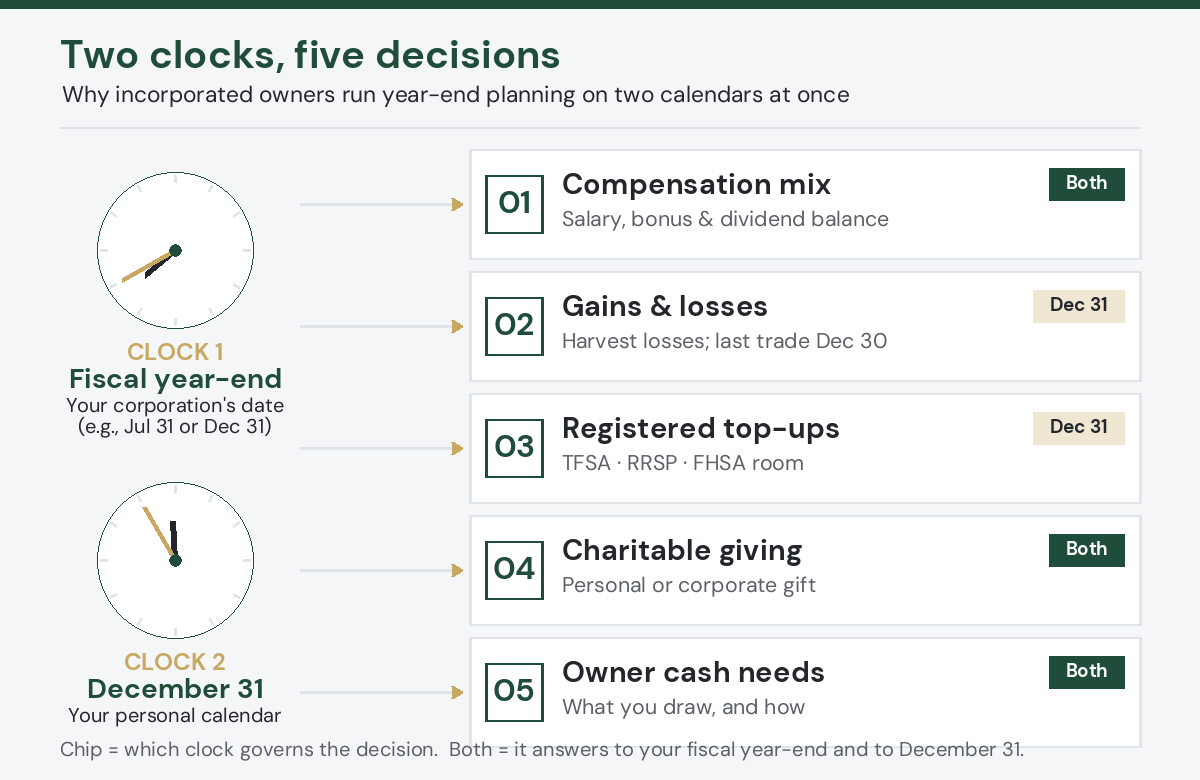
What the corporate clock governs. The deductibility of a salary or bonus, the timing of corporate investment gains and losses, and a corporate charitable gift all hang off your fiscal year-end. The classic example is the bonus: a bonus your corporation accrues is only deductible in that fiscal year if it is actually paid within 179 days of year-end. That rule lets you book the deduction now and fund the cash a little later — but only inside the window, and the personal tax on that bonus lands in your calendar year when it is received.
What the personal clock governs. Your TFSA and FHSA room, your personal capital gains and losses, your salary and dividend income for the year, and your personal donation credits all run to December 31. There is no fiscal-year flexibility here — if it has to happen in 2026 for you personally, it has to happen by December 31, 2026 (with the single, important RRSP exception below).
When the two clocks disagree — say your corporation runs to July 31 but you are deciding in December how much salary to draw — you are juggling a corporate deduction that may belong to the next fiscal year against personal income that belongs to this calendar year. That is exactly the kind of two-clock problem worth raising with your planner and accountant rather than guessing. For owners whose fiscal year-end is not December, the practical move is to run a mid-year compensation review at fiscal year-end and a second, lighter review in December for the purely personal items.
Walking the five decisions
Here is each decision in turn, with the deeper guide for the ones that deserve a full sitting of their own.
Decision 1 — Your compensation mix
This is the keystone. The salary-versus-dividend choice sets your RRSP room (only salary creates it), your CPP contributions, your personal cash flow, and how much is left inside the company to invest or pay out later. At year-end the live question is not the whole strategy — that is a year-round design — but the timing: do you top up with a bonus before the corporate year closes, declare a dividend before December 31, or hold off and shift income into next year? The answer depends on where this year’s income leaves you in the personal brackets, whether a bonus clears the 179-day window, and what next year is likely to look like. If your income is unusually high this year and lower next, deferring helps; if the reverse, accelerating does. Walk through the mechanics and the timing levers in the deep-dive: year-end salary and dividend timing. For the underlying salary-versus-dividend framework, see the definitive salary vs dividends guide, and if family members hold shares, read it alongside how the TOSI rules shape family compensation.
Decision 2 — Your gains and losses
With the inclusion rate holding at one-half, this decision is back to being a calm, ordinary tool rather than a panic about a looming rule change. If you have realized gains this year — personally or in a non-registered corporate account — harvesting losses to offset them can lower the tax bill, and unused capital losses carry back three years or forward indefinitely. The one hard date is settlement: to have a sale count for the 2026 tax year, it must settle in 2026, and under the T+1 cycle the last trade date is December 30, 2026. Mind the superficial-loss rule too — buying back the same security within 30 days denies the loss. This is a decision to make with your investment advisor on execution and your planner on whether realizing now fits the bigger picture; the full mechanics, dates and traps are in the deep-dive on tax-loss selling in Canada.
Decision 3 — Your registered top-ups
Three accounts, three different clocks — this is where owners lose room by accident. The FHSA ($8,000 for 2026, $40,000 lifetime) has a hard December 31 deadline with no grace period, so if a first home is anywhere in your plans, this is genuinely use-it-or-lose-it. The TFSA ($7,000 of new room for 2026) carries unused room forward indefinitely, so there is no “deadline” as such — but if you plan to withdraw, doing it before December 31 means the withdrawn amount is added back to your room sooner, on January 1. The RRSP (2026 dollar limit $33,810, your personal limit being 18% of prior-year earned income up to that cap) is the exception that confuses everyone: contributions in the first 60 days of 2027 can still be deducted on your 2026 return. That grace is real, but it is also why owners drift — “I’ll do it in February” becomes “I forgot.” Decide the number in December even if you fund the RRSP in the new year. The interaction between these accounts and your compensation mix is the whole point of the deep-dive on TFSA, RRSP and FHSA year-end deadlines.
Decision 4 — Your giving
Charitable giving is where year-end timing and personal values meet, and where the corporate-versus-personal choice actually changes the math. A personal donation generates a tax credit and must be made by December 31 to count for 2026; a corporate donation is a deduction against corporate income and follows the fiscal-year clock. Donating publicly traded securities with an accrued gain in kind — rather than selling and donating cash — can eliminate the capital gain entirely while still giving you full credit for the fair market value, one of the most efficient moves available to an owner with appreciated holdings. Larger or recurring giving may belong in a more deliberate structure. The deep-dive walks the personal-versus-corporate decision and the in-kind mechanics: charitable giving for business owners.
Decision 5 — Your owner cash needs
This is the decision with no form attached and the one that drives the other four, which is why it has no separate deep-dive — it is the thread running through all of them. Before you can sensibly set your compensation, you need a clear number for how much cash you and your household actually need out of the company over the next twelve months: lifestyle, tax instalments, the RRSP/TFSA/FHSA contributions you just decided on, any large planned purchases. That number sets the floor under your salary-and-dividend mix. Pull out far more than you need and you pay personal tax on money that could have stayed in the corporation compounding; pull out too little and you raid the company awkwardly mid-year or lean on a shareholder loan. Getting this number right is also the bridge to the longer game — turning the corporation into a retirement paycheck — which is the subject of the Cluster 4 pillar on corporate retirement decumulation. If a holding company is part of your structure, how cash moves between operating company, holdco and you personally is covered in do I really need a holding company.
Sequencing: what to decide first
The decisions are linked, so order matters. Make them in the wrong sequence and you redo work; make them in the right one and each answer narrows the next.
First, owner cash needs. Settle the twelve-month number before anything else, because it sets the floor under your compensation. Second, compensation mix. With the cash number in hand, decide salary versus dividends and whether a year-end bonus clears the 179-day window — and remember salary is what creates next year’s RRSP room, so this choice feeds decision three. Third, gains and losses. Now that you know your rough personal income for the year, you can see whether realizing a gain pushes you into a higher bracket or whether harvesting losses is worthwhile — and the last trade date (December 30) gives this a real deadline. Fourth, registered top-ups. Your compensation decision has now fixed your RRSP room and your available cash, so you can size the TFSA, RRSP and FHSA contributions sensibly. Fifth, giving. Done last because the most efficient gift — appreciated securities in kind — depends on what you decided about gains in step three, and because the size of a comfortable gift depends on everything above it.
If your fiscal year-end is not December, split the sequence: handle the corporate-clock items (bonus, corporate gains, corporate gifts) at fiscal year-end, and the personal-clock items (TFSA, FHSA, personal gains, personal donations) in December. The cash-needs decision sits at the top of both passes.
What to bring to your accountant, and when
The when is the part most owners get wrong. Book the conversation for November, not March. In November the decisions are still live and your accountant can model two or three scenarios while there is time to act on them. In March, the accountant is a historian: the year is closed and all they can do is report what you chose by default. A November sitting routinely pays for itself many times over; a March sitting just produces the bill.
Walk in with decisions drafted, not documents dumped. A useful package looks like this: your twelve-month cash-needs number and how you would like to take it (your draft compensation mix); a year-to-date snapshot of salary and dividends already drawn and corporate profit so far; a list of realized and unrealized capital gains and losses, personal and corporate; the registered contributions you intend to make (TFSA, RRSP, FHSA amounts); any giving you are considering, flagged as cash or in-kind; and your corporation’s fiscal year-end date clearly stated, so the 179-day bonus window and corporate-clock items are obvious. With that in hand, the accountant’s role is what it should be — pressure-testing and executing your decisions correctly — rather than reverse-engineering a year that has already happened.
One honest caveat on lanes: I am a financial planner, not a CPA. The figures in this post — contribution limits, rates, the 179-day rule, the settlement date — are current for the 2026 planning season and verified to government sources below, but they change, and your specific situation always has wrinkles a general guide cannot see. Confirm the numbers and the execution with your accountant before acting.
The 2027 setup: decisions now that buy room later
The best year-end reviews do not just close the current year — they buy you room in the next one. A few of December’s decisions are really 2027 setup in disguise.
The clearest example is salary creating RRSP room. The salary you pay yourself in 2026 generates the RRSP contribution room you will use in 2027 (room equals 18% of the prior year’s earned income, up to the annual cap). So the compensation decision you make this December is quietly setting next year’s registered capacity — an argument for paying enough salary to keep that room growing if RRSP saving matters to your plan. Similarly, knowing the 2027 limits — the RRSP dollar cap is already set at $35,390, and the CRA typically announces the 2027 TFSA dollar amount in late November — lets you pre-plan January contributions rather than scrambling again next December.
The deeper 2027 questions are structural, not seasonal: whether your compensation strategy still fits where the business is heading, whether retained earnings inside the company have grown to the point where passive-income or holdco questions deserve a fresh look, and whether this year’s decisions move you toward or away from the eventual goal of drawing a retirement income from the corporation. None of those belongs in a December scramble — but the December review is the natural moment to notice them and put them on the agenda for a proper planning session in the new year. Treat this post as something you re-run every October: the figures refresh, the five decisions stay the same, and the habit compounds.
Sources
- Canada Revenue Agency — TFSA contribution room (2026 dollar limit $7,000)
- Canada Revenue Agency — Registered plans / MP, DB, RRSP, DPSP and TFSA limits (2026 RRSP dollar limit $33,810)
- Canada Revenue Agency — First Home Savings Account contributions ($8,000 annual, $40,000 lifetime, December 31 deadline)
- Department of Finance Canada — Cancellation of the proposed capital gains inclusion rate increase (rate remains one-half; LCGE raised to $1.25 million, indexing resumes in 2026)
- TaxTips.ca — Lifetime capital gains exemption limits by year (2026 indexed limit $1,275,000)
- TaxTips.ca — Trade date vs settlement date and the last trading day of the year under T+1
- Baker Tilly Canada — Owner-manager bonus accrual and the 179-day payment rule (ITA s.78(4))
Frequently Asked Questions
How is year-end tax planning for business owners in Canada different from just filing taxes?
Filing is reporting decisions you have already made; year-end planning is making those decisions while you still can. By the time you file in the spring, the levers — compensation mix, gains and losses, registered contributions, giving — are locked. The whole value sits in the October-to-December window, when you can still choose how to take money out of the company, whether to realize a gain, and what to contribute. That is why this is a planning review, not a filing chore.
If the RRSP deadline runs into March, why decide in December?
The RRSP is the one account with a grace period: contributions in the first 60 days of 2027 can still be deducted on your 2026 return. But the amount you should contribute depends on your compensation and income for 2026, which you settle in December — and the grace period is precisely what makes owners forget. Decide the number during the year-end review even if you transfer the cash in the new year. Note that the TFSA and FHSA do not get this grace: their clocks stop on December 31.
Is tax-loss selling still worth doing now that the inclusion rate didn’t change?
Yes — arguably it is cleaner now. With the inclusion rate holding at one-half and the proposed two-thirds increase cancelled, tax-loss selling is back to being a normal portfolio-housekeeping tool rather than a reaction to a rule change. If you have realized gains this year, harvesting losses against them lowers the bill, and unused losses carry back three years or forward indefinitely. Just respect the December 30 last-trade date for 2026 settlement and the 30-day superficial-loss rule.
Should I pay myself a bonus before year-end?
It depends on the two clocks. A bonus is deductible to the corporation in the fiscal year it is accrued only if it is paid within 179 days of the corporation’s year-end — that is the corporate-clock test. The personal tax on the bonus, meanwhile, lands in your calendar year when you receive it. Whether a bonus beats a dividend, and whether to take it this year or next, depends on your bracket this year versus next and on your cash needs. This is a classic planner-and-accountant decision rather than a default; the salary-and-dividend timing guide works through it.
It’s already late December — what can I still do?
More than you might think, but move quickly. You can still make TFSA and FHSA contributions and personal donations up to December 31, and place tax-loss or gain-realization trades up to the December 30 last-trade date for 2026 settlement. Declaring a dividend before December 31 is possible with your accountant’s sign-off. The RRSP you have until early March. What you cannot fix in late December is a bonus that needed to clear the 179-day window or a compensation strategy that wanted the whole year — which is the argument for running the review in November next time.
Related Reading on This Site
- Year-End Salary and Dividend Timing — Decision 1, in depth: the timing levers on your compensation mix.
- Tax-Loss Selling in Canada (2026) — Decision 2: harvesting losses, dates, and the superficial-loss trap.
- TFSA, RRSP and FHSA Year-End Deadlines — Decision 3: three accounts, three clocks.
- Charitable Giving for Business Owners — Decision 4: personal vs corporate, and giving securities in kind.
- Turning Your Corporation Into a Retirement Paycheck — the Cluster 4 pillar your cash-needs decision feeds into.
- Salary vs Dividends in 2026 and the TOSI rules — the compensation framework behind Decision 1.
Conclusion
Year-end is not the moment you get measured — it is the last moment you get to decide. Five decisions come due at once: how you take money out, what you do with gains and losses, what you put into registered accounts, what you give, and how much cash you actually need. Run them on purpose, in order, against the two clocks you live by, and you walk into spring having shaped your tax bill rather than received it. Put the review on your calendar for late October, bring the decisions — not the shoebox — to your accountant in November, and hand the four deep-dives the detail work. That is the whole discipline, and it pays every single year.
Want a planner’s read on your year-end decisions before you talk to your accountant? Book a complimentary 15-minute call → Book a discovery call
Important disclosure
General educational information only — not personalized tax, investment, or legal advice, and not a recommendation to take any specific action. Contribution limits, tax rates, the 179-day bonus rule, trade-settlement timing, and other figures are current for the 2026 planning season and verified to government and professional sources at the time of writing; they change, and they may not reflect your situation. Tax filing and the execution of any compensation, investment, or giving decision are the role of a qualified Canadian CPA and, where relevant, a CIRO-registered investment advisor. Confirm all figures and execution with your own professionals before acting on anything in this post.
Author bio: Jahid Hassan is a CFA Charterholder and CFP Professional based in Calgary, Alberta, specializing in comprehensive financial planning for Canadian incorporated business owners, newcomers to Canada, and Muslim investors building Shariah-compliant portfolios. Connect on LinkedIn.