The Decision Behind the Number: Insurance Against Living Too Long
Every retired owner I meet has heard the same advice at the same barbecue: “Take CPP at 60 — get it while you can.” It's repeated with such confidence that it sounds like a rule. It isn't. When to switch on CPP and OAS — the CPP OAS timing decision — is not a race to grab money before it disappears; it's a decision about how much guaranteed, inflation-protected income you want flowing for the rest of a life that might run to 95. Framed that way, the question flips. CPP and OAS aren't an investment you're trying to time — they're the only longevity insurance you can buy that never runs out, never falls in a bad market, and rises with inflation every year. The real question this post answers is: given your health, your longevity outlook, and the fact that your retirement income is mostly dividends, how long should you defer CPP and OAS to maximize what you keep over your whole life — without tipping into the OAS clawback? That last clause is the owner-specific trap, and it's where the barbecue advice falls apart. This is the plan you build first and hand to your CPA to confirm.
Key Takeaways
- It's insurance, not a bet. Deferring CPP and OAS buys a larger, guaranteed, inflation-indexed cheque for life. Its value shows up precisely in the scenario you can't plan around — living a long time and watching other pools run thin.
- The 2026 levers are large. CPP grows about 0.7% for every month you wait past 65 (up to +42% at 70) and shrinks 0.6% per month you take it early (down to −36% at 60). OAS grows 0.6% per month deferred, up to +36% at 70, and then rises another 10% automatically at age 75.
- “Breakeven age” is the wrong lens. The crossover lands somewhere in your mid-70s to low-80s, but optimizing for it treats a long life as a risk to hedge instead of the outcome to protect.
- Incorporated owners face different math: a dividend-heavy pay history often means a below-maximum CPP, gap years with little or no contribution, and no defined-benefit pension — so the guaranteed base carries more weight, not less.
- The clawback trap is real and quiet. The dividend gross-up inflates the income the government tests for OAS recovery (around $95,000 in 2026), so a modest cash lifestyle funded by eligible dividends can trigger a clawback on income you never actually received.
- You leave with a deferral plan, not a rule of thumb — a target start age for each benefit, the pools that bridge the gap, and the income band to stay under, ready for your CPA to model.
On this page
- The Decision Behind the Number
- Why Incorporated Owners Face Different Math
- CPP: The 60 / 65 / 70 Trade-off — and Why “Breakeven Age” Isn't the Point
- OAS: Deferral, the Age-75 Bump, and the Gross-up Trap
- Coordinating With Your RRSP Meltdown and Holdco Draw
- The Spousal and Survivor Angle
- A Decision Tree by Health, Other Income, and Longevity
- What to Hand Your CPA or Financial Planner to Model
- Sources
- Frequently Asked Questions
- Should I just take CPP at 60 like everyone tells me?
- Does deferring CPP to 70 really add 42%?
- I live on dividends — how can OAS be clawed back when my cash income is low?
- Should I start CPP and OAS at the same time?
- If I defer and die early, didn't I waste it?
- What does my CPA do that I haven't already done here?
- Related Reading on This Site
- Conclusion
Why Incorporated Owners Face Different Math
The barbecue advice is built for a salaried employee with a full CPP record and a workplace pension. You are neither, and three features of an owner's life bend the decision in ways the standard rule never considers.
Your CPP is probably below the maximum. For years you and your accountant may have favoured dividends over salary — often the right call at the time, and the reason your salary-versus-dividend history looks the way it does. But dividends don't generate CPP contributions. Every year you paid yourself in dividends is a year that added little or nothing to your CPP record. The 2026 maximum at 65 is about $1,508 a month, yet the average new pension is closer to $900 — and many owners land below even that. The headline percentages still apply to your number; the dollar amounts are simply smaller, which changes how much the gap years can bridge.
You have gap years. Employment income that swung with the business, parental leaves, a few lean years — CPP's general drop-out provision sets aside your lowest-earning months, and the child-rearing provisions can help, but an uneven record still leaves holes. Those holes mean the “take it early” default is comparing your real, dented pension against a full one that isn't yours.
You have no defined-benefit pension. A retired teacher or civil servant already owns a large, indexed, guaranteed income stream; CPP and OAS are a top-up. You don't have that floor. Your guaranteed, can't-outlive-it income is CPP and OAS, full stop. That makes the case for buying as much of it as your health and cash flow reasonably allow stronger for you than for almost anyone the standard advice was written for. And because your other income arrives largely as grossed-up dividends, the clawback math — covered below — is uniquely yours to manage.
CPP: The 60 / 65 / 70 Trade-off — and Why “Breakeven Age” Isn't the Point
The mechanics are fixed and generous. Take CPP before 65 and it drops 0.6% for each month early — 36% less if you start the day you turn 60. Wait past 65 and it climbs 0.7% for each month delayed — 42% more if you hold out to 70. On the 2026 maximum that's roughly $965 a month at 60, about $1,508 at 65, and around $2,141 at 70, every figure indexed to inflation for the rest of your life. The increase from waiting is not a forecast or a market return; it is contractual.
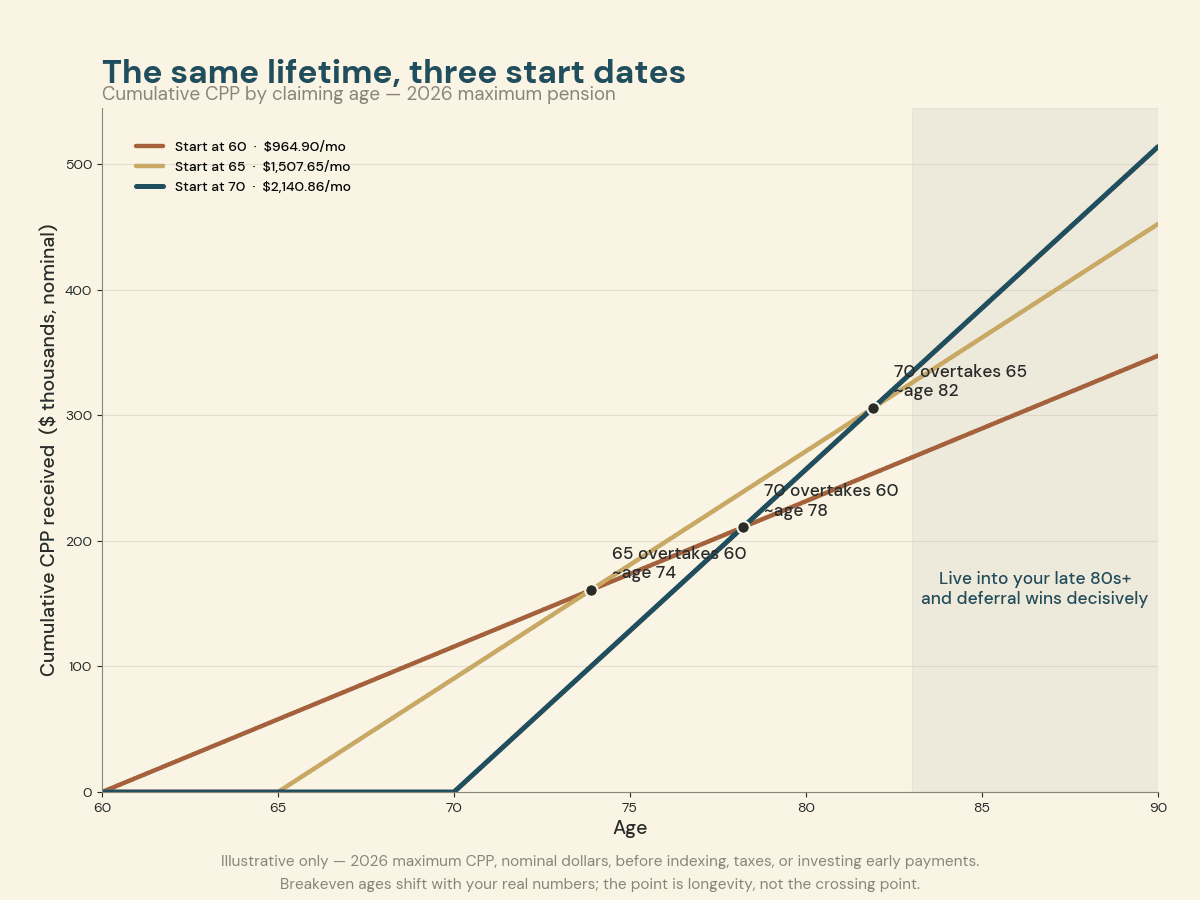
Look at the cumulative curves and the instinct is to find where they cross and “solve” for it: take CPP at 60 and you're ahead until your mid-70s; defer to 70 and you pull ahead in your early 80s. That framing is the trap. It quietly treats a long life as the risk — as if outliving the crossover were the bad outcome to hedge. Reverse it. If you take CPP early and die at 74, you “won” the bet, but you didn't need the money. If you take it early and live to 92, you spend nearly two decades on a permanently smaller, inflation-eroded cheque at exactly the age when your other pools are thinnest and your costs — health, care, help around the house — are highest. Deferral is insurance against that second scenario, the one that actually hurts. You don't buy insurance hoping to come out ahead; you buy it so the bad case is survivable.
Two more inputs belong on the table. The enhanced CPP — phased in since 2019 with a higher contribution rate — is gradually lifting future pensions for people who contributed through those years; it doesn't change the timing logic, but it means the only number that matters is your own estimate from your Statement of Contributions, not the headline maximum. And health and family longevity sit on the other side of the scale: a serious diagnosis or a family history of dying young is the clearest reason to take CPP earlier and stop optimizing for a long tail you have reason to doubt.
OAS: Deferral, the Age-75 Bump, and the Gross-up Trap
OAS rewards patience too, though less steeply: 0.6% more for each month you defer past 65, up to 36% more at 70 (there's no benefit to waiting beyond 70). In early 2026 the maximum runs about $742 a month for ages 65–74. Then a quirk worth planning around kicks in: at 75 the benefit rises another 10% automatically — to roughly $817 a month — for everyone, no application required. So a deferral decision made in your 60s compounds into a meaningfully larger, permanently indexed payment in the decade when you may need it most.
The OAS recovery tax — the “clawback” — takes back 15 cents of OAS for every dollar of net income above a threshold of roughly $95,300 in 2026, and claws the benefit back entirely by about $154,700 for those aged 65–74 (a little higher, near $160,600, once you're 75 and the benefit is larger). The number it tests is your net income — line 23400 — and that line does not always match the cash in your hand.
Here is where owners get ambushed. Canadian dividends are “grossed up” before they hit your return: eligible dividends are reported at 138% of the cash received, non-eligible at 115%. The dividend tax credit later offsets the tax, but the clawback test runs on the inflated, grossed-up figure — before the credit. Draw $80,000 of eligible dividends to live on and your return shows about $110,000 of income for OAS purposes. You never saw that extra $30,000, but the recovery tax does, and it can quietly erase thousands of dollars of OAS you were entitled to. A retired owner living comfortably but not lavishly on dividends can trip the clawback on paper income that never reached the chequing account.
That trap is exactly why timing and income-shaping have to be planned together. Deferring OAS while you keep your taxable income deliberately low in the early years — living on non-registered savings, a return of holdco capital, or your TFSA — can both lift the eventual benefit and keep you under the recovery threshold. The worst outcome is the accidental one: a big grossed-up dividend year that claws back an OAS cheque you could have protected with a little sequencing.
Coordinating With Your RRSP Meltdown and Holdco Draw
The CPP and OAS start dates aren't a standalone choice; they're one move in the larger decumulation sequence. The most valuable window in your whole retirement is the stretch from when work income stops to the year you turn 71 — the “gap years.” In that window your taxable income is naturally low and, crucially, you control it. Deferring CPP and OAS keeps those years low on purpose, and that low-income runway is exactly what makes room to do two things cheaply: melt down the RRSP before age-71 RRIF minimums force it out, and draw holdco dividends into your empty lower brackets.
The two moves reinforce each other. The pools you spend in the gap years — non-registered, modest holdco dividends, and an early RRSP-to-RRIF meltdown — fund your living costs while you wait, so deferral costs you nothing in lifestyle; it's paid for by capital you were going to draw anyway, in a smarter order. Pacing the corporate side is its own discipline — the holdco withdrawal strategy — because a careless dividend in a year you're also collecting full benefits is the surest way to stack income into the clawback zone.
The risk you're engineering against is income stacking in your 70s: full CPP, full OAS, and rising mandatory RRIF withdrawals all landing in the same years and pushing you over the recovery threshold. Switch the benefits on at 65 without a plan and you can manufacture exactly that pile-up. Defer them, melt the RRSP early, and you arrive at 71 with a smaller forced withdrawal sitting on top of a guaranteed base you bought at a discount. This is the spoke-level view of the bigger picture mapped out in the pillar on turning your corporation into a retirement paycheck — where the order you unwind your four pools is the whole game.
The Spousal and Survivor Angle
For a couple, the timing decision is really two decisions that have to be made together, and the survivor rules change the calculus in ways a single retiree never faces.
CPP has a survivor benefit, but it's capped. When one spouse dies, the survivor can inherit part of the deceased's CPP — but a survivor already collecting their own pension runs into a combined-benefit ceiling, so not all of a deferred pension transfers. The practical read: deferring the higher earner's CPP still does real work, because it raises the floor for the years both of you are alive and lifts the base the survivor calculation starts from, even though the cap blunts the inheritance. CPP sharing between spouses is a separate lever that can shift income to the lower-bracket partner and trim the household tax bill.
OAS has no survivor transfer at all. It simply stops when you die. That makes OAS deferral purely a bet on your own longevity — valuable if you're healthy, worth less if you're not — with nothing passing to your spouse. So the healthier, longer-lived spouse is usually the stronger candidate to defer OAS, while a spouse in poor health has little reason to wait.
Step back and the household is the unit of planning, not the individual — the same logic that governed your working-years compensation choices. Two people each drawing a moderate income pay dramatically less combined tax, and are far less likely to hit the clawback, than one person drawing a large one. Staggering the two start dates, sharing CPP, and ordering withdrawals so neither spouse spikes into the recovery zone is the art of retirement income layering across two taxpayers.
A Decision Tree by Health, Other Income, and Longevity
There is no universal answer, but there is a structured one. Find the branch that looks most like you, then treat it as a hypothesis to test with your own numbers rather than a prescription.
Healthy, long-lived family, and other pools to live on in the meantime? This is the textbook case for deferral — lean toward starting CPP at 70 and OAS at least past 65, and fund the gap from non-registered savings, holdco dividends, and an RRSP meltdown. You're buying the most insurance when you're most likely to collect on it, and the low-income gap years do double duty.
Large RRSP or holdco and real clawback risk? Deferring OAS while you melt the RRSP hard and early in your 60s can shrink the forced 70s income that would otherwise vaporize your OAS. Here the timing decision is doing tax-smoothing work as much as longevity work; CPP timing becomes a secondary dial you set around the meltdown.
Poor health, or a family history of dying young? Take CPP early, around 60 to 65, and don't agonize over the lost upside. Insurance against living too long is worth little when that isn't the risk you're carrying, and money in hand now has clear value.
Need the cash flow now, with no bridge to fund a delay? Then start the benefits — a deferral you can't afford to wait for isn't insurance, it's a hardship. The point of the gap-year strategy is that it's available only if you have other capital to spend; if you don't, the guaranteed income you can switch on today is the right call, and there's no shame in it.
What to Hand Your CPA or Financial Planner to Model
Everything above is the planning work — the framing only you, with a planner, can do, because it turns on your health, your spouse, and how long you expect to need the money. What you walk into your accountant's office with is a short, specific brief:
- Your actual CPP estimate at 60, 65, and 70 from your Statement of Contributions — the real numbers, not the maximum — plus your OAS entitlement.
- Your planning age and health assumption, and your spouse's, so the model weighs longevity honestly instead of defaulting to a breakeven.
- A year-by-year projection of net income — with dividends shown at their grossed-up value — so the clawback threshold is tested against the figure the CRA actually uses.
- The bridge plan: which pools fund living costs in the gap years if you defer, and the RRSP-meltdown schedule that runs underneath.
- The instruction to compare lifetime after-tax income under take-at-60, 65, and 70 — not the breakeven age — for you and your spouse together.
Your CPA then does what they do best: confirms the current-year thresholds and gross-up factors, runs the projection, and flags any wrinkle in your corporate structure. The division of labour is the whole point — you and your planner decide the strategy; your accountant verifies the figures and files. A start-date plan handed over this way is worth far more than a question asked in a panic the month before you turn 65.
Sources
- Government of Canada — CPP retirement pension: how much you could receive (2026 maximum and average)
- Government of Canada — When to start your CPP retirement pension (early/late adjustment factors)
- Employment and Social Development Canada — Maximum benefit amounts, CPP 2026 and OAS January–March 2026
- Government of Canada — Old Age Security pension recovery tax (clawback)
- Government of Canada — OAS payment amounts and the age-75 increase
- Canada Revenue Agency — Taxable amount of dividends (eligible and non-eligible gross-up)
Frequently Asked Questions
Should I just take CPP at 60 like everyone tells me?
Only if your situation calls for it — and for a healthy owner with other pools to live on, it usually doesn't. Taking CPP at 60 locks in a permanent 36% cut to an inflation-indexed income you can never outlive, which is the opposite of what you want if you live into your late 80s or 90s. The “get it while you can” instinct treats CPP like a savings account that might vanish; it's really insurance that gets more valuable the longer you live. Early CPP makes sense for poor health, a short family-longevity outlook, or a genuine need for the cash flow now — not as a default.
Does deferring CPP to 70 really add 42%?
Yes — the increase is 0.7% for every month you wait past 65, which compounds to 42% more at age 70, and it's applied to your own pension, then indexed to inflation for life. On the 2026 maximum that's the difference between roughly $1,508 a month at 65 and about $2,141 at 70. It is a contractual increase set in legislation, not a market return you're hoping for, which is what makes deferral such an unusually clean form of longevity insurance.
I live on dividends — how can OAS be clawed back when my cash income is low?
Because the clawback is tested on your grossed-up income, not your cash. Eligible Canadian dividends are reported at 138% of what you actually received, so $80,000 of dividend cash can show up as about $110,000 of net income on the line the CRA uses for OAS recovery. The dividend tax credit fixes your tax bill, but it doesn't lower the figure the clawback looks at. That's why an owner with a modest lifestyle funded by dividends can lose OAS to a recovery tax on income that never reached the bank — and why shaping your dividend draw and leaning on TFSA or return-of-capital in high years matters so much.
Should I start CPP and OAS at the same time?
Not necessarily — they're separate decisions with different mechanics. CPP rewards waiting more steeply (0.7% a month, to 70) than OAS does (0.6% a month, to 70), and OAS carries its own quirks: a 10% automatic bump at 75 and the clawback to manage. Many owners defer CPP toward 70 for the bigger guaranteed increase while making the OAS call separately around the recovery threshold. The right pairing falls out of your income projection, not a rule that they move together.
If I defer and die early, didn't I waste it?
In dollar terms you'd collect less — but that's the wrong scorecard, the same way you don't regret home insurance because your house didn't burn down. The risk worth protecting against isn't dying early; it's living a long time on a shrinking, inflation-eroded income with your other savings depleted. If you die early, your TFSA and estate — which you preserved by leaning on the guaranteed base — pass to your family anyway. Deferral makes the genuinely dangerous outcome, a very long life, comfortable. That's the job it's doing.
What does my CPA do that I haven't already done here?
The strategy — when to start each benefit, how to bridge the gap years, how to keep your spouse and your dividends out of the clawback — is the planning work you do first, with a planner. Your CPA takes that plan and executes the technical layer: confirming this year's thresholds and gross-up factors, running the multi-year projection, structuring the dividend draw, and catching any corporate-structure wrinkle. Think of it as design versus construction — you draw the blueprint, your accountant builds to code and files the returns.
Related Reading on This Site
- Turning Your Corporation Into a Retirement Paycheck — the pillar: the order you unwind your four pools, with CPP and OAS as the guaranteed base.
- RRSP-to-RRIF Conversion in 2026 — the meltdown that funds your gap-year deferral and shrinks forced 70s income.
- Holdco Withdrawal Strategy — pacing corporate dividends so they don't stack you into the OAS clawback.
- Retirement Income Layering — staggering benefits and withdrawals across two spouses.
- Salary vs Dividends in 2026 — why your CPP record looks the way it does, and the household-as-unit logic.
- TOSI in 2026 — the income-splitting constraints that shape family compensation into retirement.
- Inflation Explained — why an inflation-indexed, guaranteed income is worth more than it looks over a 30-year retirement.
Conclusion
The hardest part of getting your CPP OAS timing right is unlearning the barbecue rule. “Take it early” optimizes for the case where you don't live long — the one case where the money matters least. The planner's frame optimizes for the case that actually threatens you: a long life, thinning savings, and rising costs, met by a guaranteed cheque you deliberately made as large as your health and cash flow allowed. For an incorporated owner with a dividend-shaped income and no pension behind you, that guaranteed base carries more weight than it does for almost anyone — and the clawback is yours to plan around, not stumble into. Build the start-date plan first — a target age for each benefit, the pools that bridge the wait, the income band to stay under — and the figures your CPA confirms become a formality instead of a guess.
Want a planner's read on when to switch on your CPP and OAS? Book a complimentary 15-minute call → Book a discovery call
Important disclosure
General educational information only — not personalized financial, investment, or tax advice, and not a recommendation to start or defer any government benefit. The right CPP and OAS timing depends on your complete financial picture, health, and goals. Benefit amounts, adjustment factors, the OAS recovery threshold, and dividend gross-up rates change and are indexed periodically; the figures cited reflect 2026 and should be reconfirmed before acting. Tax filing and corporate-structure mechanics are the role of a qualified Canadian CPA; consult the appropriate professionals before acting on anything in this post.
Author bio: Jahid Hassan is a CFA Charterholder and CFP Professional based in Calgary, Alberta, specializing in comprehensive financial planning for Canadian incorporated business owners, newcomers to Canada, and Muslim investors building Shariah-compliant portfolios. Connect on LinkedIn.