The Real Question Isn't “How Much” — It's “From Where, First”
For thirty years your corporation told you what your income was. The opco generated cash, you and your accountant decided on a salary-and-dividend mix, and the question of “where does my paycheck come from” answered itself. Now the opco is sold or winding down, and for the first time nobody is setting your paycheck. You're sitting on some combination of a holdco full of invested proceeds, an RRSP, a TFSA, maybe a pile of non-registered savings — and the money has to last twenty-five or thirty years. The instinct is to ask “how much can I safely spend?” That matters, but it's the second question. The first one — the one that decides how much tax you pay across your whole retirement and how much of your estate survives — is from which pool do I draw, and in what order? This post is the planner's framework for answering that. It is not a filing walkthrough; it's the plan you build first and hand to your CPA to execute.
Key Takeaways
- Sequence beats size. The order you unwind your four pools — holdco, RRSP/RRIF, TFSA, non-registered — moves your lifetime tax bill and your estate more than almost any single product or rate decision.
- The plan comes before the account. Income target, time horizon, longevity, and legacy intent define the problem. Only then does the drawdown order have a right answer.
- The sensible default for many owners is to draw non-registered and modest holdco dividends early, melt the RRSP down before age 71, and let the TFSA grow as the last-touched pool. But three situations flip it.
- Three forces move the answer more than the rules do: the OAS clawback (which begins around $95,000 of net income in 2026), your estate plan, and a spouse with room in a lower bracket.
- You leave with a plan, not a tax return. The drawdown map, the melt-down schedule, and the income target are yours to design; your CPA confirms the figures and files.
On this page
- Start With the Plan, Not the Account
- Your Four Pools — and What Each One Really Costs to Unwind
- The Default Drawdown Order — and the Three Situations That Flip It
- Where the Big Levers Live: OAS, Your Estate, and Your Spouse
- A Decision Tree by Asset Mix
- Sequencing Across a 30-Year Retirement
- What This Hands Off to Your CPA
- Sources
- Frequently Asked Questions
- Should I drain the holdco or the RRSP first?
- Does it make sense to defer CPP and OAS while I live off savings?
- Why would I leave the TFSA for last when it's tax-free anyway?
- What is an RRSP meltdown and do I need one?
- How does a lower-income spouse change my drawdown order?
- What does my CPA do that I haven't already done here?
- Related Reading on This Site
- Conclusion
Start With the Plan, Not the Account
Every drawdown question people bring me starts at the account level — “should I take dividends from the holdco this year?” — and that's exactly backwards. The account is the last thing to decide. Before any pool gets touched, four numbers define the problem, and they're all about your life, not the tax code.
Your income target. Not your old salary — the spending you actually want to fund, in today's dollars, split into the non-negotiable floor (housing, food, insurance, the basics) and the discretionary layer (travel, gifts, the boat). The floor and the discretionary layer get funded differently, and knowing the split changes which pool you lean on in a down market.
Your time horizon and longevity. A plan that runs out at 85 is not a plan if you live to 94. For a healthy 60-year-old couple, the realistic planning horizon is to age 95, and that long tail is exactly why the order of withdrawals matters — a sequence that looks tax-efficient for ten years can leave you over-exposed for the next twenty. Inflation is the silent partner here: a 3% inflation rate roughly halves your purchasing power over 24 years, which is why your real, after-inflation return assumptions matter more than the headline ones. (I walk through that erosion in this guide to inflation for Canadians.)
Your legacy intent. Spend to zero, or leave a defined estate to children or charity? This single answer reorders everything: an owner who wants the largest possible estate runs a very different sequence than one who wants to enjoy every dollar and leave only the house. There's no right answer — but there is a wrong outcome, which is letting the default tax mechanics decide your legacy by accident.
Your other guaranteed income. CPP, OAS, any defined-benefit pension, rental income. These form the base layer of your paycheck and set the tax “floor” that every discretionary withdrawal stacks on top of. When you switch CPP and OAS on is itself a planning lever, covered in the spoke on CPP and OAS timing for business owners.
Only once those four are on paper does the sequencing question have a right answer. Everything downstream serves them. If a drawdown strategy ever conflicts with the income floor or the legacy intent, the strategy is wrong, not the goal.
Your Four Pools — and What Each One Really Costs to Unwind
Think of your retirement capital as four taps, not one tank. Each tap pours the same dollars into your bank account, but each one carries a different cost to open — tax now versus tax later, what it does to your estate, and how much flexibility you give up. The planner's job is to decide the order you open the taps. The CPA's job is to read the meter once you have.
The holdco. Usually the biggest tap and the most misunderstood. Money inside your holding company was already taxed once at the corporate level; getting it into your hands means personal tax on a dividend on top. But the holdco also holds hidden efficiencies: a Capital Dividend Account balance that flows out completely tax-free, and refundable tax pools returned when you pay taxable dividends. Drawn thoughtfully, it can fund years of income at a blended rate well below your top marginal rate; drawn carelessly — or left untouched until death — it can trigger one of the ugliest results in Canadian tax: double taxation on the same dollars. Pacing those withdrawals, using the CDA and refundable pools as levers, is the holdco withdrawal strategy spoke. One timing wrinkle: Budget 2025 proposed rules suspending the dividend refund in certain tiered structures with mismatched year-ends — if your holdco sits under or over another company, confirm with your CPA before setting the dividend schedule.
The RRSP, soon to be a RRIF. Every dollar here is fully taxable as ordinary income when it comes out, and the government eventually forces your hand: by the end of the year you turn 71, the RRSP must convert to a RRIF (or an annuity), and the RRIF imposes a minimum withdrawal every year — starting at 5.28% of the balance at age 71 and climbing each year after. That forced, rising, fully-taxable income is the single biggest cause of the OAS clawback and a bloated final-year tax bill. The cost of leaving this pool untouched is not zero — it's a deferred tax that compounds into a problem. The timing of converting and drawing it down early is the RRSP-to-RRIF conversion spoke.
The TFSA. The cleanest tap you own. Withdrawals are completely tax-free, they don't count toward the income that triggers the OAS clawback, and the room you withdraw comes back the following year. In 2026 the annual limit is $7,000 and someone eligible since 2009 who never contributed has $109,000 of cumulative room. Because a TFSA dollar is worth more to your heirs than an RRSP dollar (which is taxed on death) and creates no clawback risk while you're alive, the TFSA is usually the pool you protect longest — the shock absorber, not the first resort.
Non-registered savings. Personal taxable investments sit in the middle. Only the growth is taxed, and capital gains are taxed at the one-half inclusion rate — the proposed increase to two-thirds was cancelled, so the half rate stands in 2026. That makes non-registered capital gains one of the most lightly taxed dollars you can spend, and it means this pool often gets drawn early alongside the holdco. There's also an estate advantage: these assets receive a step-up and pass relatively cleanly, and any unrealized gains can be managed across years rather than all at once.
The point of describing the pools as trade-offs rather than mechanics is this: there is no “best” account — only the best order for your plan, and that order falls out of which pool costs the least to unwind in each phase of your retirement.
The Default Drawdown Order — and the Three Situations That Flip It
Start with a sensible default, then learn the cases that reverse it. For a typical retired owner with a balanced mix of pools and no unusual constraint, the order I'd sketch first looks like this:
- Spend non-registered savings and the low-tax slices of the holdco first — including any tax-free Capital Dividend Account balance — while keeping taxable income deliberately low.
- Begin melting down the RRSP in your low-income early-retirement years, before the age-71 RRIF conversion forces large withdrawals on top of CPP and OAS.
- Defer CPP and often OAS to increase the guaranteed, inflation-indexed base — funded by the pools above in the gap years.
- Touch the TFSA last, letting it compound tax-free and stand ready as the shock absorber for big one-off expenses or down markets.
The logic is to use your early, low-income years — after work income stops but before CPP, OAS, and forced RRIF income kick in — as a tax-rate bargain. Those years are the cheapest time you will ever have to pull money out of an RRSP or realize a gain. Waste them, and the RRSP keeps growing until 71 forces it out at a much higher rate, often while clawing back your OAS.
Now the three situations that flip the default:
1. A large RRSP plus OAS-clawback risk. If your RRSP is big enough that the forced RRIF minimums will push your net income past the OAS recovery threshold (around $95,000 in 2026, with OAS fully clawed back by roughly $155,000 for those 65–74), the default isn't aggressive enough. You melt the RRSP down harder and earlier, accepting more tax in your 60s to avoid a decade of clawed-back OAS and top-rate RRIF income in your 70s and 80s. The goal flips from “defer tax” to “levelize income” across the whole horizon.
2. An estate-heavy goal. If leaving a large estate matters more than maximizing your own spending, the calculus inverts. A TFSA passes to heirs tax-free; an RRSP/RRIF is taxed as income on the second death, often at the top rate; and a holdco can face double tax at death. Here you may spend the RRSP and holdco down faster to shrink the future tax hit on your estate, while preserving the TFSA and managing the holdco wind-down around the rules for private-company shares at death. The drawdown order becomes an estate-tax strategy, not just an income strategy.
3. A spouse with a low income. If one spouse has little income of their own, the household can run two sets of low brackets instead of one. That argues for splitting eligible pension and RRIF income, having the lower-income spouse draw their own registered money at a low rate, and using spousal strategies that the single-person default never considers. Two people each drawing $60,000 pay dramatically less combined tax than one person drawing $120,000. Income layering across spouses is its own discipline — the retirement income layering spoke covers it.
Where the Big Levers Live: OAS, Your Estate, and Your Spouse
Three forces move the right answer more than any single rule, rate, or product. Get these right and the details mostly take care of themselves; get them wrong and no amount of clever account-picking saves you.
OAS, the income test you can plan around. Old Age Security is clawed back at 15 cents per dollar of net income above the 2026 threshold of about $95,323, and fully recovered around $155,109 for those aged 65–74 (a higher ceiling, about $161,088, applies at 75-plus, where the benefit is 10% larger). For a couple that's potentially tens of thousands of dollars over retirement — entirely a function of how much taxable income you report each year. Because TFSA withdrawals and a return of holdco capital don't count toward that test while large RRIF withdrawals do, the clawback is one of the strongest arguments for melting the RRSP early and leaning on tax-light pools in your 70s. OAS turns the abstract draw-order question into real dollars.
Your estate, the second tax return nobody plans for. On death your RRSP/RRIF is generally deemed fully withdrawn and taxed as income — a final-year bill that can run to half the balance — and a holdco can be hit twice: tax on the deemed disposition of the shares and again when the assets come out. The TFSA, by contrast, passes cleanly. Plan the drawdown without the estate in mind and you can spend the wrong pools and hand the government a windfall. This is where decumulation connects to structures you may already have: an estate freeze and family trust changes how the holdco passes, and the original decision about whether to hold a holding company echoes into how you unwind it.
Your spouse, the second set of brackets. A married or common-law couple is really a two-taxpayer household, and Canada's graduated rates reward spreading income across both. Pension and RRIF income splitting, spousal RRSPs, ordering withdrawals so neither spouse spikes into a high bracket or the clawback zone — these are levers a single retiree simply doesn't have. The same logic that governed your working-years salary-versus-dividend decisions carries straight into retirement: the household, not the individual, is the unit of planning.
A Decision Tree by Asset Mix
The right sequence depends heavily on where your money actually sits. Three common profiles, three different starting points. Find the one that looks most like you — then read it as a hypothesis to test with your own numbers, not a prescription.
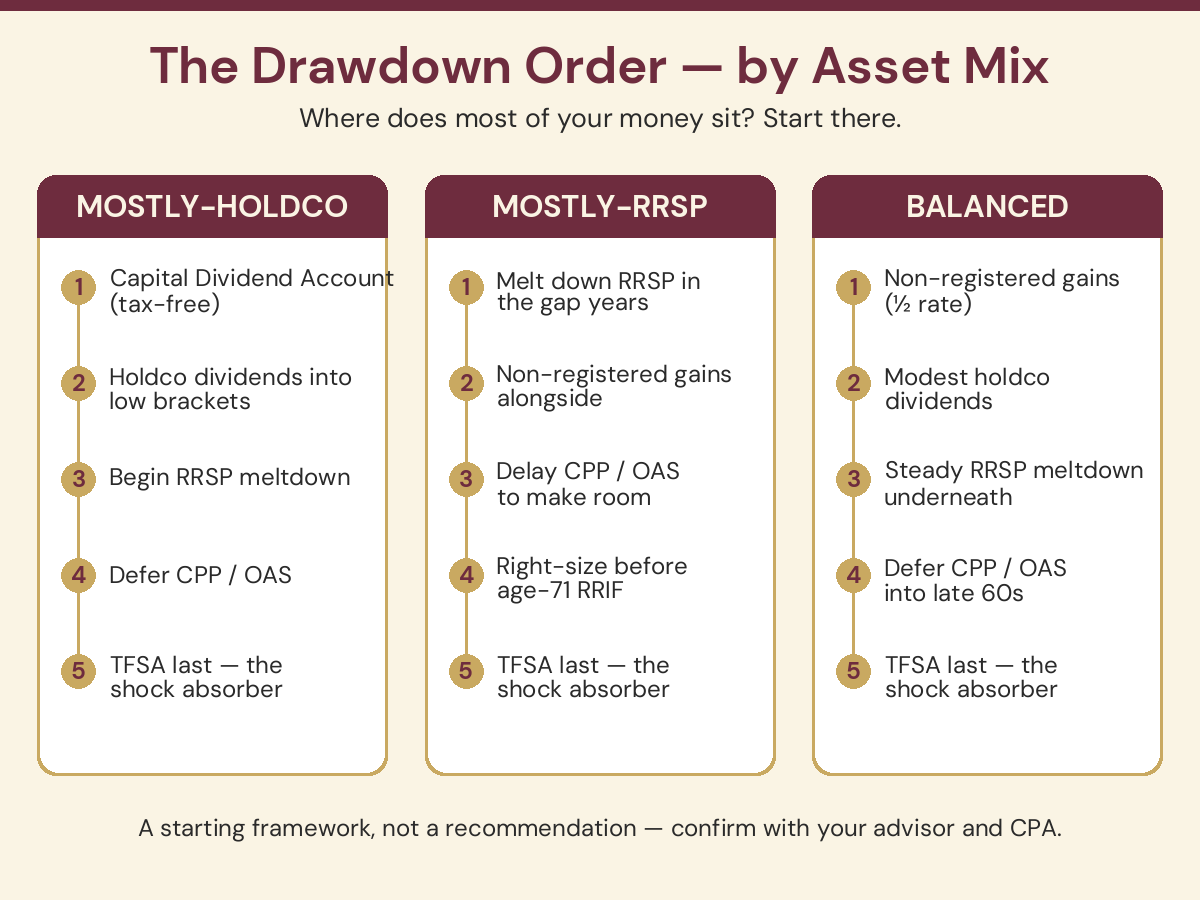
Mostly-holdco. You sold the opco and most of your wealth sits inside the holding company, with smaller RRSP and TFSA balances. Your central problem is pacing corporate withdrawals: take enough dividend each year to use up your lower brackets and recover the company's refundable tax pools, flow out any Capital Dividend Account balance tax-free, and avoid any single year where a large dividend spikes you into the top rate or the clawback. The RRSP meltdown is a smaller task layered on top. The holdco is a multi-year project, and the biggest mistake is under-drawing it in your 60s only to face a forced, top-rate wind-down at death.
Mostly-RRSP. Your largest pool is registered — a career of contributions with a modest holdco or none. Here the early RRSP meltdown is the headline move. From the year work income stops until 71, you draw the RRSP deliberately up to the top of a middle bracket, possibly delaying CPP and OAS to keep those years low and make room. The aim is to shrink the RRSP before the RRIF minimums and government benefits stack on top and trigger years of clawed-back OAS. Done well, you pay a steady moderate rate for life instead of a low rate now and a punishing one later.
Balanced. You have meaningful balances across all four pools. This is the richest set of options and the one where sequencing pays off most. The typical spine: fund early spending from non-registered gains (taxed lightly at the half inclusion rate) and modest holdco dividends, run a steady RRSP meltdown underneath, defer CPP and OAS into your late 60s, and guard the TFSA as the last pool standing. In any year markets fall, you pivot to the TFSA so you're not selling depressed assets to fund the same paycheck — the shock-absorber role that makes the whole plan resilient.
Sequencing Across a 30-Year Retirement
Decumulation isn't a single decision; it's a sequence you re-run every year for three decades. It helps to see it in phases rather than as one static rule.
The gap years (roughly 60 to 71). The most valuable and most wasted window in retirement. Work income has stopped, CPP and OAS may not have started, and forced RRIF income hasn't begun — so your taxable income is naturally low, and you control it. This is when you melt the RRSP, realize capital gains at low rates, and draw holdco dividends into the empty lower brackets. Every dollar you move out at a low rate now is a dollar that won't be forced out later at a high one. The owners who do best deliberately raise their taxable income in these years — counterintuitive, but it's the smoothing that pays.
The transition (71 to mid-70s). The RRIF conversion is now mandatory and the minimums begin and rise each year. CPP and OAS, if deferred, are now at their richest. The risk in this phase is income stacking — forced RRIF withdrawals piling on top of full government benefits and pushing you into the clawback. If you did the gap-year melt-down well, the RRIF is smaller and this phase is calm. If you didn't, this is where the bill lands. Holdco dividends get dialed back to make room for the now-unavoidable RRIF income.
The long tail (late 70s onward). Now the TFSA earns its keep. Spending often shifts — less travel, eventually more health and care costs — and the TFSA you protected for twenty years becomes the flexible, tax-free, clawback-free source for lumpy late-life expenses, and the most efficient asset to leave behind. Any remaining holdco wind-down is managed with the estate in view so the shares don't collide with the double-tax problem at death.
Across all three phases, two ideas hold. First, smooth, don't defer blindly — a roughly level taxable income across thirty years almost always beats low-then-high. Second, keep one flexible pool — the TFSA — so a bad market or a surprise expense never forces you to sell the wrong asset at the wrong time.
What This Hands Off to Your CPA
Everything above is the plan — the architecture only you and your planner can design, because it depends on your goals, your spouse, your longevity assumptions, and your legacy intent. What you walk into your accountant's office with is a clear set of instructions:
- The target taxable-income band you want to hit each year, and the drawdown order that produces it.
- The RRSP meltdown schedule for the gap years — how much to pull, and the bracket ceiling not to cross.
- The holdco dividend plan — the mix of capital dividends, eligible and non-eligible dividends, and the year-end coordination, including the Budget 2025 tiered-corporation timing question if it applies to you.
- The income-splitting moves between spouses you want executed.
Your CPA then does what they do best: confirms the exact figures against the current year's rules, files the returns, and flags anything in the corporate structure that needs a technician's eye. The division of labour is the whole point — you design the decision, your accountant executes it. A drawdown plan handed over this way is worth far more than a shoebox of slips handed over in April.
Sources
- Government of Canada — Old Age Security pension recovery tax (clawback)
- Canada Revenue Agency — Calculating the RRIF minimum amount (prescribed factors)
- Canada Revenue Agency — TFSA contributions and annual dollar limit
- Department of Finance Canada — capital gains inclusion rate (one-half rate maintained)
- Budget 2025 — Tax Measures: tiered corporations and dividend-refund timing
- Canada Revenue Agency — 2026 federal income tax brackets and rates
Frequently Asked Questions
Should I drain the holdco or the RRSP first?
Usually neither “first” in isolation — you blend them. Use your low-income early-retirement years to pull from both at modest rates: enough RRSP to start melting it down before 71, plus holdco dividends and any tax-free capital dividend balance to fill out your lower brackets. Draining one entirely before touching the other wastes a low bracket one year and overshoots into a high one the next. The right blend depends on the relative size of each pool and your OAS exposure — exactly the trade-off a drawdown plan exists to resolve.
Does it make sense to defer CPP and OAS while I live off savings?
Often, yes — for healthy owners with other pools to spend meanwhile. Deferring raises the guaranteed, inflation-indexed income you can never outlive, and the gap years before benefits start are also the cheapest years to melt down an RRSP, so the two moves reinforce each other. It's not universal — health and your need for cash flow now both weigh in — which is why the timing decision gets its own treatment in the CPP and OAS spoke.
Why would I leave the TFSA for last when it's tax-free anyway?
Precisely because it's tax-free. A TFSA dollar compounds with no tax drag, its withdrawals never count toward the OAS clawback, and it passes to heirs tax-free — advantages no other pool offers. Leaving it for last means it grows the longest, stays available as your shock absorber for down markets and late-life costs, and is the most efficient asset to leave behind. It's the pool you protect, not the one you reach for first.
What is an RRSP meltdown and do I need one?
It's deliberately drawing your RRSP down in your lower-income 60s rather than waiting until 71 forces RRIF minimums on top of CPP, OAS, and other income. The point is to pay tax on those dollars at a moderate rate by choice instead of a high rate by force, and to shrink the future RRIF so it doesn't trigger the OAS clawback. Whether you need one, and how aggressive it should be, depends on your RRSP's size relative to your other income — the heart of the RRSP-to-RRIF conversion decision.
How does a lower-income spouse change my drawdown order?
A lot. A couple is taxed as two individuals on a graduated scale, so spreading income across both — rather than concentrating it on one — lowers the household's total bill and reduces the chance either person hits the OAS clawback. That opens up pension and RRIF income splitting, spousal RRSP strategies, and ordering withdrawals so both sets of low brackets get used. Two people each drawing a moderate income almost always beat one drawing a large one.
What does my CPA do that I haven't already done here?
The drawdown architecture — which pool, which order, against your goals and your spouse's situation — is the planning work you do first. Your CPA takes that plan and executes the technical layer: confirming the exact figures, structuring the holdco dividends correctly, handling the filings, and catching any structural wrinkle. Think of it as design versus construction — you and your planner draw the blueprint, your accountant builds to code. Both matter, but the plan comes first.
Related Reading on This Site
- RRSP-to-RRIF Conversion in 2026 — the meltdown-timing spoke: how hard to draw, and when.
- CPP and OAS Timing for Business Owners — when to switch on the guaranteed base, and the clawback math.
- Holdco Withdrawal Strategy — pacing corporate dividends with the CDA and refundable pools as levers.
- Retirement Income Layering — blending the pools across two spouses.
- Private-Company Shares at Death — the double-tax problem and how the wind-down avoids it.
- Do I Really Need a Holding Company? — the original structure decision that shapes the wind-down.
- Salary vs Dividends in 2026 — the household-as-unit logic that carries into retirement.
- The Estate Freeze + Family Trust Playbook — how the holdco passes, and why it changes the drawdown.
- Capital Gains Tax on Selling Your Business — how the proceeds you're now drawing down were taxed on the way in.
- Halal Investing Inside Your CCPC — the corporate-framework path for Muslim owners.
- Inflation Explained — why your real, after-inflation return is the number that matters over a 30-year retirement.
Conclusion
The hardest part of turning a corporation into a retirement paycheck isn't the math — it's realizing the question changed. For thirty years the job was to accumulate, and the rules rewarded deferring tax as long as possible. Decumulation rewards the opposite instinct: smoothing income, sometimes paying tax earlier on purpose, and protecting the one pool that asks nothing of you. Four taps, one paycheck, and an order that's yours to design around your goals rather than the tax code's to dictate by default. Build that order first — income target, melt-down schedule, spouse split, estate intent — and the figures your CPA confirms each April become a formality instead of a surprise.
Want a planner's read on your own drawdown order? Book a complimentary 15-minute call → Book a discovery call
Important disclosure
General educational information only — not personalized financial, investment, or tax advice, and not a recommendation to take any specific drawdown action. Retirement decumulation depends on your complete financial picture, goals, and circumstances. Tax rules, contribution limits, OAS thresholds, RRIF factors, and the status of proposed measures (including Budget 2025 corporate proposals) change and may differ by province; figures cited reflect 2026 and should be reconfirmed before acting. Product selection and trade execution are the role of a CIRO-registered investment advisor or portfolio manager; tax filing and corporate-structure mechanics are the role of a qualified Canadian CPA. Consult the appropriate professionals before acting on anything in this post.
Author bio: Jahid Hassan is a CFA Charterholder and CFP Professional based in Calgary, Alberta, specializing in comprehensive financial planning for Canadian incorporated business owners, newcomers to Canada, and Muslim investors building Shariah-compliant portfolios. Connect on LinkedIn.