The Execution Side
Post 7 covered the four planning decisions you make before your CPA gets involved: documenting pre-arrival asset values, deciding your residency-start date, sequencing registered accounts, and engaging a CPA at the right time. This post is the other side — the execution checklist your CPA works from. Every form, every deadline, every filing step, in chronological order. If Post 7 is the “what to decide,” this is the “what gets filed.”
What I Do, What Your CPA Does
This post is the CPA’s lane. The forms, the deadlines, the filing mechanics — all execution. The planning decisions that feed into this checklist are covered in the four Year-1 planning decisions. Start there if you haven’t read it yet.
Five Definitions You Need to Know
Social Insurance Number (SIN)
A nine-digit identifier issued by Service Canada under the Department of Employment and Social Development Act. Required before working, filing a Canadian tax return, opening a registered investment account, or registering for CRA My Account. Issued same-day in person at any Service Canada centre; up to five business days online.
CRA My Account
The CRA online portal for individuals at canada.ca/cra-my-account, providing access to assessments, RRSP/TFSA room, benefit payments, direct deposit, and digital correspondence. Full access requires a prior-year Notice of Assessment; newcomers can register pre-NOA but full features activate after the first T1 is processed.
Form RC151
The CRA application for the GST/HST credit used by newcomers with no children under 19. Submitted by mail to the assigned CRA tax centre with proof of arrival date. If you have children under 19, use Form RC66 instead — it covers GST/HST credit eligibility automatically.
Form RC66
The Canada Child Benefit application for newcomer families with children under 19. Permanent residents qualify immediately on landing — no 18-month wait. Temporary residents wait 18 months unless they become PR sooner. RC66 automatically determines GST/HST credit eligibility, so file RC66 — NOT both RC66 and RC151.
Notice of Assessment (NOA)
The CRA document issued after each T1 is processed, confirming income, tax, refund or balance owing, and the official RRSP contribution room for the next year. Approximately two weeks after NETFILE, eight to twelve weeks after paper. The Year-1 NOA unlocks full CRA My Account access in Year 2.
On this page
- The Execution Side
- Five Definitions You Need to Know
- Year-1 Filing Timeline
- Month 1: File RC151 or RC66
- By April 30 of Year 2: File the First T1
- Forms Reference Card
- Four Common Year-1 Filing Mistakes
- Sources
- Frequently Asked Questions — What forms? · When due? · NETFILE? · Common mistake?
- Related Reading on This Site
- Quick Reference Card
- Important disclosure
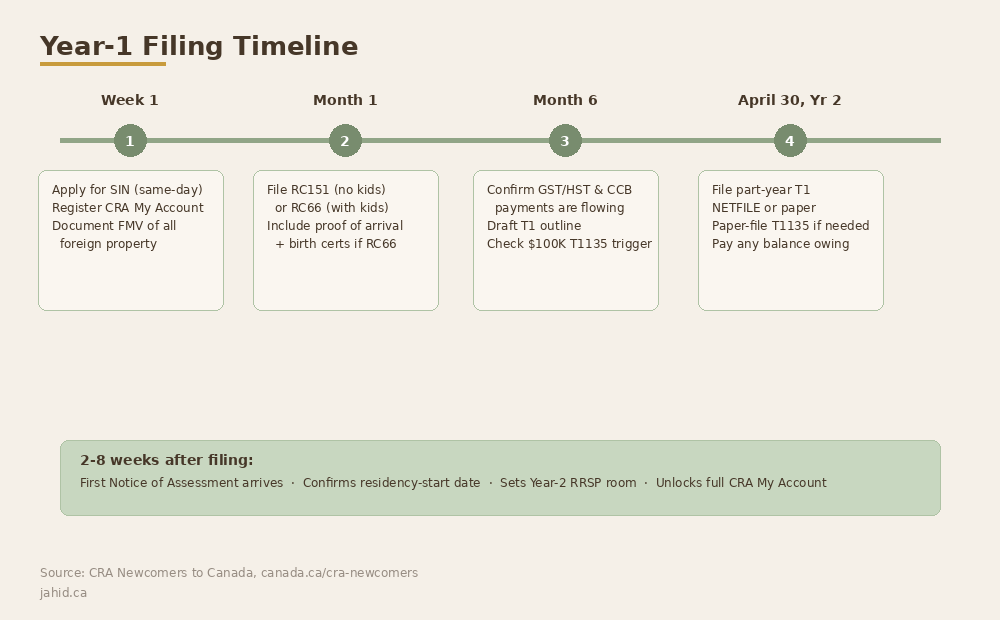
Year-1 Filing Timeline
Every newcomer first tax return Canada milestone from arrival day through the first Notice of Assessment — four phases, chronological order.
Month 1: File RC151 or RC66
Apply for the GST/HST credit and Canada Child Benefit as soon as you have your SIN. Two paths:
No children under 19: File Form RC151 by mail to your assigned CRA tax centre with proof of arrival date (COPR landing record or stamped Canadian work permit). The GST/HST credit begins flowing in the next quarterly cycle, usually four to six weeks after processing.
Children under 19: File Form RC66 instead. RC66 automatically covers GST/HST credit eligibility — do not file both RC151 and RC66; duplicates delay processing by months. Permanent residents qualify for the Canada Child Benefit immediately on landing. Temporary residents wait 18 months unless they become PR earlier. Include proof of birth for each child plus proof of arrival.
By April 30 of Year 2: File the First T1
April 30 of Year 2 is the universal deadline. Self-employed filers (or filers whose spouse is self-employed) get a filing extension to June 15, but any balance owing is still due April 30 to avoid interest.
The part-year T1 reports worldwide income from your residency-start date through December 31 of Year 1, with pre-residency foreign income on Schedule A. Many federal non-refundable credits are pro-rated under section 118.91. If you used a Canadian CPA, this is handled by their software; if you used a self-serve tool, double-check the part-year flag is set.
NETFILE works in most first-year cases. The exceptions that force paper filing: T1135 attached (required when specified foreign property cost exceeds CAD $100,000 at any point — your CPA assesses the threshold), treaty tie-breaker disclosure, certain non-standard income items. Mail T1135 separately even when NETFILING the T1, because CRA’s electronic T1135 path requires a prior-year NOA.
After processing — about two weeks for NETFILE, eight to twelve for paper — the first Notice of Assessment arrives. Save it permanently. It confirms your residency-start date with CRA, sets your Year-2 RRSP room, and unlocks full CRA My Account access. The roadmap for Years 2 and 3 sits inside the 3-year newcomer financial roadmap.
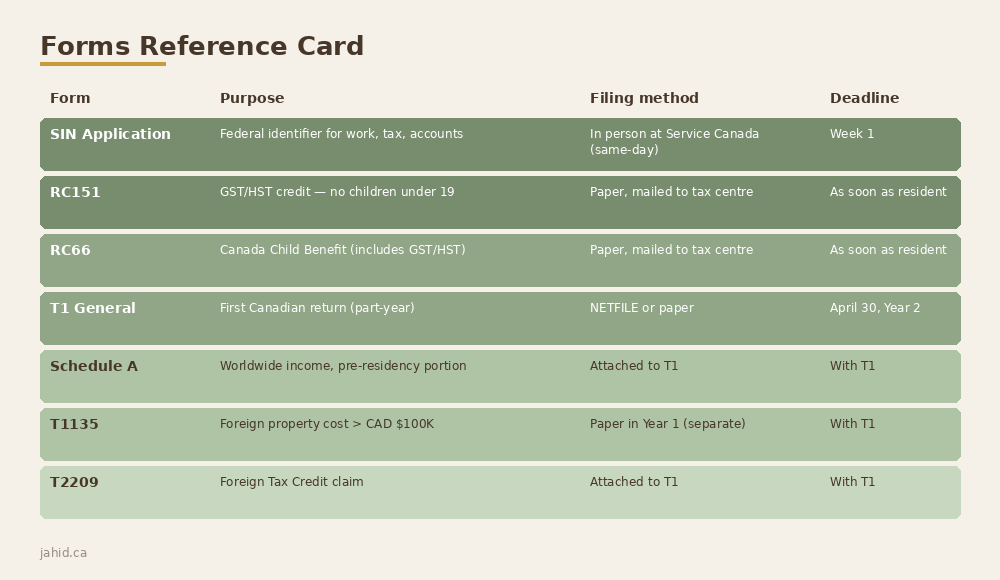
Forms Reference Card
Every form in the newcomer first tax return Canada filing set, with purpose, method, and deadline.
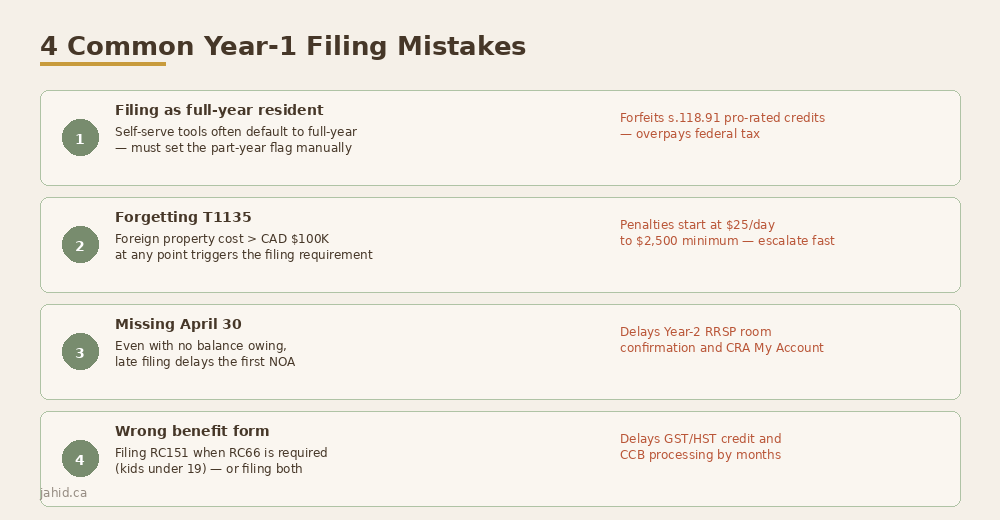
Four Common Year-1 Filing Mistakes
The most expensive Year-1 mistake — skipping FMV documentation on arrival week — is a planning failure covered in the four Year-1 planning decisions. These four are the filing mistakes your CPA should catch, but that you should know about.
Sources
- Canada Revenue Agency — Newcomers to Canada
- CRA — Form RC151 (GST/HST Credit Application for Newcomers)
- CRA — How to get the GST/HST credit
- CRA — Form T1135 (Foreign Income Verification Statement)
- CRA — Get ready to file
- CRA — What you need to know for the 2026 tax-filing season
- Service Canada — Apply for a Social Insurance Number
- CRA — CRA My Account for Individuals
Frequently Asked Questions
What forms do I need to file in my first year in Canada?
The newcomer first tax return Canada form set depends on family situation and foreign-asset position. Every newcomer applies for a SIN in Week 1. After that, file either Form RC151 (no children under 19) or Form RC66 (children under 19 — never file both). By April 30 of Year 2, file your first part-year T1 General covering worldwide income from residency-start through December 31, with pre-residency foreign income on Schedule A. If specified foreign property cost exceeded CAD $100,000, attach Form T1135 (paper-filed even if the T1 is NETFILED). If foreign tax was paid on Canadian-resident-period income, attach Form T2209. The planning decisions that determine which forms apply — especially T1135 and treaty considerations — are covered in the four Year-1 planning decisions.
When is my first Canadian tax return due if I arrived in 2026?
If you became a Canadian tax resident at any point during 2026, your first T1 is due by April 30, 2027. If you or your spouse are self-employed in 2026, the filing deadline extends to June 15, 2027, but any tax owing is still due April 30, 2027 to avoid interest. The return covers the part-year period from your residency-start date through December 31, 2026. No special grace period for newcomers — April 30 is hard. Missing it delays your first Notice of Assessment, which delays Year-2 RRSP contribution room confirmation. Even if you owe no tax, file on time.
Can I file my first Canadian tax return online (NETFILE), or do I have to mail it?
Most first-year newcomers can NETFILE the T1 using CRA-certified software (Wealthsimple Tax, TurboTax, UFile, GenuTax, StudioTax, H&R Block). NETFILE returns generate a Notice of Assessment in about two weeks versus eight to twelve weeks for paper. Exceptions forcing paper: T1135 attached, treaty tie-breaker disclosure, certain non-standard income types, prior-year amendment. Important: even when the T1 can be NETFILED, T1135 must usually be paper-filed separately in Year 1 because CRA’s electronic T1135 path requires a prior-year NOA. Self-serve software also sometimes mishandles the part-year residency-start-date field — a reason many newcomers use a CPA for Year 1.
What’s the most common filing mistake newcomers make?
The most expensive Year-1 mistake is the planning failure of skipping FMV documentation — that is covered in the four Year-1 planning decisions. The most common filing mistake is selecting full-year resident instead of part-year. Full-year filing forfeits the section 118.91 pro-rating of non-refundable credits. Self-serve tools often default to full-year — double-check the part-year flag. Other avoidable filing mistakes: forgetting T1135 when foreign property cost exceeds CAD $100,000 (penalties start at $25/day), missing April 30 even when no balance is owing (delays your first NOA), and filing both RC151 and RC66 instead of RC66 only when you have children.
Related Reading on This Site
- Your First Year in Canada: The 4 Planning Decisions Before April 30 (That Your CPA Can’t Make For You) → (Post 07 — the four Year-1 planning decisions that feed into this checklist; FMV documentation, residency-start date, registered accounts, CPA sequencing)
- The 3-Year Newcomer Financial Roadmap → (Post 08 — where Year 1 sits inside the broader 3-year planning arc)
- RRSP and TFSA for Newcomers to Canada 2026 → (Post 09 — the registered-account contribution-room mechanics that follow Year 1 filing)
Quick Reference Card
Print this and stick it on the fridge. The newcomer first tax return Canada Year-1 sequence in 80 words:
- Week 1: SIN at Service Canada (same-day) · register CRA My Account · document FMV of all foreign property (see how)
- Month 1: file RC151 (no kids) or RC66 (with kids) by mail
- Month 6: confirm GST/HST and CCB payments are flowing · draft T1 outline · check the $100K T1135 trigger
- By April 30 of Year 2: file part-year T1 (NETFILE if no T1135; paper if T1135 attached) · pay any balance owing
- 2–8 weeks later: first Notice of Assessment lands; save it; Year-2 RRSP room is now official
Book a complimentary discovery call to walk through your Year-1 filing position with a Calgary CFP who works with newcomers → Book a 15-minute call
Important disclosure
General information only — not personalized investment, tax, or legal advice. The newcomer first tax return Canada workflow is fact-intensive: source country, family structure, immigration class, foreign trusts/pensions, and dual-citizenship situations all change the right answer materially. The 2026 figures cited (T1135 $100,000 cost-amount threshold; April 30 / June 15 deadlines) are accurate as of May 2026 — verify on the relevant government website before acting. The Canada Carbon Rebate was discontinued March 15, 2025 and is not part of the 2026 newcomer benefit stream. The first-year T1, T1135 assessment, treaty tie-breaker analysis, and Foreign Tax Credit computation are properly the responsibility of a qualified Canadian CPA with cross-border experience. Consult a qualified Canadian CFP and CPA before acting on anything in this post.
Author bio: Jahid Hassan is a CFA Charterholder and CFP Professional based in Calgary, Alberta, specializing in Investment Planning and tax integration for Canadian business owners and newcomers to Canada. Connect on LinkedIn.