Two Calendars
Your first Canadian tax return is due April 30 of the year after you arrive. Your first Canadian planning decisions are due in your first 30 days. They are not the same thing.
The moment you land with intent to settle, you become a Canadian tax resident. That date resets your foreign assets’ cost base, starts worldwide income reporting, and begins registered-account contribution room. Those consequences are permanent, compound for decades, and are shaped by decisions you make in the first 90 days.
April 30 is your CPA’s deadline — filing the return accurately is execution. This post is about the four planning decisions that sit upstream of that return. The ones your CPA cannot make for you, because they are life decisions, not filing decisions.
I am a CFP Professional and CFA Charterholder working with newcomer families in Calgary. The pattern I see most: a newcomer engages a CPA in March of Year 2 and discovers that decisions they did not realize they were making in Month 1 have already locked in outcomes they cannot undo.
Key Takeaways
- Document every foreign asset’s value on arrival day. A one-hour exercise in your first week is worth tens of thousands of dollars in avoided double taxation over the next decade.
- Your residency-start date is a planning decision, not just a CRA fact. If you have a treaty-country passport and family arriving later, the timing of when residential ties form is something you can influence — with your planner, before your CPA files.
- Open registered accounts in the right order: TFSA on arrival day, FHSA before year-end, RRSP defer to Year 2. The sequencing matters more than the amounts.
- Hire your CPA before April 30 of Year 2, not the week before. Hand them the FMV documentation file, the residency-start position, and the registered-account inventory — not a shoebox of foreign-language bank statements in March.
- Your CPA files the return. Your planner designs the decisions that shape the return — and the next ten returns after it.
On this page
- Two Calendars
- Key Takeaways
- What I Do, What Your CPA Does
- How Canadian Tax Residency Actually Works
- Decision 1: Document Your Pre-Arrival Asset Values
- Decision 2: Decide Your Residency-Start Date Deliberately
- Decision 3: Open the Right Registered Accounts in the Right Order
- Decision 4: Sequence Your CPA Engagement
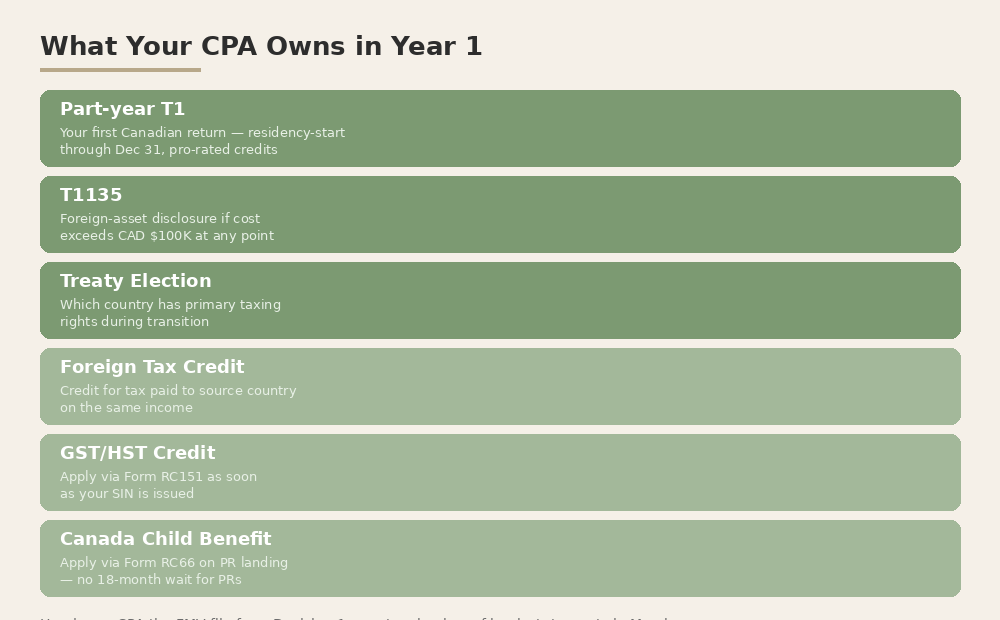
- What Your CPA Owns in Year 1
- The Three Planning Failures I See Most
- Sources
- Frequently Asked Questions – What’s the single most important thing I should do in my first week in Canada? – Do I really need a CPA in my first year? – My spouse and kids arrived three months after me — does that matter? – What’s the difference between what my CPA does and what my planner does?
- Related Reading on This Site
- Conclusion and Next Steps
- Important disclosure
What I Do, What Your CPA Does
This post is the planning conversation; the year-end filing is your CPA’s. My role is the decision side in your first 90 days — documenting pre-arrival asset values, deciding your residency-start date deliberately, sequencing your registered accounts in the right order, and choosing when to engage a CPA and what to hand them. Your CPA owns the execution side — the T1 itself, the T1135 if it applies, the treaty election if it applies, the documentation pack if CRA asks for one. I don’t file your return and I don’t sit between you and the CRA on a documentation file.
How Canadian Tax Residency Actually Works
The most-misunderstood concept in newcomer planning: permanent residence and tax residency are not the same thing. PR is an immigration status. Tax residency is a fact-driven CRA determination based on residential ties — where you live, whether your spouse and dependents are here, and whether your social and economic connections point to Canada.
Most newcomers become Canadian tax residents on the day they arrive with the intent to settle. Signing a Calgary lease, opening a bank account, enrolling children in school, applying for a SIN — these are the ties that establish residency. You can be a tax resident on a work permit long before your PR card arrives. You can hold PR and not yet be a tax resident if you have not established residential ties.
Tax residency (Canada)
A fact-driven status determined under common-law residency principles and supplemented by the deemed-residency rule in the Income Tax Act. Tax residency is based on residential ties (dwelling, spouse, dependents, social and economic connections), not on immigration status. The residency-start date — usually the arrival date for a newcomer arriving with intent to settle — triggers deemed acquisition, worldwide income reporting, and the start of TFSA contribution room.
Why this matters for planning: the residency-start date is the anchor for every Year-1 decision. It determines when your foreign assets get a new Canadian cost base, when worldwide income reporting begins, when TFSA contribution room starts, and when the clock on your CPA’s filing obligation begins. Getting this date right — and, as you will see in Decision 2, choosing it deliberately when the facts allow — is the foundation every subsequent decision rests on.
Decision 1: Document Your Pre-Arrival Asset Values
The single highest-return-on-effort move in Year 1. When you become a Canadian tax resident, the Income Tax Act deems you to have disposed of and reacquired most non-Canadian property at fair market value on your residency-start date. That FMV becomes your Canadian cost base for every future capital-gains calculation.
Deemed acquisition
A provision in the Income Tax Act that deems an individual who becomes a Canadian tax resident to have disposed of and reacquired most of their non-Canadian property at fair market value on the residency-start date. The reacquisition FMV becomes the Canadian adjusted cost base for future capital-gains calculations. Contemporaneous documentation — broker statements dated on or near the arrival date, real-estate appraisals, business valuation memos — preserves the cost-base position years later.
Worked example. You arrive owning US stocks purchased for USD $200,000, now worth USD $400,000. Without the rule, a later sale at USD $500,000 exposes the full USD $300,000 gain. With it, your cost base resets to USD $400,000 and only post-arrival appreciation is taxable.
The rule works in your favour — but only if you can prove arrival-day FMV. CRA wants contemporaneous evidence:
- Listed securities: Brokerage statement showing closing prices on or near the arrival date.
- Foreign real estate: Independent appraisal dated as close to arrival as practical.
- Closely-held business interests: Business valuation memo from a CBV or local equivalent.
- Cryptocurrency: Exchange statement or screenshot showing the converted arrival-date price.
- Foreign bank accounts: Closing balance statements.
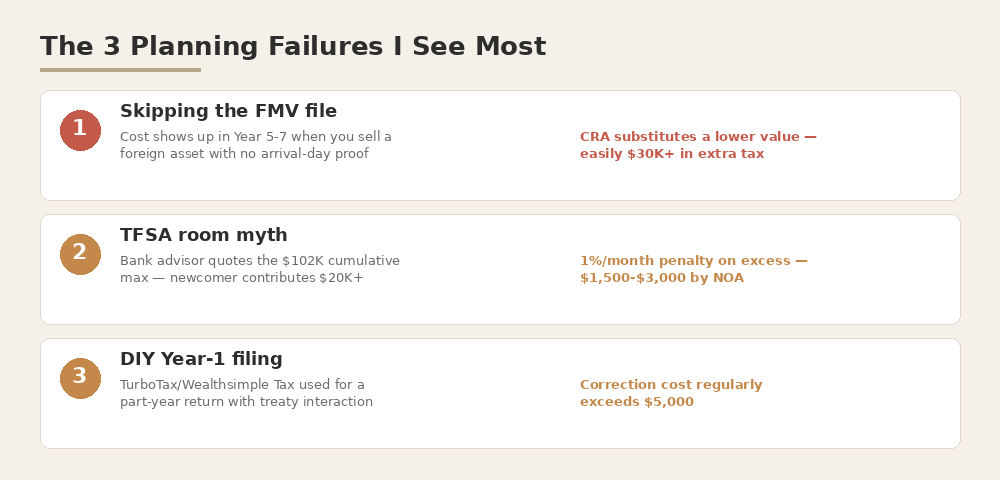
Documents created on arrival week are dramatically stronger than reconstructions years later. Skip the file and sell your Mumbai flat in Year 7 without an appraisal? CRA substitutes a lower value — easily CAD $30,000 in extra tax. One hour of arrival-week work prevents it.
Decision 2: Decide Your Residency-Start Date Deliberately
Most newcomers think their residency-start date happens to them. It does not. The date is determined by when you establish residential ties, and the timing of some of those ties is within your control.
The residency-start date sets the boundary between pre-arrival income (not taxable in Canada) and post-arrival income (taxable worldwide). It also determines which country has primary taxing rights during the transition.
Where timing is a genuine planning lever. If your spouse and children arrive three months after you, when Canada becomes your “centre of vital interests” is less clear-cut. If you maintain a home abroad, whether you have a “permanent home available” in one country or both affects the treaty analysis.
You cannot fabricate ties that do not exist, and you should never misrepresent your situation to CRA. But you can be deliberate about the sequence in which you establish ties — and that sequence can affect the residency-start date, the treaty positioning, and the foreign-tax-credit outcome.
Country-specific considerations I see most in Calgary:
- US newcomers: US citizens owe the IRS on worldwide income regardless of residence. Need Form 1040 + T1 + FBAR/FATCA. A cross-border CPA is essential.
- UK newcomers: File P85 with HMRC for non-resident status. UK State Pension becomes Canada-taxable. UK SIPP stays in the UK.
- India newcomers: Indian EPF often earns after-tax returns exceeding Canadian equivalents — “leave it” is usually the default.
- Philippines newcomers: OFW returnees’ BIR documentation supports Canadian foreign-tax-credit analysis. SSS and GSIS pensions become Canada-taxable.
The CPA handles the treaty election mechanics. The planner’s job is to help you decide your position before the CPA files it.
Decision 3: Open the Right Registered Accounts in the Right Order
One of the few Year-1 moves entirely within your control, costs nothing to get right, and is expensive to get wrong.
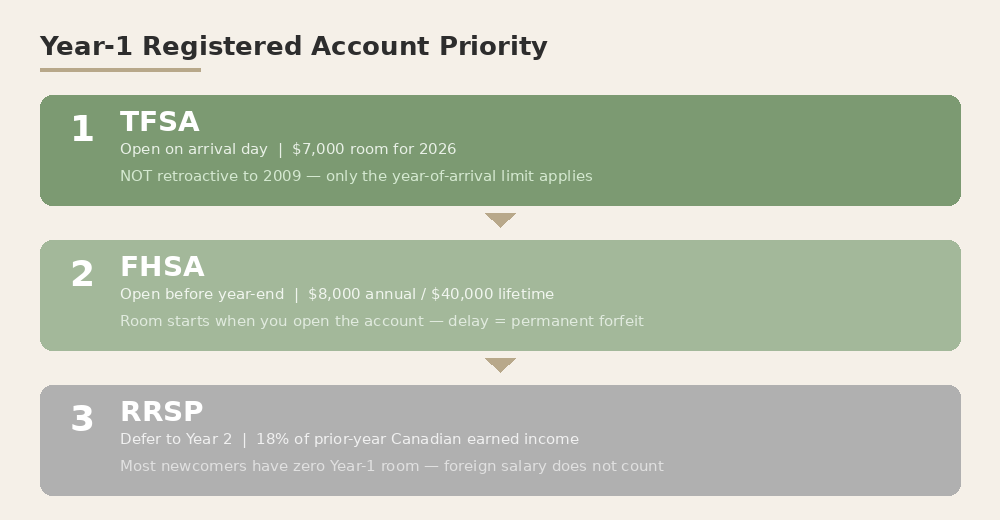
The critical trap: a bank advisor quotes the $102,000+ cumulative TFSA figure. Your actual room as a 2026 arrival is $7,000 — over-contributing triggers 1% per month CRA penalties automatically. The FHSA 4-year home-ownership look-back applies to foreign homes too.
The deep mechanics sit in the contribution-room mechanics for RRSP, TFSA, and FHSA for newcomers →.
Decision 4: Sequence Your CPA Engagement
The meta-decision that ties the first three together.
When to hire. Before April 30 of Year 2 — but not the week before. The smoothest Year-1 outcomes come from engaging a CPA by Month 6 of arrival, well before the filing crunch. Early engagement lets the CPA review your FMV file, confirm residency-start positioning, and flag treaty requirements without deadline pressure.
What to bring. Three things ready for the first meeting:
- The FMV documentation file (Decision 1) — broker statements, appraisals, valuations, all dated on or near arrival.
- Your residency-start position (Decision 2) — the date and supporting facts. A clear position beats a shrug.
- Your registered-account inventory (Decision 3) — which accounts opened, amounts contributed, dates.
What NOT to DIY. Year 1 is the worst year to file your own return. Part-year mechanics, foreign-asset disclosure penalties, and treaty elections all require cross-border CPA expertise. Worth the $500–$1,500 fee.
The planner’s role is upstream: decisions made and documentation organized before the CPA meeting. The CPA’s role is downstream: translating those decisions into a correctly filed return. When both do their job, Year 1 is clean. When neither expects the other, it is expensive.
What Your CPA Owns in Year 1
Everything below is your CPA’s execution territory — know what to flag, not how to do it.
The Three Planning Failures I See Most
After working with newcomer families in Calgary, three patterns account for the majority of avoidable Year-1 damage.
Sources
- CRA Folio S5-F1-C1, Determining an Individual’s Residence Status
- Income Tax Act — Section 128.1 (Becoming a Resident, Deemed Acquisition)
- CRA — TFSA Contribution Room Calculation
- CRA — First Home Savings Account
- CRA — T1135 Foreign Income Verification Statement
- CRA — Newcomers to Canada (Tax Information)
- Canada-US Tax Treaty
- Canada-UK Tax Treaty
- Canada-India Tax Treaty
- CRA — Form RC151 GST/HST Credit Application for Newcomers
Frequently Asked Questions
What’s the single most important thing I should do in my first week in Canada?
Document the fair market value of every non-Canadian asset you own on your arrival date. This one-hour exercise — downloading brokerage statements, screenshotting cryptocurrency balances, requesting real-estate appraisals — creates the FMV file that protects your Canadian cost base for every future capital-gains calculation. It is the single highest-return planning move in Year 1, it cannot be done retroactively with the same evidentiary strength, and skipping it is the most common first-year mistake I see in newcomer cases. Everything else — opening accounts, applying for the SIN, choosing a bank — matters, but nothing else has the same ratio of effort to long-term financial impact.
Do I really need a CPA in my first year? Can’t I use Wealthsimple Tax?
Your Year-1 Canadian return has part-year filing mechanics, foreign-income reporting, deemed-acquisition positioning, possible treaty interaction, and foreign-asset disclosure thresholds. Consumer tax software handles none of these well. A Canadian CPA with cross-border experience for your source country costs $500–$1,500 for the first-year filing. The cost of correcting a DIY return with missed disclosures — including retroactive penalties, interest, and potential voluntary-disclosure filings — regularly exceeds $5,000. Year 1 is the worst year to DIY.
My spouse and kids arrived three months after me — does that matter for Year 1?
It can. Your residency-start date depends on when you establish residential ties — and the timing of your family’s arrival affects when CRA considers your “centre of vital interests” to have shifted to Canada. If you arrived alone and started working, but your spouse and children remained abroad for three months, there is a legitimate question about whether your residency-start date is your arrival date or the date your family joined you. The difference affects how much of your Year-1 income is taxable in Canada and the treaty position if both countries claim residency. This is a planning conversation to have with your planner and CPA before the return is filed.
What’s the difference between what my CPA does on my first-year tax and what my financial planner does?
Your CPA files the return — the T1, the T1135 if applicable, the treaty election, the foreign tax credit calculation. That is execution: accurate, technical, deadline-driven. Your financial planner works upstream: helping you make the four decisions that shape the return before it is filed. Which assets to document and how. Whether the residency-start date positioning matters for your treaty situation. Which registered accounts to open and in what order. When to engage the CPA and what to hand them. The planner designs the Year-1 architecture; the CPA translates it into a compliant filing.
Related Reading on This Site
- The 3-Year Newcomer Financial Roadmap: From Arrival to Year 3 in Canada (2026) (Post 08 — the strategic pillar mapping the Year-1-through-Year-3 sequence; this post covers the Year-1 planning decisions that feed into the roadmap)
- RRSP and TFSA for Newcomers to Canada in 2026 (Post 09 — the contribution-room mechanics for RRSP, TFSA, and FHSA for newcomers; the deep mechanics behind Decision 3)
- Newcomer Year-1 Tax-Filing Checklist Canada (2026) (Post 10 — the form-and-deadline reference your CPA will work from)
- Salary vs Dividends in 2026 (Cluster 1 — relevant for newcomers planning to incorporate post-Year 3)
Conclusion and Next Steps
Your first year in Canada runs on two calendars. The CPA’s calendar ends at April 30 of Year 2 — that is when the return is due and the execution work closes. Your planning calendar starts on arrival day and closes in the first 90 days — that is when the four decisions in this post get made, documented, and handed to the right professional.
Document your pre-arrival asset values. Decide your residency-start date deliberately. Open the right registered accounts in the right order. And sequence your CPA engagement so they get a clean file, not a March scramble.
The planning moves are small, early, and inexpensive. The cost of skipping them shows up years later, when it is large, late, and difficult to reverse.
Book a discovery call to walk through your Year-1 planning decisions → Book a complimentary 15-minute call
Important disclosure
General information only — not personalized investment, tax, or legal advice. Tax rules change frequently and your situation may differ materially from the scenarios and examples above. The first-year Canadian tax return for a newcomer is fact-intensive — the residency-start date, the deemed-acquisition FMV documentation, the foreign-asset disclosure assessment, and the treaty position all depend on the specific facts of your arrival and your source country. The first-year filing is properly the responsibility of a qualified Canadian CPA, ideally one with cross-border tax experience for your specific source country (US, UK, India, etc.). This post is a financial-planning overview, not a tax-preparation guide — Consult a qualified Canadian CFP and CPA before acting on anything in this post.
Author bio: Jahid Hassan is a CFA Charterholder and CFP Professional based in Calgary, Alberta, specializing in Investment Planning and tax integration for Canadian business owners and newcomers to Canada. Connect on LinkedIn.