The Question Everyone Asks (And Why It’s the Wrong One)
The first question every newcomer asks their bank advisor: “How much TFSA room do I have?”
The advisor checks the system and says something like “$102,000.” The newcomer contributes $20,000 in their first week. Six months later, CRA sends a Notice of Assessment with a 1% per month penalty on $13,000 of over-contribution — because the advisor quoted the cumulative room for someone who has been a Canadian resident since 2009, not the $7,000 that applies to a 2026 arrival.
That question — how much room do I have? — is the wrong starting point. The right questions for a newcomer to Canada are these: Which account should I fund first? How does my arrival year change the rules? And what’s the sequencing mistake that costs the most over 10 years? Those are planning questions, and they have different answers than the contribution-room questions your bank or CPA will answer.
This post reframes the RRSP newcomer Canada and TFSA newcomer conversation around the four questions that actually shape your outcome — not the mechanical room calculations (your CPA handles those), but the planning decisions that determine whether your first-year dollars compound in the right accounts for the next decade.
Key Takeaways
- TFSA room starts the year you become a Canadian tax resident — not retroactively to 2009. A 2026 arrival has $7,000 of room, not $102,000+. Over-contributing triggers 1% per month penalties automatically.
- RRSP room is built from prior-year Canadian-source earned income only. Foreign salary before your arrival does not generate room. Most newcomers have zero or near-zero RRSP room in Year 1.
- FHSA is often the highest-value Year-1 move — $8,000 annual, $40,000 lifetime, tax-deductible contributions with tax-free withdrawals for a first home. But the 4-year home-ownership look-back applies to foreign homes too.
- The right Year-1 priority order is TFSA first, FHSA second, RRSP last. This is a planning decision, not a contribution-room calculation.
- Your CPA computes the room and files the return. Your planner decides the sequencing, the account priority, and how each registered account fits into your 3-year newcomer financial plan.
What I do, what your CPA does
This post is the planning conversation. My role is the sequencing decision — which registered account gets your first dollar, how the RRSP newcomer Canada contribution timing interacts with your marginal bracket, when the FHSA clock should start, and how the whole picture fits into your 3-year newcomer financial roadmap. Your CPA owns the room calculations: the TFSA contribution limit based on your residency-start year, the RRSP room from your Year-1 T4, the Pension Adjustment from your employer’s plan, and the T1 filing that makes all of it official. I don’t compute the room. I decide where the money goes.
On this page
- The Question Everyone Asks
- Key Takeaways
- Which Account Gets My First Dollar?
- How Does My Arrival Year Change the TFSA Rules?
- When Should I Start the FHSA Clock?
- When Does the RRSP Actually Make Sense?
- Year-1 Allocation at a Glance
- The Three Planning Failures I See Most
- Sources
- Frequently Asked Questions
- Conclusion and Next Steps
The Right Question 1: Which Account Gets My First Dollar?
The RRSP newcomer Canada question and the TFSA newcomer question are usually asked separately — “how much RRSP room do I have?” and “how much TFSA room do I have?” — as if they are independent calculations. They are not. They are one allocation decision: given that you have limited Year-1 dollars and three registered accounts competing for them, which account produces the best outcome over the next 10 years?
The answer for the typical newcomer arriving in 2026 with $20,000–$40,000 to invest:
TFSA first. You have $7,000 of room on arrival. Contributions are not tax-deductible (no upfront benefit), but growth is permanently tax-free and withdrawals add back to room the following year. No lock-in, no penalty for early withdrawal, no interaction with government benefits. This is the foundation.
FHSA second (if you plan to buy a first home within ~5 years). You have $8,000 of annual room the moment you open the account. Contributions are tax-deductible like an RRSP and qualifying withdrawals are tax-free like a TFSA — the best of both worlds. But funds are locked into a first-home purchase or rolled to RRSP if unused. The 4-year home-ownership look-back applies to foreign homes too — if you owned and lived in a home abroad in any of the four years before arrival, you are not eligible until the look-back clears.
RRSP last. Your Year-1 room is likely zero or near-zero, because RRSP room is built from prior-year Canadian-source earned income. Foreign salary before your arrival does not count. Even if you start a $150,000 Canadian job in April 2026, your Year-2 RRSP room (calculated from the partial-year T4) is roughly $20,000 — and if your employer runs a defined-benefit pension plan, the Pension Adjustment can cut that by 80%. RRSP is a Year-2 decision, not a Year-1 priority.
RRSP contribution room (newcomer)
Accumulates at 18% of prior-year Canadian-source earned income, capped at $33,810 in 2026, reduced by any Pension Adjustment. Foreign salary earned before becoming a Canadian tax resident does not generate room. Most newcomers have zero room in their arrival year.
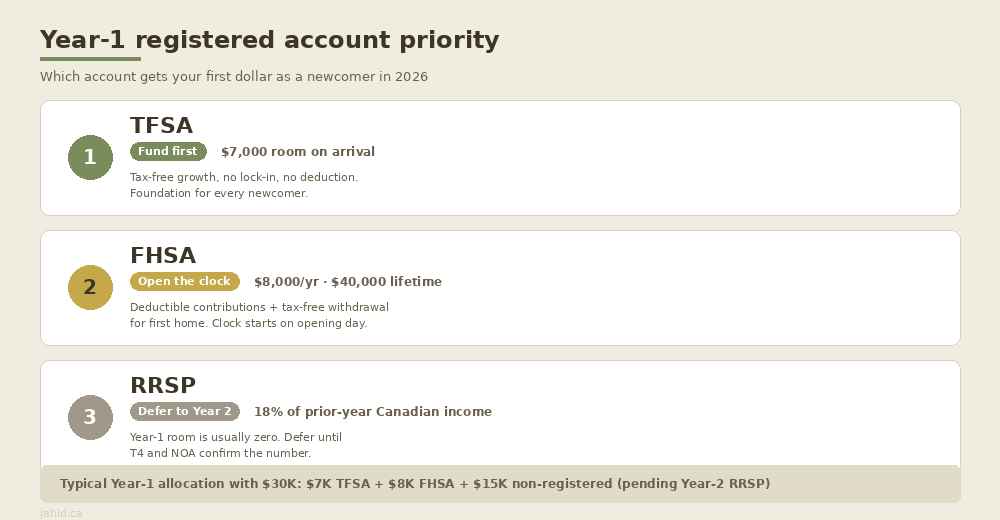
The planning lever: The priority order — TFSA, FHSA, RRSP — is not a universal rule; it is the default for the typical newcomer, and it shifts based on marginal bracket, home-buying timeline, and employer pension. I model the allocation for your specific situation. Your CPA confirms the room numbers on your Notice of Assessment.
The Right Question 2: How Does My Arrival Year Change the TFSA Rules?
The TFSA newcomer Canada trap is the most expensive single mistake in the registered-account space, and it starts with bad information from a well-meaning bank advisor.
What actually happens: TFSA contribution room starts the calendar year you become a Canadian tax resident. A 2026 arrival gets $7,000 for 2026 — the full year’s amount, not pro-rated. On January 1, 2027, you get another $7,000 (or whatever the indexed limit is). That is it. The cumulative $102,000+ figure belongs to people who were Canadian-resident adults since 2009.
What goes wrong: The bank advisor’s system shows the maximum cumulative figure. The newcomer contributes $20,000 in May 2026. CRA’s automated system catches the $13,000 over-contribution and assesses a 1% per month penalty — $130 per month until the excess is withdrawn. By the time the Notice of Assessment arrives in 2027, the penalty is $1,500–$3,000. No warning, no grace period, no $2,000 buffer (the RRSP has one; the TFSA does not).
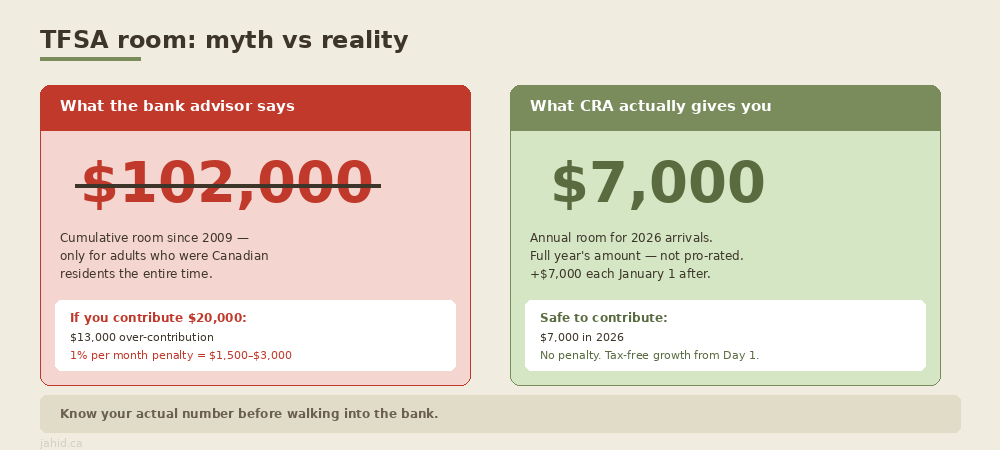
Timing details that matter: Room begins the day you become a Canadian tax resident, not the day after. Contributions before that day are non-resident contributions and trigger the same penalty. Practical advice: don’t rush to contribute on landing day. Apply for the SIN (same-day at Service Canada), open the TFSA (one to three business days), and contribute once the account is in your name. Year-of-arrival room is identical whether you contribute on Day 1 or Day 365, but earlier contribution means more compounding.
Foreign equivalents are not TFSAs: A UK ISA grows taxable in Canada from your residency-start date. A US Roth IRA can be sheltered from Canadian tax through a treaty election, but the election must be filed by April 30 of Year 2. Australian superannuation is neither. The TFSA is a fresh Canadian account — do not assume your home-country equivalent transfers.
The planning lever: I flag the TFSA room on arrival day and make sure you know your actual number before talking to the bank. Your CPA confirms the figure on the first Notice of Assessment.
The Right Question 3: When Should I Start the FHSA Clock?
The FHSA is frequently the highest-value Year-1 move for newcomers who qualify — and the planning mistake is not contributing too much; it is opening the account too late.
FHSA (First Home Savings Account)
A registered account for Canadian tax residents 18+ who have not lived in a home they (or their spouse or common-law partner) owned in the current year or any of the four preceding calendar years. The 2026 limits are $8,000 annual and $40,000 lifetime. Contributions are tax-deductible; qualifying withdrawals for a first-home purchase are tax-free.
Why the clock matters: FHSA contribution room only starts when you open the account — not on your arrival date, not retroactively. A newcomer who arrives in March 2026 and opens an FHSA in April has $8,000 of room for 2026 and another $8,000 on January 1, 2027. A newcomer who waits until 2028 to open the account permanently forfeits the 2026 and 2027 room — $16,000 of tax-deductible, tax-free-withdrawal capacity gone forever.
Open the FHSA in your arrival year even if you contribute $0. Starting the clock is free.
The 4-year look-back trap: CRA guidance makes clear the look-back applies to homes owned outside Canada as well as inside. If you owned and lived in a home in Bangalore, London, or Manila until December 2025 and arrived in Calgary in January 2026, you are not FHSA-eligible until 2030. Whether the home was sold or kept does not change the test.
The combination play: FHSA can be paired with the Home Buyers’ Plan (HBP) for additional first-home funding. HBP allows a tax-free RRSP withdrawal of up to $60,000 per individual, repayable over 15 years. A couple buying together: up to $40,000 from each FHSA plus $60,000 from each RRSP — a maximum of $200,000 of tax-advantaged first-home funding.
The planning lever: I check FHSA eligibility against the 4-year look-back on arrival day and open the account immediately if you qualify. Your CPA tracks the contribution room and claims the deduction on the T1. The home-purchase timing — and whether to combine FHSA with HBP — is a planning conversation tied to your 3-year roadmap.
The Right Question 4: When Does the RRSP Actually Make Sense?
For most newcomers, the RRSP is a Year-2 decision. Here is why, and when the exceptions apply.
The mechanics: RRSP room is 18% of prior-year Canadian-source earned income, capped at $33,810 in 2026. “Prior-year” means the calendar year before the contribution year. Your Year-1 RRSP room is calculated from the year before you arrived — which has zero Canadian earned income. Your Year-2 room is calculated from your partial-year T4 in the arrival year.
Worked example: A consulting professional becomes a Canadian tax resident on April 1, 2026 and joins a Calgary employer at $150,000 base salary. Pro-rated for nine months, the 2026 T4 earned income is roughly $112,500. Eighteen percent is $20,250 — that is the Year-2 RRSP room, available after the first Notice of Assessment in mid-2027. If the employer runs a defined-benefit pension plan generating a $14,000 Pension Adjustment, the room shrinks to roughly $6,250.
Pension Adjustment (PA)
An annual amount on your T4 (box 52) representing the value of pension benefits accrued in your employer’s Registered Pension Plan. The PA reduces the following year’s RRSP room. Defined-benefit plans typically generate large PAs that can consume most of the 18% calculation.
When the RRSP makes sense in Year 1: Only if your partial-year Canadian earned income is substantial (above ~$100,000) and your marginal bracket exceeds 30%. Below that, the TFSA deduction-free environment usually wins because the RRSP deduction is worth less at a lower bracket.
The spousal RRSP for newcomer couples: If one spouse will earn substantially more — common when one incorporates a consulting practice — the spousal RRSP equalizes retirement income across two brackets. Withdrawals within three calendar years of any contribution are attributed back to the contributor. This interacts directly with the salary-vs-dividends decision for newcomers who incorporate.
The foreign pension transfer: A US 401(k), Traditional IRA, or qualifying foreign pension can be rolled into an RRSP under paragraph 60(j) without consuming regular room. A Roth IRA cannot. This is a separate workstream from regular RRSP contributions — mechanics are covered in the foreign pension post.
The planning lever: I defer the RRSP decision to Year 2 for most newcomers and model it against the confirmed T4 and PA. Contributing in Year 1 with no Canadian earned income locks up cash for no tax benefit — one of the most common newcomer mistakes. Your CPA confirms the official room on the Notice of Assessment.
The RRSP and TFSA Newcomer Year-1 Allocation at a Glance
| Account | Year-1 newcomer eligibility | 2026 limit | Tax-deductible? | Best Year-1 use |
|---|---|---|---|---|
| TFSA | Open immediately on residency. 18+ with SIN. Room = $7,000. | $7,000/yr | No | Always. Even $1,000 starts tax-free compounding. |
| FHSA | Open in arrival year if not lived in home you owned in past 4 years (foreign homes count). | $8,000/yr, $40,000 lifetime | Yes | Open in arrival year even with $0 contribution. Contribute if home purchase planned ~5 years. |
| RRSP | Room = 18% of prior-year Canadian earned income. Year-1 room is usually zero. | $33,810 max | Yes | Defer to Year 2. Year-1 only if marginal bracket exceeds 30% and Canadian income exceeds $100K. |
The dominant Year-1 allocation for a typical newcomer with $30,000 to invest: $7,000 to TFSA, $8,000 to FHSA, and the remaining $15,000 to non-registered savings pending the Year-2 RRSP decision.
The Three Planning Failures I See Most
After working with newcomer families in Calgary, three RRSP and TFSA newcomer patterns account for the majority of avoidable Year-1 damage.
Failure 1: The $20,000 TFSA contribution on advice from a bank advisor. The advisor quoted the cumulative maximum. The newcomer contributed $20,000 against $7,000 of actual room. CRA’s automated system assessed $130/month in penalties for 12 months before the first Notice of Assessment arrived. Total cost: $1,500–$3,000 in penalties, plus the stress of unwinding the over-contribution. The fix: know your actual TFSA room before walking into the bank — your arrival year times the annual limit, nothing more.
Failure 2: The RRSP contribution in Year 1 with no Canadian earned income. The newcomer arrived with savings and a financial advisor back home who said “always maximize your RRSP.” They contributed $15,000 to an RRSP in their arrival year — against zero room, because they had no prior-year Canadian earned income. The $2,000 lifetime RRSP over-contribution buffer absorbed part of it; the remaining $13,000 triggered 1% per month penalties. Worse, the money was now locked in a registered account with no tax benefit and an early-withdrawal tax hit. The fix: RRSP is a Year-2 decision for nearly every newcomer.
Failure 3: The FHSA opened two years too late. The newcomer qualified on arrival but did not open an FHSA until Year 3 — losing two years of $8,000 annual room permanently. By the time they bought a home in Year 4, they had $16,000 less in tax-advantaged first-home funding than they could have had. At a 30% marginal rate, the lost deduction alone was worth $4,800. The fix: open the FHSA in your arrival year, even with a $0 contribution.
Sources
The statutory provisions and CRA guidance referenced in this post:
- CRA — Calculate your TFSA contribution room
- CRA — Opening your FHSAs
- CRA — How non-residency affects your TFSA
- Income Tax Act — Section 146 (RRSPs, including earned income definition)
- Income Tax Act — Section 60 (Transfers, including paragraph 60(j) foreign pension rollover)
- CRA — RRSP/MP/DB/DPSP/TFSA limits, YMPE
- CRA — Home Buyers’ Plan
- CRA — Newcomers to Canada
Frequently Asked Questions
When does TFSA contribution room start for newcomers to Canada?
TFSA contribution room starts the calendar year you become a Canadian tax resident — not retroactively to 2009. A 2026 arrival has $7,000 of room for that year, plus the indexed annual amount on January 1 of each subsequent year. The cumulative $102,000+ figure does not apply to you. Room is annual, not pro-rated — a March 2026 arrival has the same $7,000 as a December 2026 arrival. Contributions before your residency-start date trigger a 1% per month penalty. The planning move: know your actual number before walking into the bank, and don’t rely on the advisor’s system to distinguish between long-standing residents and newcomers.
Can I contribute to an RRSP in my first year if I only earned foreign income?
No, if all Year-1 income was foreign-source earned before becoming a Canadian tax resident. RRSP newcomer Canada room is built only from Canadian-source earned income as defined in the Income Tax Act — T4 employment income, net self-employment income, net rental income, and a short list of other Canadian items. Foreign salary before residency does not count. Most newcomers have zero RRSP room in their arrival year. Year-2 room — calculated from the residency-start-to-December-31 earned income — is the first meaningful number. The planning default: defer RRSP to Year 2 and let TFSA carry the Year-1 load.
Should newcomers prioritize RRSP, TFSA, or FHSA in Year 1?
The default RRSP newcomer Canada priority order in Year 1 is TFSA first, FHSA second (if a home purchase is planned within ~5 years), and RRSP last. TFSA wins because room is available immediately, growth is tax-free, and withdrawals are flexible. FHSA wins second because contributions are deductible and qualifying withdrawals are tax-free — but funds are locked into a first-home purchase. RRSP comes last because most newcomers have no Year-1 room and the partial-year bracket is usually too low to make the deduction efficient. Exceptions: newcomers with Canadian income exceeding $100,000 in a high bracket may benefit from early RRSP; newcomers with a DB pension should wait until the Pension Adjustment is known.
What is the Pension Adjustment and how does it affect my RRSP room?
The Pension Adjustment is an amount on your T4 (box 52) representing pension benefits accrued in your employer’s Registered Pension Plan. It reduces the following year’s RRSP room. For newcomers joining an employer with a defined-benefit plan, the PA can consume 80%+ of the 18%-of-earned-income RRSP calculation. A newcomer earning $112,500 of partial-year T4 income has an 18% figure of $20,250; a $14,000 DB plan PA shrinks Year-2 room to ~$6,250. Contributing the unreduced figure triggers 1% per month over-contribution penalties. The planning fix: wait for the T4 and Notice of Assessment before contributing, and factor the PA into your allocation model.
Related Reading on This Site
- Your First Year in Canada: The 4 Planning Decisions Before April 30 — Post 07 — the four Year-1 planning decisions that feed into your registered-account strategy
- The 3-Year Newcomer Financial Roadmap — Post 08 — where the RRSP newcomer Canada decisions sit in the broader 3-year plan
- Your CPA’s Year-1 Checklist for Newcomers — Post 10 — the filing execution side that follows the planning in this post
- Salary vs Dividends in Canada 2026 — Cluster 1 — salary creates RRSP room, dividends do not; relevant for newcomers who incorporate
Conclusion and Next Steps
The RRSP newcomer Canada and TFSA newcomer questions are simple in principle and unforgiving in detail. TFSA room starts the year you arrive — $7,000, not $102,000. RRSP room is built from prior-year Canadian income only — Year 1 is usually zero. FHSA is often the highest-value Year-1 move, but the clock starts only when you open the account.
The planning questions that matter are not “how much room do I have?” — your CPA answers that on the Notice of Assessment. The questions that matter are: which account gets my first dollar, when should I start the FHSA clock, and when does the RRSP actually justify a contribution? Those are sequencing decisions, and they shape the next decade of compounding.
Book a discovery call to walk through your Year-1 registered-account allocation → Book a complimentary 15-minute call
Important disclosure
General information only — not personalized investment, tax, or legal advice. RRSP newcomer Canada planning is fact-intensive: source country, family structure, immigration class, and employer pension plan all change the right answer materially. The 2026 figures cited (TFSA $7,000, RRSP $33,810, FHSA $8,000/$40,000, HBP $60,000) are accurate as of May 2026 — verify on the relevant government website before acting. Treaty-article interactions (Canada-US, Canada-UK, Canada-India) change foreign-account treatment and are not covered here in source-country-specific detail. The room calculations, PA reconciliation, and T1 filing are properly the responsibility of a qualified Canadian CPA. This post is a financial-planning overview, not a tax-preparation guide. Consult a qualified Canadian CFP and CPA before acting on anything in this post.
Author bio: Jahid Hassan is a CFA Charterholder and CFP Professional based in Calgary, Alberta, specializing in Investment Planning and tax integration for Canadian business owners and newcomers to Canada. Connect on LinkedIn.