Your Holdco Isn't “the Company's Money” — It's the Pension You Built
You spent thirty years being careful with the company's cash. You left profits inside the corporation, paid yourself only what you needed, and treated the holdco balance as something separate from your own money — a war chest, the business's account, not yours. That discipline built real wealth. But now the opco is sold or wound down, the salary has stopped, and that habit of mind has quietly become the most expensive mistake in your retirement. The money inside your holding company is not the company's money waiting for a purpose. It is the purpose. It is the pension you built for yourself, dollar by dollar, instead of an employer building one for you. The planning question is no longer “how do I protect it?” — it's “how do I pay it out to myself at the lowest tax over the next twenty-five years?”
That reframe changes everything downstream. Turning a corporation into holding company retirement income is not a single-year tax-return problem your accountant solves each April; it's a multi-year drawdown decision you design first, then hand over to be executed. This post is the planner's framework for that decision. The capital dividend account, the refundable tax pools, eligible versus non-eligible dividends — you'll meet all of them, but as levers that serve the schedule, never as the subject. The subject is your paycheck.
Key Takeaways
- The decision is the schedule, not the amount. “How much should I take this year?” is the wrong question. “What multi-year dividend plan empties the holdco at the lowest lifetime tax?” is the right one.
- Flush the free money first. Any balance in the capital dividend account comes out completely tax-free — it's the cleanest dollar in the whole structure, and it's the first lever to pull.
- Don't strand the refundable tax. Your corporation prepaid tax that only comes back when it pays you a taxable dividend — about 38 cents on the dollar. Leave it stranded and you've donated it.
- The OAS line is the ceiling you plan against. Eligible and non-eligible dividends hit your personal bracket differently and both count toward the clawback that begins around $95,000 of net income in 2026. The dividend mix is how you stay under it.
- You leave with a schedule, not a tax return. A year-by-year dividend plan — CDA first, then a managed eligible/non-eligible mix under the OAS line, coordinated with your RRSP melt — is what you hand your CPA to execute.
On this page
- What You're Actually Deciding: The Multi-Year Schedule
- Take the Free Money First: The Capital Dividend Account
- Don't Strand the Refundable Tax
- Eligible vs Non-Eligible: Your Bracket and the OAS Line
- The Budget 2025 Timing Wrinkle, in One Pointer
- Coordinating With CPP, OAS, and the RRSP Melt
- What This Holdco Looks Like at Death
- What to Hand Your CPA
- Sources
- Frequently Asked Questions
- Related Reading on This Site
- Conclusion
What You're Actually Deciding: The Multi-Year Schedule, Not This Year's Number
Almost everyone walks in with the same question: “How much can I take out of the holdco this year without a big tax hit?” It feels responsible, but it's the wrong frame, because it optimizes one year at the expense of the next twenty. Take too little — the instinct of a careful owner — and the balance keeps compounding inside the company until something forces it out all at once, at the worst possible rate, often after you're gone. Take a big lump in a single good year and you spike into the top bracket and trigger the OAS clawback for nothing. Both mistakes come from looking at one year instead of the whole horizon.
The real decision: what multi-year dividend schedule empties my holding company at the lowest tax over my whole retirement — not just this year — while keeping me under the OAS line and leaving the estate clean? Everything else in this post is a lever that serves that one schedule.
Framed this way, the holdco stops being a tank you nervously dip into and becomes a project with a beginning, a middle, and an end. The beginning is your early retirement years, when your other income is low and your brackets are empty — the cheapest years you will ever have to pull money out. The middle is steady, levelized withdrawals that keep your taxable income in a deliberate band year after year. The end is a holdco that is substantially wound down by the time the estate is in view, so the shares don't collide with the double-tax trap at death. You're not asking “how much this year?” You're drawing a line across twenty-five years and deciding how to fill the space underneath it.
This is exactly the same logic that governs the whole-portfolio corporate retirement decumulation plan — the order in which you unwind your holdco, RRSP, TFSA and non-registered savings. This post zooms into one of those four taps: the corporate one, usually the biggest and the one with the most levers. Get its multi-year schedule right and it can fund years of income at a blended rate well below your top marginal rate.
Take the Free Money First: The Capital Dividend Account
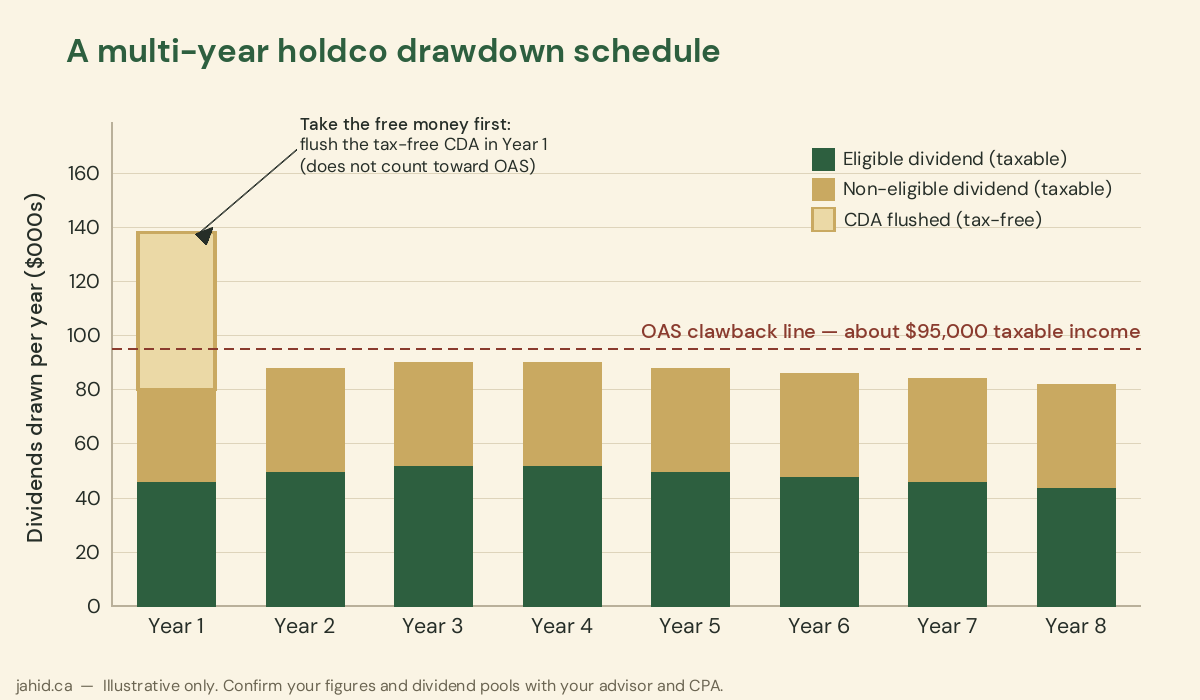
Before you pay yourself a single taxable dollar, find out what's sitting in the capital dividend account. The CDA is a notional balance that tracks the tax-free slices of what your corporation has earned — principally the non-taxable half of every capital gain the company has realized, plus the proceeds of any corporate-owned life insurance above its cost base. A dividend paid out of that balance lands in your personal account completely tax-free. No gross-up, no clawback effect, nothing on your return. It is the single cleanest dollar in the entire structure.
So the first lever in your schedule is simple: flush the CDA early, and don't let it evaporate. The balance isn't permanent. It's a moving number that can shrink if the company later realizes capital losses, and a positive balance does nothing for you while it sits there. The planning move is to confirm the current balance with your accountant, pay it out as a tax-free capital dividend in an early year, and bank that money personally — ideally topping up your TFSA and non-registered savings so it keeps working for you outside the corporation. Flushing the CDA also lowers the company's value for the eventual wind-down, which quietly helps the estate side of the plan.
The timing nuance worth knowing — at the planning level, not the technician's — is that the CDA balance moves with the company's realized gains. If your corporation is about to realize a large gain (say, selling an investment property held inside it), that transaction will add to the CDA, and there can be a case for sequencing the capital dividend right after. This is precisely the kind of timing your CPA confirms before the election is filed; your job is simply to know the free money exists and to make claiming it the first line of the schedule rather than an afterthought.
Don't Strand the Refundable Tax
Here is the lever almost everyone leaves on the table. When your holding company earns investment income — interest, dividends, capital gains on its portfolio — it pays a high rate of corporate tax on it, deliberately. A big chunk of that tax isn't really the government's to keep; it's a deposit. It sits in a notional pool (your accountant calls it RDTOH) and gets refunded to the company — roughly 38 cents for every dollar of taxable dividend the company pays out to you. The system is designed so that money earned inside a corporation and then paid out to you isn't taxed more heavily than if you'd earned it personally. But the refund only happens when you actually pay the dividend.
That single fact reshapes the schedule. If you under-draw the holdco to “keep taxes low,” you're leaving that prepaid tax stranded inside the company, doing nothing, year after year. Pay yourself a sensible taxable dividend and you trigger the refund — the company gets cash back from the government, which means the combined tax you and the corporation paid on that income drops. Underpaying isn't conservative; it's expensive. The refundable pool is the reason a steady stream of moderate dividends usually beats a strategy of hoarding and then dumping.
You don't need to compute the pools — that's the CPA's job. What you need from this section is the instinct: a dollar of refundable tax left in the company at death is a dollar you gave away. The schedule should draw enough taxable dividend each year to keep recovering that prepaid tax, pacing it so you never have to release it all in one bracket-busting year. Recovering the refundable tax and staying under the OAS line are the two constraints your dividend plan is balancing — which is exactly where the eligible-versus-non-eligible choice comes in.
Eligible vs Non-Eligible: Managing Your Bracket and the OAS Line
Taxable dividends from your holdco come in two flavours, and the difference is a genuine planning lever rather than accounting trivia. Eligible dividends are paid out of income that was taxed at the higher general corporate rate; they're grossed up more (38% in 2026) but carry a larger dividend tax credit, so in your hands they're taxed relatively lightly. Non-eligible dividends come out of income taxed at lower corporate rates — small-business and most investment income; they're grossed up less (15%) and carry a smaller credit, so they cost you a bit more personally. Which type your company can pay depends on its tax pools, but where you have a choice, the mix is yours to manage.
The constraint that turns this into a real decision is Old Age Security. The clawback claws back 15 cents of OAS for every dollar of net income above the 2026 threshold of about $95,323, and fully erases the benefit by roughly $152,062 for those aged 65 to 74 (a slightly higher ceiling, about $157,923, applies from 75). Here's the catch most owners miss: it's the grossed-up dividend that lands on your return, not the cash you received. A dividend that puts, say, $80,000 in your pocket can show up as well over $100,000 of taxable income after the gross-up — quietly pushing you into the clawback even though you only spent $80,000. Plan against the grossed-up figure, not the cash.
So the lever works like this: in each year of the schedule, you choose a dividend size — and, where the pools allow, a blend of eligible and non-eligible — that fills your lower and middle brackets, recovers refundable tax, and keeps your grossed-up taxable income under the OAS ceiling. In a year you have room, you take more; in a year the RRIF or other income is already high, you dial the holdco back. The goal across the whole retirement is a smooth, deliberate band of taxable income rather than a low-then-high sawtooth. Smooth almost always wins, because Canada's graduated rates punish the spikes.
The Budget 2025 Timing Wrinkle, in One Planning Pointer
One pointer, and only if it applies to you. Budget 2025 introduced rules that suspend a corporation's dividend refund in certain tiered structures — where one company you own sits under or over another and the two have mismatched, staggered year-ends that were being used to defer tax. In those cases the refund the paying company would normally receive is held back until the income actually flows out to a non-affiliated company or to you personally. The measure applies to dividends paid in taxation years that begin on or after November 4, 2025.
For most retired owners with a single holdco, this changes nothing — your refund works the way it always has. But if your wealth sits in a two-tier arrangement (a holdco beneath another holdco, or a holdco under what used to be the opco), the timing of when refunds land can shift, and that affects how you sequence dividends across the group. The planning pointer is simply this: if you have more than one corporation in a chain, ask your CPA to confirm the year-ends line up before you lock in the dividend schedule. It's a one-line check on your plan, not a reason to fear the schedule — and it's exactly the sort of structural detail a technician confirms while you keep your eyes on the income target.
Coordinating With CPP, OAS, and the RRSP Melt
The holdco schedule is never designed in isolation, because every dollar of dividend shares the same tax bracket — and the same OAS ceiling — as the rest of your income. The two pieces it has to dovetail with are your RRSP and your government benefits.
Your RRSP is the competing claim on those precious low-income early years. The same gap years that are ideal for big holdco dividends are also the ideal years to melt the RRSP down before age 71 forces the RRIF minimums on top of everything else. You can't max out both in the same bracket — so the two schedules are built together, deciding each year how much room goes to corporate dividends and how much to RRSP withdrawals. That trade-off is the heart of the RRSP-to-RRIF conversion decision, and it's why the holdco plan and the melt-down plan are really one plan.
When you switch on CPP and OAS is the other half of the coordination. Deferring them into your late 60s keeps your taxable income low in the gap years — making more room for tax-efficient holdco and RRSP withdrawals — and buys you a larger, inflation-indexed guaranteed income for life. The flip side is that once OAS starts, every taxable dividend now stacks on top of it and counts against the clawback. The dividend schedule has to know exactly when those benefits begin, which is the subject of the CPP and OAS timing spoke. Blending all of these income sources across a household — especially with a spouse — is the discipline covered in retirement income layering.
What This Holdco Looks Like at Death
The reason “leave the estate clean” is built into the decision is that a holdco left full at death is one of the harshest results in Canadian tax. On death you're deemed to dispose of your shares, triggering a capital gain on their value — and then the assets inside the company are taxed again when they're eventually paid out to your heirs. Without careful planning, the same dollars can be taxed twice, and the combined bite can approach or exceed half the value. That isn't a reason for fear; it's a reason to have a schedule. A holdco you've been deliberately emptying over twenty years simply has far less left to be caught by that trap.
This is where the drawdown schedule and the estate plan become the same conversation. Paying yourself a steady stream of dividends through retirement, flushing the CDA, and recovering the refundable tax all shrink the balance that would otherwise face double taxation. The mechanics of avoiding that double tax — and the relief strategies your executor and CPA can use — are covered in the spoke on private-company shares at death. The takeaway for the schedule is directional and simple: a holdco that's mostly drained by the time it passes is a clean estate; one that's full is a problem you've handed to the next generation.
What to Hand Your CPA
Everything above is the plan — the part only you and your planner can design, because it depends on your spending, your spouse, your longevity assumptions, and what you want the estate to look like. What you walk into your accountant's office with is a clear, executable brief:
- The multi-year dividend schedule — roughly how much to pull from the holdco each year across the retirement horizon, not just this year's figure.
- The CDA flush — confirm the current capital dividend account balance and pay it out tax-free in an early year.
- The eligible/non-eligible mix and refundable-tax recovery — the dividend type and size each year that recovers the prepaid tax without stranding it.
- The OAS ceiling — the grossed-up taxable-income band you want to stay under each year, coordinated with your RRSP melt and benefit start dates.
- The tiered-structure check — if you have more than one corporation, confirm the Budget 2025 year-end question before locking the schedule.
Your CPA then does what they do best: confirms the exact pool balances and rates against the current year's rules, files the capital dividend election and the corporate returns, and flags any structural wrinkle that needs a technician's eye. The division of labour is the whole point. You design the decision — the schedule, the order, the ceiling — and your accountant builds to code. A drawdown schedule handed over this way is worth far more than a question about this year's dividend asked in April.
Sources
- Canada Revenue Agency — Capital dividends and the capital dividend account
- Canada Revenue Agency — Refundable dividend tax on hand (RDTOH)
- Canada Revenue Agency — Eligible and other-than-eligible dividends and the dividend gross-up
- Government of Canada — Old Age Security pension recovery tax (clawback)
- Budget 2025 — Tax Measures: dividend-refund suspension for tiered corporations (years beginning on or after November 4, 2025)
Frequently Asked Questions
How much should I take out in the first year?
That's the question to stop asking in isolation. The right first-year dividend falls out of the multi-year schedule, not the other way around. In practice, an early retirement year — before CPP, OAS and RRIF income begin — is usually a year to take more, because your brackets are empty and you can flush the tax-free CDA and recover refundable tax cheaply. But the number is set by where you want your taxable income to sit every year for the next two decades, under the OAS line. Design the line first; this year's figure is just the first point on it.
When should I flush the capital dividend account?
Generally early, and deliberately. A capital dividend is tax-free regardless of your bracket, so there's little reason to delay claiming a balance you already have — and a positive balance can shrink if the company later realizes capital losses, so waiting carries risk. The main exception is when a large gain inside the company is imminent (it will add to the CDA), in which case sequencing the election around that transaction can make sense. Either way, confirm the balance with your CPA, take the capital dividend, and move that money into your TFSA and personal savings where it keeps growing tax-advantaged.
Why not just leave it invested in the holdco and take a little each year?
Because under-drawing isn't actually conservative. Two costs build up quietly: the refundable tax your company prepaid sits stranded until you pay dividends to recover it, and the balance keeps compounding toward a forced, top-rate wind-down — and a potential double tax — at death. Leaving it invested feels safe, but it often means paying more tax overall and handing your heirs a messy estate. A steady, levelized drawdown that recovers the refundable tax and shrinks the eventual estate usually beats hoarding, even though it means reporting more income today.
Should I take eligible or non-eligible dividends?
Where you have a choice, eligible dividends are taxed more favourably in your hands — but which type your company can pay depends on its tax pools, and non-eligible dividends are often what triggers the refundable-tax recovery. So it's rarely “one or the other” for the whole retirement; it's a mix managed year by year to fill your brackets, recover the prepaid tax, and stay under the OAS line. Remember that both types are grossed up on your return, so plan against the grossed-up figure rather than the cash you receive. The exact blend is something your CPA confirms against the company's pools.
Do I really need to empty the holdco completely?
Not to zero on a deadline — but the direction of the plan is to draw it down substantially over your retirement rather than preserve it. A holdco left full at death faces a deemed disposition of the shares plus tax on the assets coming out, a combination that can approach half the value. Drawing it down on a schedule — while you're alive, at controlled rates, recovering refundable tax along the way — converts that future problem into present, lower-taxed income. How far to empty it depends on your spending, your legacy intent, and any estate-freeze structure you have in place.
What does my CPA do that this plan doesn't?
The schedule — how much, what type, in what order, against your goals and the OAS line — is the planning work you do first. Your CPA executes the technical layer: confirming the exact CDA and refundable-tax balances, filing the capital dividend election, designating dividends correctly as eligible or non-eligible, handling the corporate and personal returns, and catching any structural issue such as the tiered-corporation timing rule. Think of it as design versus construction. You and your planner draw the blueprint; your accountant builds to code. Both matter, but the plan comes first.
Related Reading on This Site
- Turning Your Corporation Into a Retirement Paycheck — the pillar plan: how the holdco fits with your RRSP, TFSA and non-registered pools.
- RRSP-to-RRIF Conversion in 2026 — the melt-down that competes with holdco dividends for your low-income years.
- CPP and OAS Timing for Business Owners — when to switch on the guaranteed base, and the clawback math.
- Retirement Income Layering — blending the holdco with other income across a household.
- Private-Company Shares at Death — the double-tax problem the wind-down is designed to avoid.
- Do I Really Need a Holding Company? — the original structure decision that shapes how you unwind it.
- Salary vs Dividends in 2026 — the compensation logic from your working years, carried into retirement.
- Halal Investing Inside Your CCPC — the corporate-framework path for Muslim owners.
Conclusion
The shift that makes all of this work is the reframe at the top: the holdco isn't the company's money you're guarding — it's the pension you built, and your job now is to pay it out to yourself well. Do that with a multi-year schedule, not a series of nervous one-year decisions. Flush the free money in the capital dividend account first. Draw enough taxable dividend each year to recover the refundable tax your company prepaid. Manage the eligible and non-eligible mix to fill your brackets while staying under the OAS line. Coordinate it with the RRSP melt and your benefit start dates, and aim to leave a holdco that's substantially drained — and an estate that's clean. Build that schedule first, and the figures your CPA confirms each year become a formality instead of a surprise.
Want a planner's read on your own holdco drawdown schedule? Book a complimentary 15-minute call → Book a discovery call
Important disclosure
General educational information only — not personalized financial, investment, or tax advice, and not a recommendation to take any specific dividend or withdrawal action. Corporate drawdown strategy depends on your complete financial picture, your corporation's tax pools, your goals, and your circumstances. Tax rules, dividend gross-up and credit rates, OAS thresholds, capital dividend account and refundable-tax mechanics, and the status of proposed measures (including the Budget 2025 tiered-corporation dividend-refund rules) change and may differ by province; figures cited reflect 2026 and should be reconfirmed before acting. Filing the capital dividend election, designating dividends, and corporate-structure mechanics are the role of a qualified Canadian CPA; product selection and trade execution are the role of a CIRO-registered investment advisor or portfolio manager. Consult the appropriate professionals before acting on anything in this post.
Author bio: Jahid Hassan is a CFA Charterholder and CFP Professional based in Calgary, Alberta, specializing in comprehensive financial planning for Canadian incorporated business owners, newcomers to Canada, and Muslim investors building Shariah-compliant portfolios. Connect on LinkedIn.