Most owners I sit with treat their RRSP like a dam they are not allowed to touch until the government opens the gates at 71. So they wait. They wait until the year they turn 71, convert because they have to, and then watch a mandatory withdrawal schedule decide the shape of their income for the next twenty-five years. The deadline did the planning for them — and it almost never plans in your favour. The better way to think about an RRSP to RRIF conversion is not as a deadline you wait for, but as a timing lever you pull early, on purpose, to smooth your lifetime tax bill. This post is about when to start pulling it.
Key Takeaways
- The age-71 conversion date is a backstop, not a strategy. You can convert all or part of your RRSP to a RRIF any time — and for many owners, starting in their early-to-mid 60s is the better move.
- The real decision is not when am I forced to convert — it is what do I want my taxable income to look like for the next 30 years. Melting down early lets you fill the low-bracket years between retiring and 71 instead of bunching everything after.
- A small, deliberate conversion at 65 unlocks the $2,000 federal pension income amount and pension income splitting with a spouse — two credits a pure RRSP cannot give you.
- The forced minimum at 71 (5.28% of your January 1 balance, climbing every year after) can push a large RRIF holder past the OAS recovery threshold — roughly $93,500 of net income in 2026. Shrinking the balance early is how you keep your Old Age Security.
- Same RRSP, opposite answers: an owner who has stopped drawing a salary should usually melt early, while an owner still pulling six figures from the business should usually wait. The lever is your other income, not the account itself.
On This Page
- Key Takeaways
- The Deadline Everyone Waits For Is the Wrong Frame
- What You’re Actually Deciding: The Shape of Your Income for 30 Years
- The Case for Converting Early
- The Case for Waiting
- The Spousal-Age Election as a Household Lever
- How This Plays With OAS and Your Holdco Draw
- A Worked Decision: Two Owners, Same RRSP, Opposite Answers
- What to Hand Your CPA
- Sources
- Frequently Asked Questions
The Deadline Everyone Waits For Is the Wrong Frame
Here is the rule everyone knows: by December 31 of the year you turn 71, your RRSP has to become a RRIF (or an annuity), and starting the following year you must withdraw a minimum percentage every year for life. That part is true, and it has not changed for 2026.
But notice what the rule does not say. It does not say you have to wait until 71. It does not say you have to convert the whole thing at once. And it does not say the minimum withdrawal is the right withdrawal. The deadline is a backstop the system uses to make sure your tax-deferred money eventually gets taxed. It was never designed to be your retirement income plan — yet for owners who do nothing, it quietly becomes exactly that.
When you let the deadline run the show, two things happen. Your RRSP keeps compounding untouched into your late 60s, growing the balance you will eventually be forced to draw from. Then at 72 the minimum kicks in at 5.40% of a now-larger balance, and it climbs every single year — 6.82% at 80, 8.51% at 85, and higher still. The income you were deferring does not disappear. It stacks up and lands later, taller, and at exactly the age when you have the least flexibility to do anything about it.
Flip the frame and the whole decision changes. Converting part of your RRSP to a RRIF is something you are allowed to do early. The question stops being “how do I survive the deadline” and becomes “how do I use the years before it.”
What You’re Actually Deciding: The Shape of Your Income for 30 Years
Strip away the account names and a meltdown decision is really about one thing: the shape of your taxable income from the day you stop working to the day your estate settles. You are deciding whether that line runs flat and smooth, or whether it sags in the middle and spikes at the end.
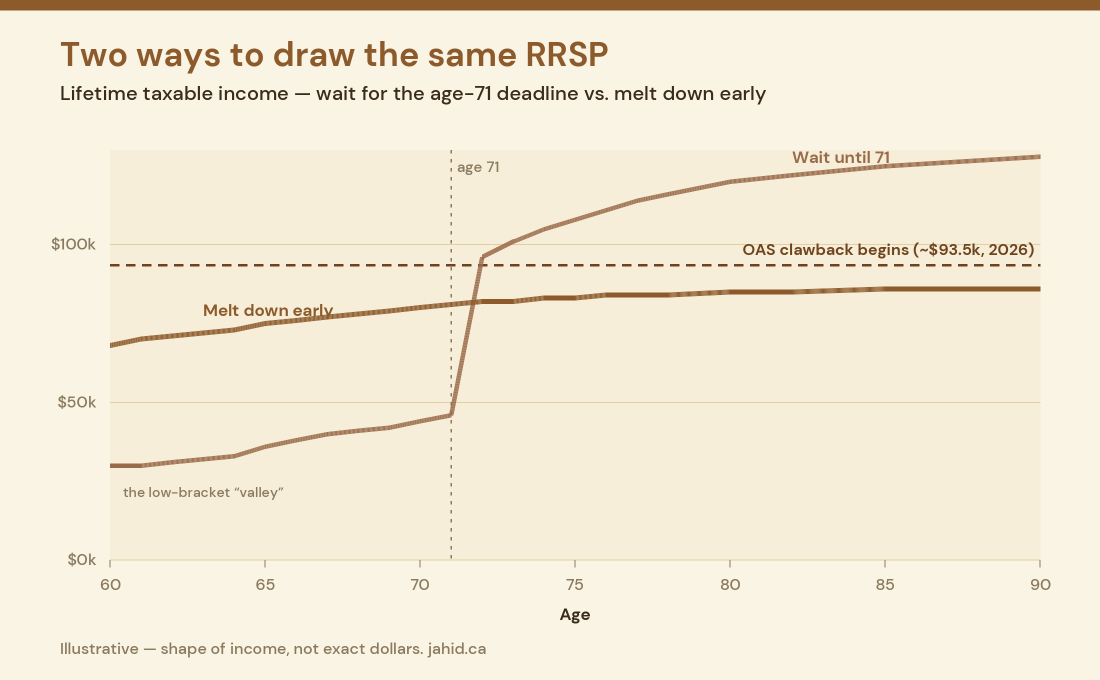
For most incorporated owners there is a window — call it the valley — that opens when you wind down active income from the business and closes when CPP, OAS, and the forced RRIF minimum all switch on around 71 to 72. In that valley your taxable income can be remarkably low. You might be living off cash, your TFSA, or modest corporate dividends, sitting comfortably in the 14% federal bracket (income up to $58,523 in 2026) or the bottom of the 20.5% bracket (up to $117,045). Those are cheap years. Tax-wise, they are the cheapest you will ever see again.
Do nothing, and you waste them. You arrive at 71 with a full RRSP, the minimum forces income on top of CPP and OAS, and you spend your late 70s and 80s paying tax at 26% or higher on money you could have pulled at 14% a decade earlier. A meltdown strategy is simply the act of moving income backward in time — out of the expensive years and into the cheap ones — until the line is as flat as you can make it. Everything that follows is just figuring out how much to move, and when.
The Case for Converting Early
Three planning advantages push most owners toward starting before they have to.
You fill the low-bracket valley. If you have years where your taxable income would otherwise sit at $30,000 or $40,000, there is room to draw RRSP or RRIF income up to the top of the 14% bracket — or even the top of the 20.5% bracket — at a rate far below what the forced minimum will cost you later. You are not avoiding the tax; you are choosing to pay it in your cheapest years instead of your most expensive ones. Done across five or six years before 71, this can move a meaningful slice of your RRSP out at low rates.
You claim the pension income credit at 65. This is the one most owners miss. Once you turn 65, income from a RRIF counts as “eligible pension income.” Convert even a small slice of your RRSP to a RRIF and draw $2,000 a year, and you claim the federal pension income amount — worth about $280 federally at the new 14% rate, plus a provincial match — every year for the rest of your life. A pure, untouched RRSP gives you none of this. The credit is small per year but it is free, it compounds over decades, and it is the kind of thing a deadline-driven approach leaves on the table.
You shrink the age-71 spike before it forms. Every dollar you melt down in your 60s is a dollar that is not sitting in the RRIF on the January 1 when the 5.28% minimum first applies. Trim the balance early and you trim the forced withdrawal — which is the single most effective thing you can do to keep that mandatory income from shoving you into OAS clawback territory in your 70s. You are defusing the spike years before it would otherwise go off.
The Case for Waiting
Early conversion is a default worth considering, not a universal rule. There are real situations where waiting is the smarter plan.
You’re still earning. If you are 64 and still pulling a healthy salary or dividend from the business, adding RRSP income on top just stacks dollars at 29% or 33% and can trigger the full OAS clawback for no reason. There is no valley to fill yet — your income is already high. The meltdown logic only works once your other income has actually come down. For many owners that is the year after they stop drawing from the company, not before.
You have large other income for life. If a generous defined-benefit pension, ongoing holdco dividends, or rental income already keeps you in a high bracket permanently, there may be no cheap years to move income into. When every year is an expensive year, the timing lever loses most of its power, and keeping the RRSP sheltered as long as possible can win.
Your priority is the estate, not your own income. If you do not need the RRSP to live on and intend to leave it to heirs, the calculus shifts. The full value of a RRIF is taxable on the second death (unless it rolls to a spouse), so there is still a strong case for melting down to avoid a six-figure tax bill landing on your estate in one year — but the urgency and the annual amounts are driven by estate math rather than your own bracket management. That is a different conversation, and one worth having deliberately rather than by default.
The Spousal-Age Election as a Household Lever
If you have a younger spouse, you hold a lever many owners do not know exists. When you convert to a RRIF, you can elect to base your mandatory minimum withdrawal on your spouse’s age instead of your own. Choose this once, at conversion, and it is locked in — so it is worth deciding on purpose.
The effect is straightforward: a younger age means a lower minimum percentage, which means less income is forced out of the RRIF each year. If your spouse is five years younger, your required withdrawal at 72 is calculated on a 67-year-old’s factor — noticeably smaller. For a household that is trying to keep taxable income low and protect OAS, that is a useful brake on the forced-income spike.
But read it alongside the meltdown decision, not in isolation. A lower forced minimum is helpful if your problem is too much mandatory income. It is unhelpful if your real goal is to get money out of the RRIF during the cheap years — in which case a smaller minimum just means you have to top up with voluntary withdrawals anyway. The election controls the floor; your meltdown plan controls how much you actually draw above it. Both decisions belong in the same conversation, ideally as part of a broader retirement income layering plan across all your accounts.
How This Plays With OAS and Your Holdco Draw
A RRIF conversion never happens in a vacuum. For an incorporated owner, it sits beside two other big income taps: your Old Age Security and the dividends still coming out of your holding company. Pull one without watching the others and you can undo your own work.
OAS. Old Age Security starts clawing back once your net income passes roughly $93,500 in 2026 (the threshold is indexed each year), at a punishing 15 cents on every additional dollar, and it is fully gone by about $152,000. A large forced RRIF minimum is one of the most common reasons owners blunder across that line in their 70s. Melting down early — in the years before OAS even begins — keeps the later balance, and therefore the later forced income, low enough to preserve the benefit. The timing of when you start OAS itself is part of this puzzle; I cover it in CPP and OAS timing for business owners.
Your holdco draw. If you are funding part of your retirement with dividends from a holding company, those dividends and your RRIF income share the same tax return — they fill the same brackets and count toward the same OAS threshold. That is actually an opportunity: in a year you want to melt down RRSP, you can dial the holdco dividend back, and in a year you want to preserve the RRSP, you can lean on the corporation instead. Coordinating the two is the heart of a good holdco withdrawal strategy, and it is why the meltdown question should never be answered on its own. All of this rolls up into the broader corporate retirement decumulation plan.
A Worked Decision: Two Owners, Same RRSP, Opposite Answers
Two clients, both 64, both with a $1.2 million RRSP and a holding company. On paper, identical. In practice, their meltdown plans point in opposite directions — because the lever is never the RRSP itself, it is everything around it.
Maria has stopped drawing from her business. She sold the operating company, her holdco is modest, and apart from a little dividend income she is living off cash and her TFSA. Her taxable income for the next several years would sit around $35,000 — deep in the 14% bracket with enormous room above it. For Maria, waiting is the expensive choice. We convert a slice of her RRSP to a RRIF now, draw roughly $60,000–$70,000 a year, and deliberately fill the bracket up toward the top of the 20.5% zone. She claims the pension income amount from 65 on, splits eligible income with her spouse, and by the time she is 71 the RRSP that would have forced a clawback-triggering minimum has been cut down to a balance whose 5.28% she barely notices. She paid the tax — but at her rates, in her years, on her terms.
David still runs his company. He takes about $180,000 a year in salary and dividends and has no plans to slow down until 70. His holdco is large and growing. For David, melting down the RRSP today would be self-defeating: every dollar he pulls lands at 29% or above, stacks on top of income that already wipes out his OAS, and buys him nothing. His valley has not opened yet — it opens the year he stops drawing from the business. So we wait, let the RRSP stay sheltered, and put a meltdown plan on the shelf marked “the year active income drops.” When that year comes, possibly at 70 or 71, we move fast and aggressively in whatever low-bracket years remain. Same account, same balance, completely different timing — because David’s other income wrote a different script.
What to Hand Your CPA
Your accountant is excellent at filing the return that reflects decisions you have already made. The meltdown decision is one you should bring to them already framed, so they can model it rather than discover it next April. Walk in with these:
- A year-by-year income projection from now to age 75. The shape matters more than any single year. Mark where the low-bracket valley opens and where CPP, OAS, and the forced RRIF minimum switch on.
- The room you have in each year — how much income you could add before crossing into the next bracket (the 20.5% rung at $58,523, the 26% rung at $117,045) or past the OAS threshold around $93,500.
- A target annual meltdown amount and where it comes from — partial RRIF conversion now versus voluntary RRSP withdrawals, and how it coordinates with your holdco dividend each year.
- Whether to elect the spousal age for your minimum, if you have a younger spouse — a one-time, locked-in choice at conversion.
- The estate question, answered out loud: is this RRSP money you will spend, or money meant for heirs? The answer changes the target.
- One explicit ask: “Model the lifetime tax of converting early versus waiting until 71, not just this year’s return.”
Hand them that, and the conversation moves from “here is what you owe” to “here is the plan.” That shift — from a deadline you meet to a lever you pull — is the entire point. Your RRSP does not have to wait for 71 to start working for you. In most cases, it should not. For the full picture of how this fits with your salary, dividends, and corporate structure on the way in, start with salary versus dividends in 2026 and whether you even need a holding company in the first place.
Sources
- Canada Revenue Agency — RRSPs and RRIFs — frequently asked questions (age-71 conversion deadline; minimum withdrawal rules).
- TaxTips.ca — Prescribed factors for minimum annual withdrawals from a RRIF (2026 factors: 5.28% at 71, 5.40% at 72, rising thereafter).
- Canada Revenue Agency — Indexation adjustment for personal income tax and benefit amounts (2026 indexation of 2.0%; bracket thresholds; OAS recovery threshold).
- Government of Canada — Old Age Security pension recovery tax (clawback threshold and 15% recovery rate).
- Canada Revenue Agency — Line 31400 — Pension income amount (eligible pension income; $2,000 maximum).
Frequently Asked Questions
Can I convert my RRSP to a RRIF before age 71?
Yes. There is no minimum age to convert — you can open a RRIF whenever it suits your plan, and you can convert just a portion of your RRSP while leaving the rest invested. Age 71 is only the final deadline by which the conversion must be done. For many owners with low-income years in their 60s, starting earlier is the more tax-efficient choice.
Do I have to convert the whole RRSP at once?
No. You can convert a slice of your RRSP to a RRIF to generate a targeted amount of income — for example, just enough to claim the pension income amount at 65 — and keep the balance in the RRSP. You can also take voluntary lump-sum withdrawals directly from an RRSP. A planner can help you choose between these mechanics based on your bracket room and withholding considerations.
Does melting down my RRSP early really protect my OAS?
It can. OAS is clawed back at 15% once net income passes roughly $93,500 in 2026, and a large forced RRIF minimum in your 70s is a common trigger. By drawing the RRSP down in your 60s — often before OAS even starts — you reduce the later balance and the mandatory withdrawal that comes with it, which is one of the most effective ways to keep your income below the clawback line in retirement.
How is withholding tax handled on early RRIF withdrawals?
Amounts you withdraw above your annual RRIF minimum are subject to withholding tax — 10%, 20%, or 30% federally depending on the size of the withdrawal (rates differ in Quebec). The minimum itself is not subject to withholding. This is a cash-flow and instalment consideration, not a reason to avoid melting down; the withholding is simply a prepayment against the tax you would owe anyway. Your CPA can confirm the right amount to set aside.